What is the Delay and Reverb Time Calculator?
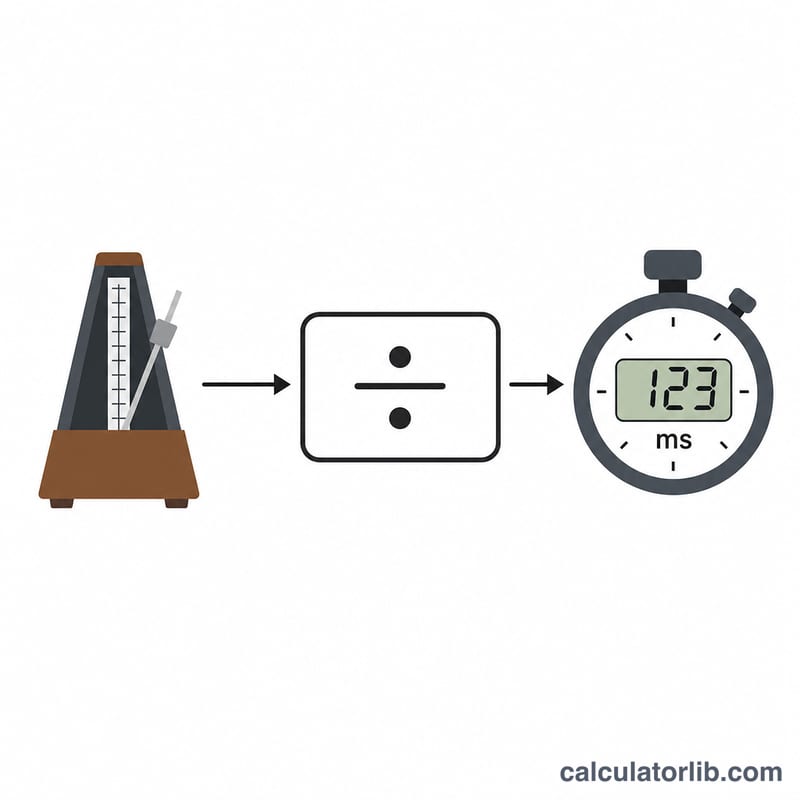
This tool converts your track's tempo into precise delay and reverb times in milliseconds. Tempo-synced delays make echoes fall exactly on the beat, glueing effects to the groove instead of muddying it. Whether you set delays manually on outboard gear or fine-tune reverb pre-delay in your DAW, this calculator gives you the exact figures for any note value.
How to use it
Enter your song's tempo in BPM, choose a note value (quarter, eighth, sixteenth, etc.), and read off the result. You get the straight delay time plus dotted and triplet variations, and the matching frequency in Hz — handy for tuning LFOs or filter movement to tempo.
The formula explained
One quarter note lasts 60000 / BPM milliseconds (60000 ms = one minute). Multiplying by a note value scales that to other durations: 1 = quarter note, 0.5 = eighth, 0.25 = sixteenth, 2 = half, 4 = whole. Dotted notes are 1.5× longer; triplets are 2/3 of the straight value. The frequency equals 1000 divided by the delay time in ms.
$$\text{Delay (ms)} = \frac{60000}{\text{Tempo (BPM)}} \times \text{Note Value}$$The dotted, triplet, and frequency variants are:
$$\text{Dotted (ms)} = \frac{60000}{\text{Tempo (BPM)}} \times \text{Note Value} \times 1.5$$$$\text{Triplet (ms)} = \frac{60000}{\text{Tempo (BPM)}} \times \text{Note Value} \times \frac{2}{3}$$$$\text{Frequency (Hz)} = \frac{1000}{\dfrac{60000}{\text{Tempo (BPM)}} \times \text{Note Value}}$$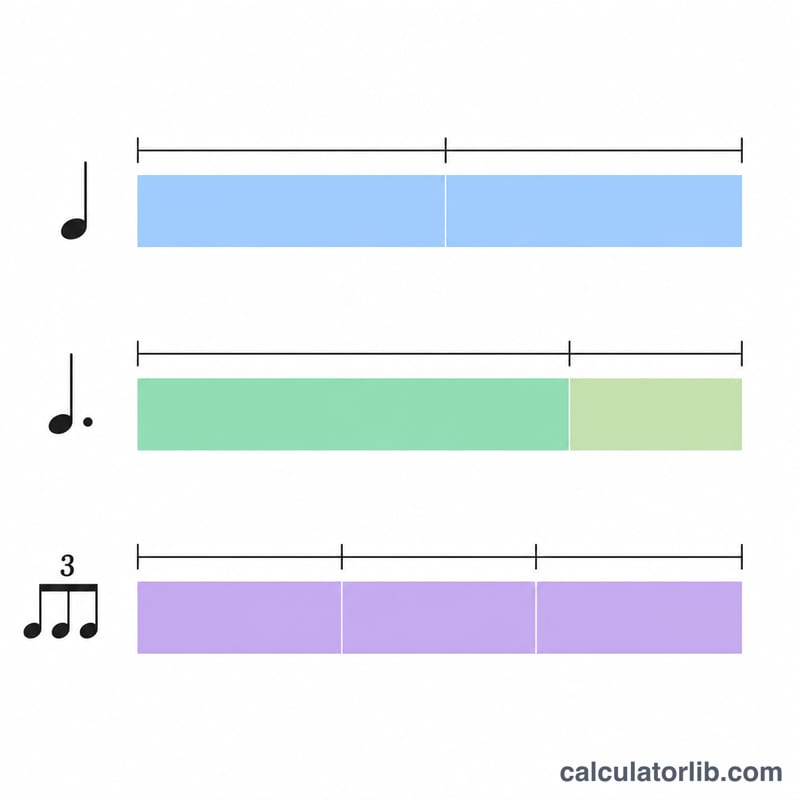
Worked example
At 120 BPM a quarter note is \(60000 / 120 = 500\) ms. An eighth note (note value 0.5) is \(500 \times 0.5 = 250\) ms. Its dotted version is \(250 \times 1.5 = 375\) ms and the triplet is \(250 \times 2/3 \approx 166.67\) ms. The 250 ms delay corresponds to \(1000 / 250 = 4\) Hz.
Delay Times by Note Value at Common Tempos
Delay time in milliseconds is \(\frac{60000}{\text{BPM}}\) for a quarter note (1/4). Other values multiply that by a fixed factor: 1/8 = ×0.5, 1/16 = ×0.25, dotted 1/8 = ×0.75, and triplet 1/8 = ×1/3. The matching repeat frequency in Hz is \(\frac{1000}{\text{ms}}\). All times below are in milliseconds and are rounded to two decimals.
| Tempo (BPM) | 1/4 (ms) | 1/8 (ms) | 1/16 (ms) | Dotted 1/8 (ms) | Triplet 1/8 (ms) |
|---|---|---|---|---|---|
| 60 | 1000 | 500 | 250 | 750 | 333.33 |
| 80 | 750 | 375 | 187.5 | 562.5 | 250 |
| 90 | 666.67 | 333.33 | 166.67 | 500 | 222.22 |
| 100 | 600 | 300 | 150 | 450 | 200 |
| 120 | 500 | 250 | 125 | 375 | 166.67 |
| 128 | 468.75 | 234.38 | 117.19 | 351.56 | 156.25 |
| 140 | 428.57 | 214.29 | 107.14 | 321.43 | 142.86 |
| 160 | 375 | 187.5 | 93.75 | 281.25 | 125 |
| 174 | 344.83 | 172.41 | 86.21 | 258.62 | 114.94 |
Example: at 120 BPM an eighth-note delay is \(\frac{60000}{120} \times 0.5 = \)250 ms, which repeats at \(\frac{1000}{250} = 4\) Hz.
Typical Delay and Reverb Time Ranges
The figures below are common mixing conventions and approximate starting points, not strict standards. The right value always depends on the song, the tempo, and the taste of the mixer.
| Effect | Approximate range | Typical use |
|---|---|---|
| Short pre-delay | 10–50 ms | Separates a dry source from its reverb so it stays clear |
| Slapback delay | 40–120 ms | A single quick echo that adds thickness without a clear rhythm |
| Rhythmic echoes | 250–500 ms (at mid tempos) | Tempo-synced repeats such as 1/8 or dotted 1/8 notes |
| Room reverb | about 0.3–1 s decay | Natural ambience, drums, and tight vocals |
| Hall reverb | about 1.5–3 s decay | Spacious sound for vocals, strings, and ballads |
Reverb decay is usually quoted as RT60, the time for the sound to fall by 60 dB. Many engineers choose a decay that fits the tempo, so that the tail fades before the next beat. Faster songs usually suit shorter decays. Delay times that sync to the tempo tend to blend into the groove, while unsynced values can sound looser or more obvious.
Treat these ranges as a starting point, then adjust by ear.
FAQ
What value should I use for reverb pre-delay? A common choice is a sixteenth or eighth note so the reverb tail starts on the grid.
Why does dotted sound "swung"? Dotted delays are 1.5× the straight time, creating a longer, bouncier echo that pairs well with the off-beat.
Is this accurate for any BPM? Yes — the formula is exact for any constant tempo. For ramping or live tempos, use the average BPM.