What is a Digit Sum?
The digit sum of a number is simply the total you get by adding all of its individual decimal digits together. For example, the digit sum of 12345 is \(1 + 2 + 3 + 4 + 5 = 15\). This Digit Sum Calculator computes that total instantly, and also reports how many digits the number has and its digital root.
How to use it
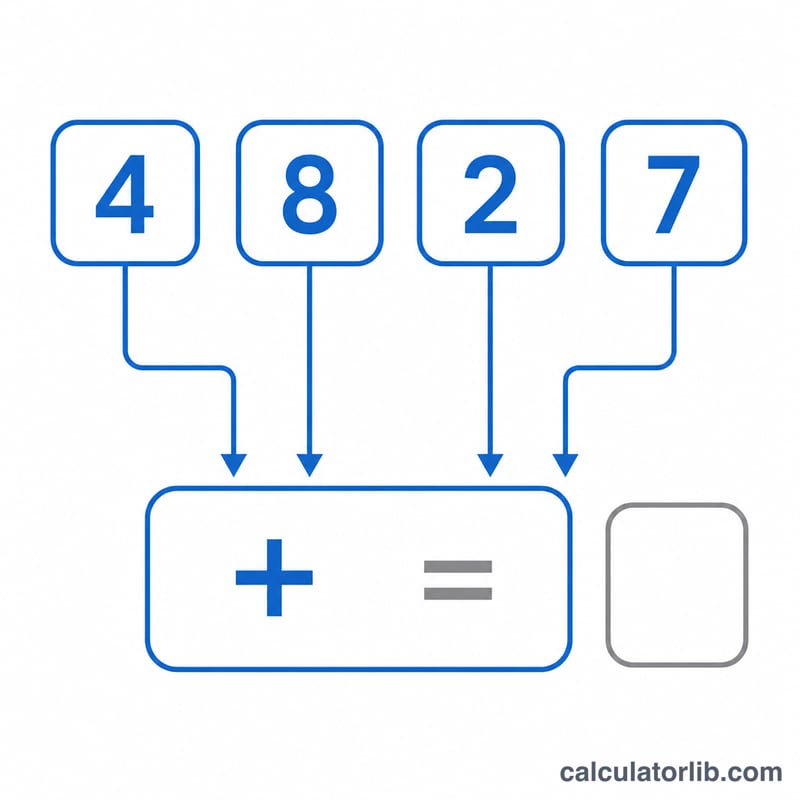
Type any whole number into the input box and submit. The calculator strips any non-digit characters, adds up the remaining digits, and displays three results: the digit sum, the digit count, and the digital root.
The formula explained
The digit sum is the sum of each digit \(d_i\).
$$\text{Digit Sum} = \sum_{i=1}^{k} d_i \quad\text{where } d_i \text{ are the digits of } \text{Number}$$The digital root is found by repeatedly applying the digit sum until only one digit is left. There is also a closed form: for any positive integer \(n\), the digital root equals \(1 + ((n - 1) \bmod 9)\).
$$\text{Digital Root} = 1 + \left(\left(\sum_{i=1}^{k} d_i\right) - 1 \bmod 9\right)$$The digital root is closely related to the value of a number modulo 9, which is why it powers the classic "casting out nines" check.
Worked example
Take 987654. The digit sum is
$$9 + 8 + 7 + 6 + 5 + 4 = 39$$It has 6 digits. To get the digital root, sum 39's digits: \(3 + 9 = 12\), then \(1 + 2 = 3\). So the digital root of 987654 is 3.
Interpreting the Digit Sum and Digital Root
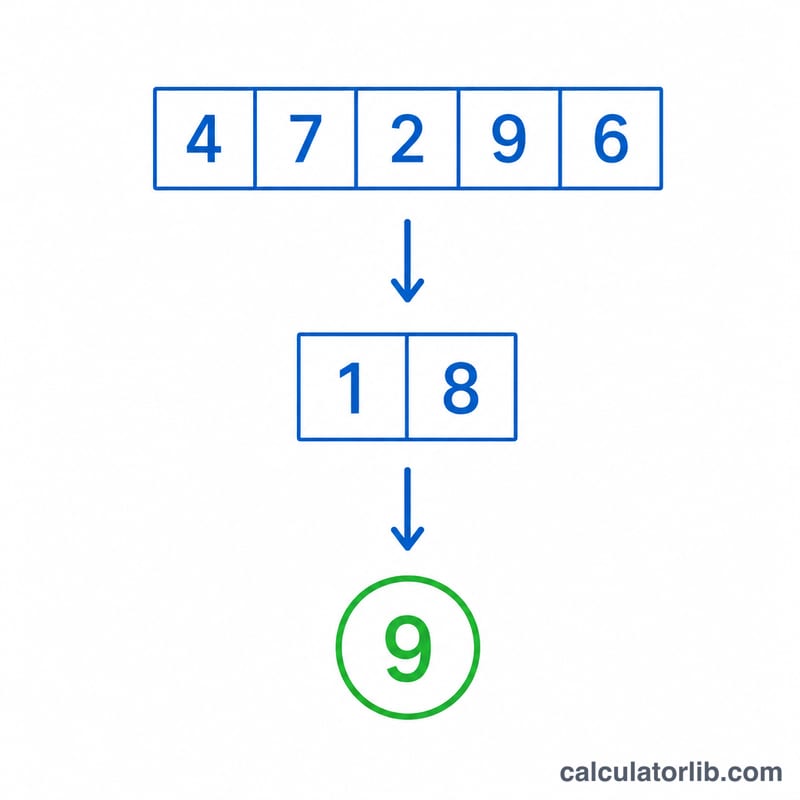
The digit sum adds the digits of a number. The digital root repeats that step until one digit remains. For example, \(9875 \to 9+8+7+5 = 29 \to 2+9 = 11 \to 1+1 = 2\), so the digital root of 9875 is 2.
Link to remainders mod 9
Both the digit sum and the digital root are congruent to the original number modulo 9:
$$n \equiv S(n) \equiv \text{dr}(n) \pmod 9$$
This holds because \(10 \equiv 1 \pmod 9\), so every power of ten leaves remainder 1 when divided by 9. Each digit therefore contributes only itself to the remainder.
Divisibility rules
- Divisible by 9: a number is divisible by 9 exactly when its digit sum is divisible by 9.
- Divisible by 3: a number is divisible by 3 exactly when its digit sum is divisible by 3.
- Digital root of 9: this means the number is a nonzero multiple of 9. Only 0 has a digital root of 0.
- Other divisors: the digital root cannot show divisibility by numbers such as 7, 11 or 13. For 7, the numbers 7 and 16 have digital roots 7 and 7, but 16 is not a multiple of 7, so no digital-root rule exists.
Casting out nines
Casting out nines checks a sum, difference or product by comparing digital roots. If the digital roots do not match the expected result, the calculation is definitely wrong. A match does not prove it is right. The check misses errors that preserve the remainder mod 9, such as swapped digits (81 written as 18, both with digital root 9), a misplaced zero, or an error that is itself a multiple of 9.
What it cannot tell you
The digit sum does not identify the number. Many numbers share a digit sum, for example 123, 132, 321 and 600 all have digit sum 6. Treat it as a quick check or a property, not a fingerprint.
Digit Sum Examples for Different Numbers
The table shows the digit sum, the number of digits, the digital root and the divisibility by 3 and 9 that follows from the digit sum.
| Number | Digit Sum | Digit Count | Digital Root | Divisibility note |
|---|---|---|---|---|
| 0 | 0 | 1 | 0 | Divisible by 3 and 9 (0 is a multiple of every integer) |
| 9 | 9 | 1 | 9 | Divisible by 3 and 9 |
| 18 | 9 | 2 | 9 | Divisible by 3 and 9 (18 = 9 × 2) |
| 99 | 18 | 2 | 9 | Divisible by 3 and 9 (99 = 9 × 11); 18 → 1+8 = 9 |
| 123 | 6 | 3 | 6 | Divisible by 3 but not 9 (123 = 3 × 41) |
| 1000 | 1 | 4 | 1 | Not divisible by 3 or 9 (remainder 1 mod 9) |
| 12345 | 15 | 5 | 6 | Divisible by 3 but not 9; 15 → 1+5 = 6 |
| 999999 | 54 | 6 | 9 | Divisible by 3 and 9; 54 → 5+4 = 9 |
| 1234567890 | 45 | 10 | 9 | Divisible by 3 and 9; 45 → 4+5 = 9 |
Worked check for 12345: \(1+2+3+4+5 = 15\), then \(1+5 = 6\). The digit sum 15 is divisible by 3 but not by 9, so 12345 is divisible by 3 and leaves remainder 6 when divided by 9.
FAQ
Does the digit sum work for very large numbers? Yes — just enter all the digits and they will be added.
What is a digital root used for? It is used in checksum and error-detection tricks like casting out nines, and in recreational mathematics.
What is the digital root of 0? The digital root of 0 is 0.