What Is a Doubling Calculator?
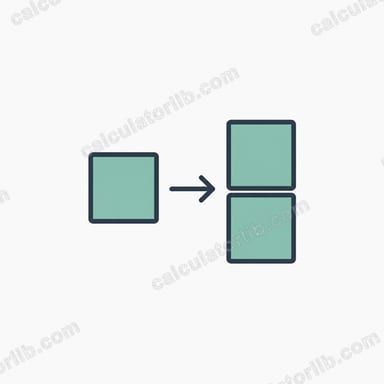
A doubling calculator takes any number you enter and multiplies it by two. Doubling is one of the most common everyday operations — splitting and combining quantities, scaling a recipe, estimating growth, or simply checking a quick calculation. This tool works with whole numbers, decimals, and negative values, and handles large numbers with automatic thousand separators as you type.
How to Use It
Type the number you want to double into the input box and the calculator instantly returns the result. There are no other settings — doubling always means multiplying by exactly 2. The result panel shows the doubled value as the headline figure and a breakdown table confirming the original number, the multiplier, and the answer.
The Formula Explained
Doubling uses the simplest multiplication: $$\text{result} = n \times 2$$. Multiplying by 2 is mathematically identical to adding the number to itself (\(n + n\)). For example, doubling 7 can be seen as \(7 \times 2\) or \(7 + 7\), both giving 14. The same rule applies to fractions and decimals: \(2.5 \times 2 = 5\).

Worked Example
Suppose you want to double 1,250. Multiply: $$1{,}250 \times 2 = 2{,}500.$$ The calculator displays 2,500 as the doubled value. For a decimal such as 3.75, the result is \(3.75 \times 2 = 7.5\).
Doubling Reference Table (Common Numbers)
Doubling means multiplying a number by 2, which is the same as adding the number to itself: \(2 \times n = n + n\). The table lists the doubles of common whole numbers.
| Number (n) | Doubled (n × 2) | n + n |
|---|---|---|
| 1 | 2 | 1 + 1 |
| 2 | 4 | 2 + 2 |
| 3 | 6 | 3 + 3 |
| 4 | 8 | 4 + 4 |
| 5 | 10 | 5 + 5 |
| 6 | 12 | 6 + 6 |
| 7 | 14 | 7 + 7 |
| 8 | 16 | 8 + 8 |
| 9 | 18 | 9 + 9 |
| 10 | 20 | 10 + 10 |
| 11 | 22 | 11 + 11 |
| 12 | 24 | 12 + 12 |
| 15 | 30 | 15 + 15 |
| 20 | 40 | 20 + 20 |
| 25 | 50 | 25 + 25 |
| 50 | 100 | 50 + 50 |
| 75 | 150 | 75 + 75 |
| 100 | 200 | 100 + 100 |
| 250 | 500 | 250 + 250 |
| 500 | 1,000 | 500 + 500 |
| 1,000 | 2,000 | 1,000 + 1,000 |
Example: for 75, \(2 \times 75 = 150\), which the calculator gives as 150.
Doubling Across Different Number Types
The rule \(2 \times n\) works for every real number: whole numbers, negatives, decimals, fractions and very large values.
| Input | Doubled | Type of number |
|---|---|---|
| 0 | 0 | Zero |
| 7 | 14 | Positive integer |
| −8 | −16 | Negative integer |
| 0.5 | 1 | Decimal |
| 12.34 | 24.68 | Decimal |
| 1/4 | 1/2 | Fraction |
| 1,000,000 | 2,000,000 | Large number |
| 1.5 billion | 3 billion | Very large number |
Notes: doubling preserves the sign, so a positive number stays positive and a negative number stays negative (its distance from zero doubles). Zero stays zero because \(2 \times 0 = 0\). For decimals, double each place carefully: \(2 \times 12.34 = 24.68\), shown by the calculator as 24.68. For a fraction, doubling the numerator (or halving the denominator) gives the same value: \(2 \times \frac{1}{4} = \frac{2}{4} = \frac{1}{2}\).
FAQ
Can I double a negative number? Yes. Doubling −8 gives −16, since \(-8 \times 2 = -16\).
What about decimals? Decimals work the same way. Doubling 0.5 returns 1, and doubling 12.34 returns 24.68.
Is doubling the same as squaring? No. Doubling multiplies by 2 (e.g. 5 → 10), while squaring multiplies a number by itself (e.g. 5 → 25). They only match at 0 and 2.