What Is the Dry Matter Basis Calculator?
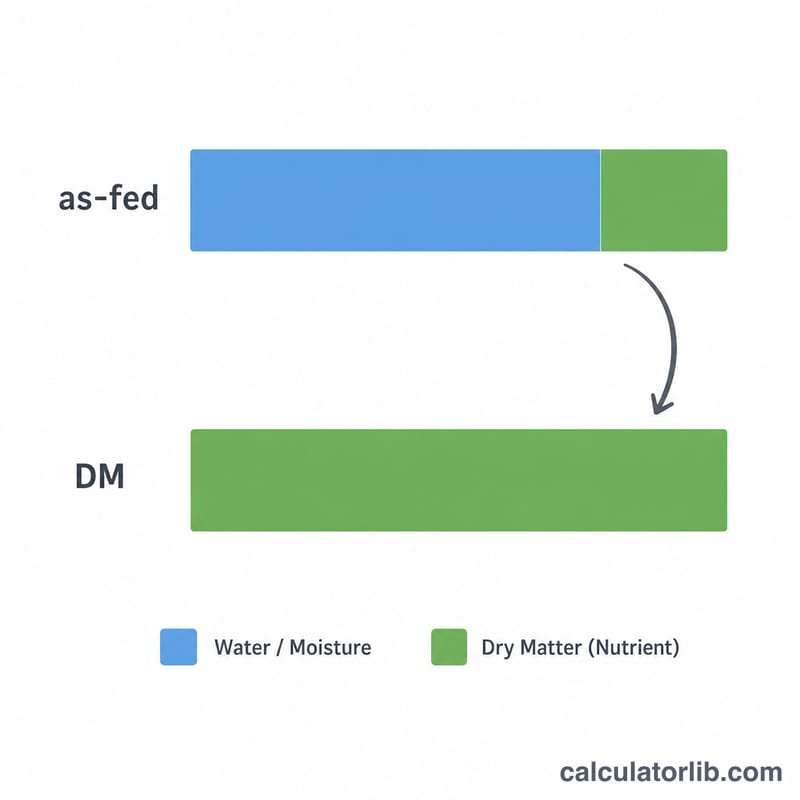
This tool converts a feed nutrient value reported on an as-fed basis (which includes water) into its equivalent on a dry matter (DM) basis (water removed). Because moisture dilutes the apparent concentration of nutrients, comparing two feeds on an as-fed basis can be misleading. Expressing nutrients on a dry matter basis lets you fairly compare feeds with very different moisture contents — for example, fresh pasture, silage, hay, or dry concentrate.
How to Use It
Enter the nutrient percentage as it appears on the as-fed (wet) feed analysis, then enter the feed's moisture percentage. The calculator returns the same nutrient expressed on a 100% dry matter basis, along with the feed's dry matter content.
The Formula Explained
The dry matter content of a feed equals \(100 - \text{moisture\%}\). To rescale a nutrient onto a fully dried basis you divide the as-fed nutrient by the dry matter fraction and multiply by 100:
$$\text{DM\%} = \dfrac{\text{Nutrient}_{\text{as-fed}}}{100 - \text{Moisture\%}} \times 100$$
The lower the moisture, the closer the dry matter value is to the as-fed value; very wet feeds show a large jump.
Worked Example
A silage tests at 9% crude protein as-fed with 65% moisture. Dry matter content = \(100 - 65 = 35\%\). Crude protein on a DM basis:
$$\frac{9}{35} \times 100 = 25.71\%$$
So although the silage looks low in protein when wet, it is actually a respectable 25.7% protein once the water is excluded.
Typical Moisture and Dry Matter Content of Common Feeds
Dry matter (DM) % is simply \(100 - \text{moisture }\%\). The ranges below are typical approximations only; actual values vary with plant maturity, weather, harvest and storage, and product formulation. Always use a laboratory analysis or the product label when you have one.
| Feed type | Typical moisture (%) | Typical dry matter (%) |
|---|---|---|
| Fresh pasture / grass | 70–85 | 15–30 |
| Grass silage | 60–75 | 25–40 |
| Corn silage | 60–70 | 30–40 |
| Haylage | 40–60 | 40–60 |
| Hay | 10–20 | 80–90 |
| Dry pet kibble | 6–12 | 88–94 |
| Canned / wet pet food | 74–82 | 18–26 |
| Grain / concentrate | 10–14 | 86–90 |
Because moisture differs so much between these feeds, comparing their nutrient values on an as-fed basis can be misleading. Converting to dry matter puts them on equal footing.
As-Fed vs. Dry Matter Comparison Across Feeds
Using \(\text{Nutrient}_{DM} = \frac{\text{Nutrient as-fed}}{100 - \text{moisture}} \times 100\), the protein values below are converted from as-fed to dry matter basis (rounded to two decimals).
| Feed | Moisture (%) | DM (%) | Protein as-fed (%) | Protein, DM basis (%) |
|---|---|---|---|---|
| Dry kibble | 10 | 90 | 26 | \(\frac{26}{90} \times 100 =\) 28.89 |
| Canned food | 78 | 22 | 8 | \(\frac{8}{22} \times 100 =\) 36.36 |
| Silage | 65 | 35 | 9 | \(\frac{9}{35} \times 100 = 25.71\) |
| Hay | 15 | 85 | 12 | \(\frac{12}{85} \times 100 = 14.12\) |
Takeaway: the canned food looks low in protein as-fed (8%) next to kibble (26%), but on a dry matter basis it is actually higher (36.36% vs. 28.89%). Likewise, silage at 9% as-fed is about 25.71% protein in its dry matter. Dry matter basis compares the nutrient itself, not the water it is diluted in.
Key Terms: As-Fed, Dry Matter, Moisture
- As-fed basis: Nutrient concentration measured in the feed exactly as it is offered, including its water.
- Dry matter basis: Nutrient concentration expressed as if all water were removed, so feeds with different moisture can be compared fairly.
- Moisture %: The percentage of the feed's weight that is water.
- Dry matter %: The percentage of the feed that is not water; equals 100 minus moisture %.
- Guaranteed analysis: The label statement of minimum or maximum nutrient levels (for example minimum crude protein, maximum moisture). In many regions, such as the US pet food and feed labeling system, these values are given on an as-fed basis.
- Crude protein: An estimate of protein based on measured nitrogen content.
- Crude fat: The portion of the feed extracted by solvent, mostly fats and oils.
- Crude fiber: The fibrous, poorly digestible plant portion remaining after specific chemical treatment.
- Ash: The inorganic mineral residue left after burning the feed.
Protein, fat, fiber, ash and other nutrients are all commonly converted from as-fed to dry matter basis using the same formula.
FAQ
Why use a dry matter basis at all? It standardizes nutrient values so feeds with different water contents can be compared and rationed accurately.
What moisture should I enter? Use the moisture from your lab analysis or feed tag (\(\text{dry matter \%} = 100 - \text{moisture \%}\)).
Can moisture be 100%? No — that would mean the feed is entirely water with zero dry matter, making the conversion undefined. Enter a value below 100.