What this calculator does
The Engineered Stone Waste Weight Calculator converts a measured volume of engineered (artificial) stone off-cuts, slurry solids, and demolition rubble into a weight figure. Many waste haulers, transfer stations, and landfills bill disposal by mass, but on site you usually only know the volume of the skip, bin, or stockpile. Converting volume to weight lets you estimate tipping fees, choose the right skip size, and stay within vehicle load limits before you book a collection.
The formula explained
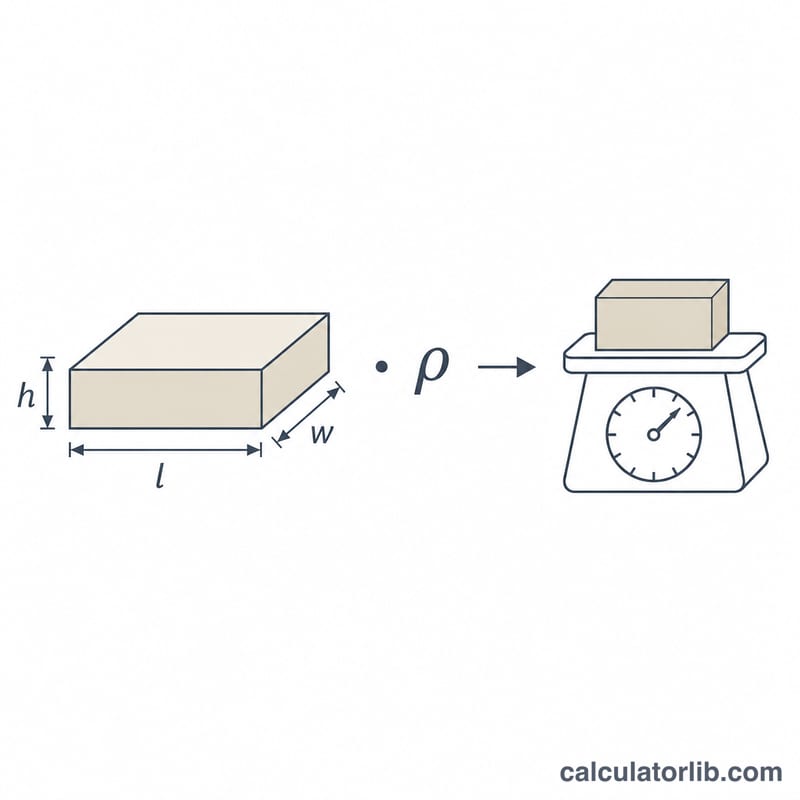
Weight is the product of volume and density. If \(V\) is the waste volume in cubic meters and \(\rho\) is the material density in kilograms per cubic meter, then the weight in metric tons is:
$$\text{W}_{\text{tons}} = \frac{V \times \rho}{1000}$$Here \(V\) = volume in m³, \(\rho\) = density in kg/m³, and the factor \(1000\) converts kilograms to metric tons. Engineered stone is a dense quartz-and-resin composite, so its density typically falls between \(2300\) and \(2500\ \text{kg/m}^3\); \(2400\) is a reasonable default.
How to use it
Enter the volume of stone waste in cubic meters and the material density in kg/m³. If you do not know the exact density, keep the default of \(2400\ \text{kg/m}^3\). The calculator returns the estimated weight in both tons and kilograms.
Worked example
Suppose you have \(2\ \text{m}^3\) of engineered stone waste at a density of \(2400\ \text{kg/m}^3\):
$$\text{W}_{\text{tons}} = \frac{2 \times 2400}{1000} = 4.8\ \text{tons}$$That is \(4800\ \text{kg}\), useful for confirming your skip and truck can carry the load.
Density Reference for Engineered Stone Waste
The weight your load produces depends heavily on the form of the waste, not just the material. Solid off-cuts are close to the parent slab density, while broken rubble, mixed demolition debris and drained slurry all contain air voids or water and therefore have a lower bulk density. Pick a value below that matches how the waste actually sits in the skip, rather than always defaulting to 2400 kg/m³.
Weight is then:
$$\text{Weight (tons)} = \frac{\text{Volume (m}^3\text{)} \times \text{Density (kg/m}^3\text{)}}{1000}$$
| Waste form | Typical density ρ (kg/m³) | Notes |
|---|---|---|
| Solid engineered stone (quartz) slab off-cuts | ~2300–2500 | Close to the intact slab; use for stacked, near-solid pieces. |
| Crushed / broken rubble (loose) | ~1400–1800 | Bulk density; air gaps between fragments lower the effective value. |
| Compacted mixed demolition waste | ~1500–1900 | Stone mixed with mortar, tile, backing board; compaction raises it. |
| Settled slurry solids (cutting sludge) | ~1600–2000 | After drainage; retained water shifts the figure within this band. |
These figures are indicative physical ranges for planning, not certified test values. Engineered (quartz) stone solids reliably fall near 2300–2500 kg/m³; the loose and mixed rows are approximate because voids and moisture vary from load to load. When in doubt, weigh a known volume to get a measured bulk density (see the last section).
Weight Across Common Skip and Load Scenarios
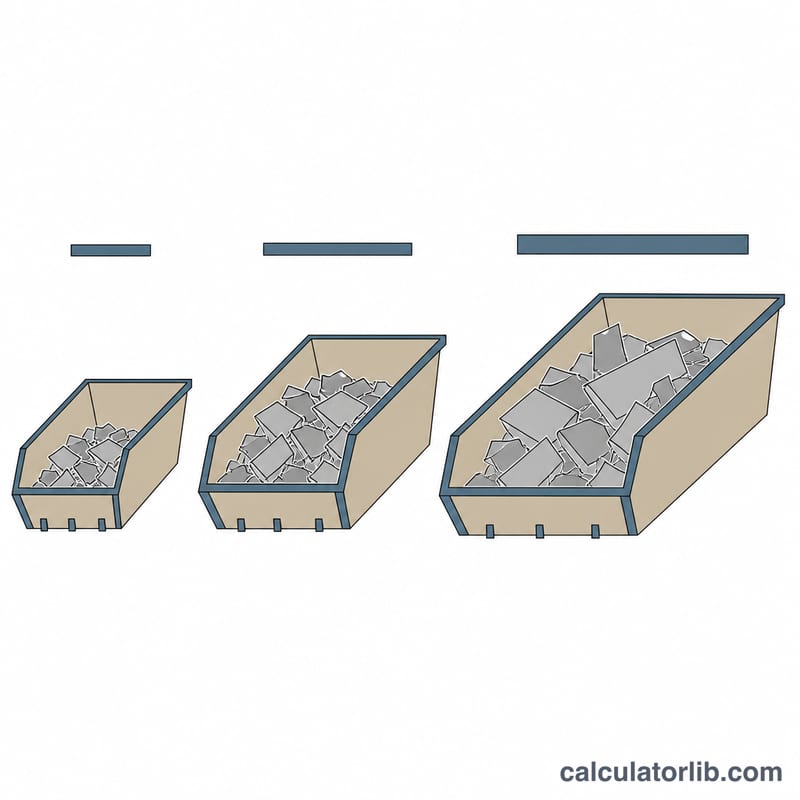
The table below applies the formula to a few realistic volumes at two representative densities: 2400 kg/m³ for solid, near-slab off-cuts, and 1600 kg/m³ for loose crushed waste with air gaps. Use it to line up your volume against a skip's or truck's rated weight limit.
Worked example — 4 m³ of solid off-cuts at 2400 kg/m³:
$$\text{Weight} = \frac{4 \times 2400}{1000} = 9.6\ \text{tons}$$
| Volume (m³) | Solid @ 2400 kg/m³ (tons) | Crushed @ 1600 kg/m³ (tons) |
|---|---|---|
| 1 | 2.4 | 1.6 |
| 2 | 4.8 | 3.2 |
| 4 | 9.6 | 6.4 |
| 6 | 14.4 | 9.6 |
Note how the same 6 m³ swings from about 9.6 to 14.4 tons purely on density: a mini/midi skip may hold the volume but exceed its weight rating long before it looks full. Values are in metric tons (1 ton = 1000 kg).
Practical Next Steps for Disposal
- Use a measured bulk density for mixed loads. Weigh a container of known volume (e.g. a full 20 L bucket), then divide mass by volume to get ρ in kg/m³, and use that instead of a generic 2400 when the waste is crushed, mixed or slurry.
- Add a safety margin. The calculator gives a point estimate; add roughly 10–15% before committing, since compaction, retained moisture and denser-than-assumed fragments all push actual weight above the nominal figure.
- Check the skip and vehicle weight rating first. Compare your computed tons against the skip's rated capacity and the truck's legal payload. A container can reach its mass limit while still looking half-empty, so verify weight, not just how full it appears.
- Confirm the tipping-fee basis with the hauler. Ask whether charges are by mass (per ton at a weighbridge) or by volume/skip size — dense stone waste is usually cheaper to estimate by weight, and knowing the basis avoids surprises on the invoice.
- Handle dust and slurry per local rules. Engineered (quartz) stone waste can contain respirable crystalline silica, and disposal, dust-control and dumpsite acceptance requirements differ by country and region — confirm the specific regulations that apply where you operate before transporting or tipping.
This section is general operational guidance for estimating and planning disposal, not professional engineering, legal or financial advice. Verify capacities, fees and regulatory requirements with your hauler, weighbridge and local authority for your specific site.
FAQ
Is the result exact? No. It is an estimate based on the density you enter. Loose rubble with air gaps weighs less per m³ than a solid slab, so use bulk density for mixed waste.
Which density should I use? For solid engineered stone use \(2300\)–\(2500\ \text{kg/m}^3\). For crushed or mixed waste, use a measured bulk density if available.
Metric or short tons? This tool reports metric tons (\(1000\ \text{kg}\)).