
What This Calculator Does
This tool computes the circular orbital velocity and the escape velocity for an object at a given distance from a central body, such as a planet, moon, or star. Both quantities depend only on the central body's mass M and the orbital radius r, using the universal gravitational constant \(G = 6.674 \times 10^{-11}\ \text{N}\cdot\text{m}^2/\text{kg}^2\).
How to Use It
Enter the mass of the central body in kilograms (for example, Earth is \(5.972 \times 10^{24}\ \text{kg}\)) and the orbital radius in meters measured from the body's center (Earth's surface radius is about \(6.371 \times 10^{6}\ \text{m}\)). You can type values in scientific notation using the "e" format, e.g. 5.972e24. The calculator returns orbital velocity in m/s and km/s, plus the escape velocity.
The Formula Explained
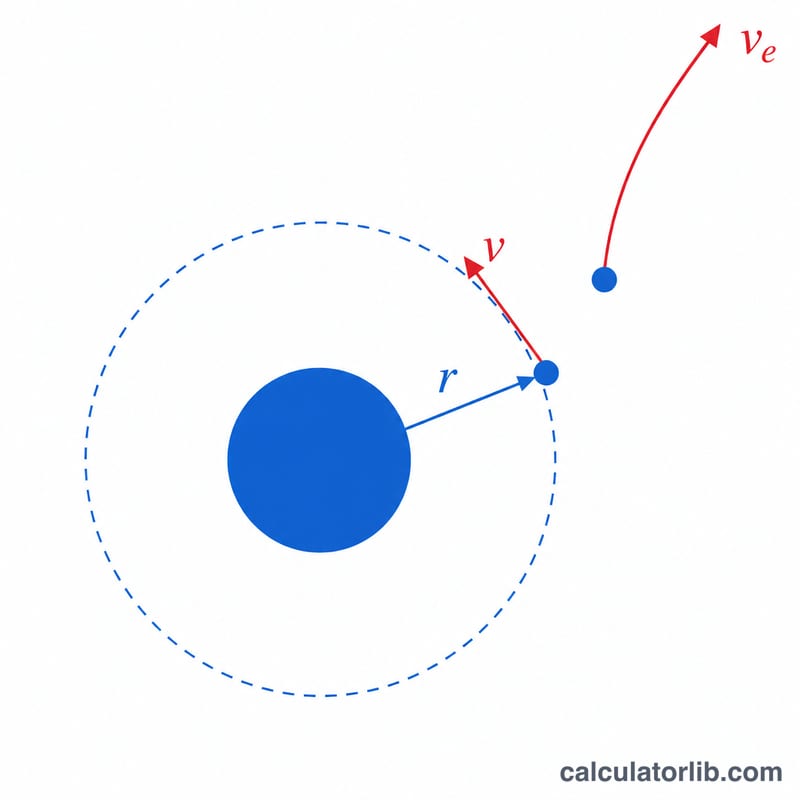
Orbital velocity comes from balancing gravitational force with the centripetal force required for circular motion: $$v = \sqrt{\frac{GM}{r}}$$ Escape velocity is the speed at which kinetic energy equals the gravitational potential energy, giving $$v_{esc} = \sqrt{\frac{2GM}{r}}$$ — exactly \(\sqrt{2}\) times the orbital velocity.
Worked Example
For a satellite skimming Earth's surface (\(M = 5.972 \times 10^{24}\ \text{kg}\), \(r = 6.371 \times 10^{6}\ \text{m}\)): $$v = \sqrt{\frac{6.674\text{e-}11 \times 5.972\text{e}24}{6.371\text{e}6}} \approx 7{,}909\ \text{m/s}$$ (about 7.91 km/s). Escape velocity is \(\sqrt{2} \times 7{,}909 \approx 11{,}185\ \text{m/s}\), close to the well-known 11.2 km/s.
FAQ
Why is escape velocity larger than orbital velocity? Escaping completely requires \(\sqrt{2} \approx 1.414\) times the speed of a stable circular orbit at the same radius.
Does the orbiting object's mass matter? No — both velocities are independent of the orbiting object's mass; only the central body's mass and radius matter.
What radius should I use? Use the distance from the center of the central body, not its surface altitude. Add the body's radius to your altitude.