What is the Foot-candles to Lux Calculator?
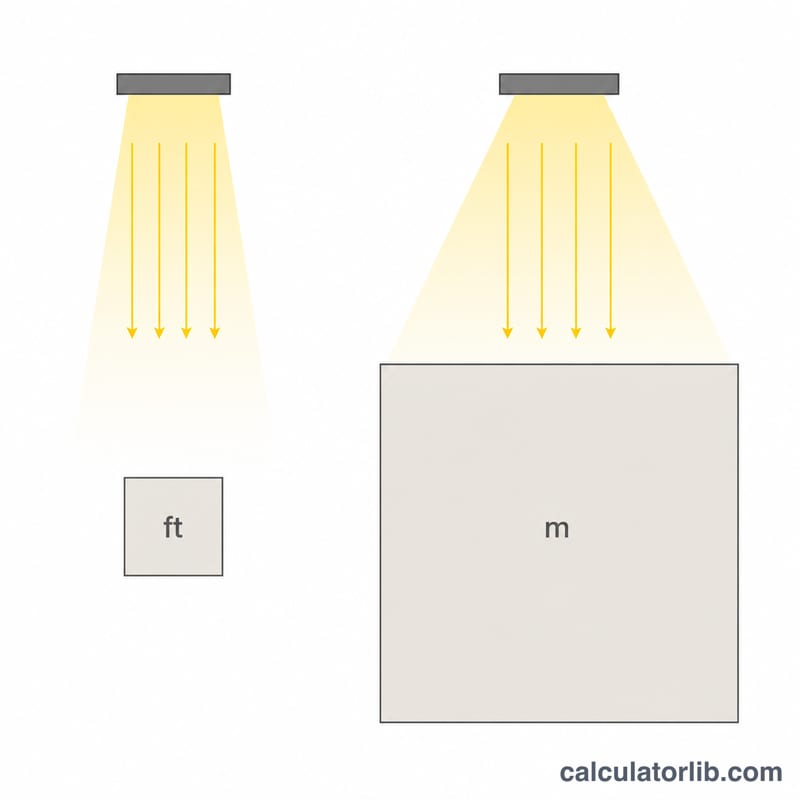
This calculator converts illuminance measured in foot-candles (fc) into lux (lx), the SI unit of illuminance. One foot-candle is defined as one lumen per square foot, while one lux is one lumen per square meter. Because one square meter equals about 10.76391 square feet, the two units are related by that same constant.
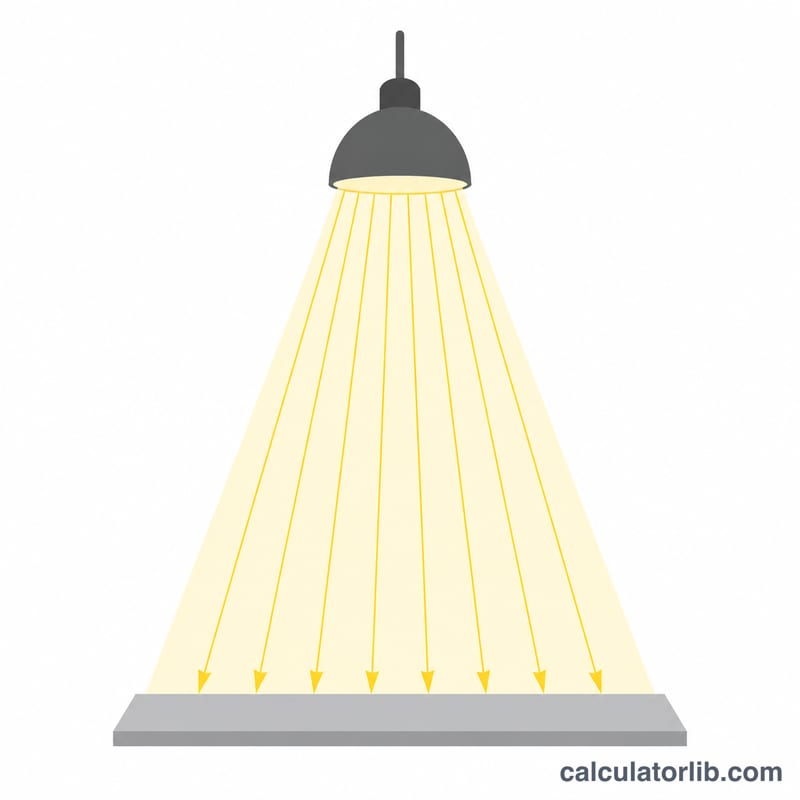
The formula explained
The conversion is a simple linear scaling. If \(E_v(\text{fc})\) is the illuminance in foot-candles, the illuminance in lux is:
$$E_{v}(\text{lux}) = E_{v}(\text{fc}) \times 10.76391$$Here \(10.76391\) is the number of square feet in one square meter, so the same luminous flux spread over a square meter gives a smaller number of lux than lumens per square foot would suggest.
How to use it
Enter the illuminance value in foot-candles into the input field and submit. The calculator multiplies your value by the conversion factor and returns the equivalent illuminance in lux. This is useful when comparing lighting specifications between imperial (US) and metric datasheets.
Worked example
Suppose a workspace is lit to \(50\) foot-candles and you need the value in lux:
$$E_{v}(\text{lux}) = 50 \times 10.76391 = 538.1955\ \text{lux}$$So 50 fc is approximately 538 lux, a typical target for detailed office work.
Typical Recommended Illuminance Levels
Lighting standards specify a maintained illuminance (the average level kept on the task area over time) for different tasks and spaces. The values below follow the European standard EN 12464-1 “Light and lighting — Lighting of work places, Part 1: Indoor work places”; comparable guidance for North America is published by the IES (Illuminating Engineering Society). These are engineering targets for the task area, not personal advice, and actual requirements depend on the specific task, standard edition and local regulations.
The foot-candle figures are the lux targets converted with the exact factor \(1\ \text{fc} = 10.76391\ \text{lx}\) and rounded. For example, the 750 lx target for technical drawing corresponds to \(750 \div 10.76391 \approx 69.7\ \text{fc}\); conversely, entering 70 fc in this calculator returns \(70 \times 10.76391 \approx\) 753.47 lx.
| Task / space | Maintained illuminance (lux) | Approx. foot-candles (fc) |
|---|---|---|
| Circulation areas and corridors | ~100 lx | ~9.3 fc |
| Warehouse / bulk storage areas | ~150 lx | ~14 fc |
| General office work, reading, writing | ~300–500 lx | ~28–46 fc |
| Technical / detailed drawing work | ~750 lx | ~70 fc |
| Fine or precision work (e.g. detailed inspection) | ~1000+ lx | ~93+ fc |
Note: these are standard reference targets from EN 12464-1 (with IES cited for North American practice), not a personal recommendation. Always confirm the required value against the current edition of the applicable standard for your task and region.
FAQ
Why 10.76391? It is the number of square feet in one square meter (\(1\,\text{m}^2 \approx 10.76391\,\text{ft}^2\)), which links the two area-based illuminance units.
Is the conversion exact? The factor is precise to the digits shown; results are rounded for display but computed at full precision.
How do I convert lux back to foot-candles? Divide the lux value by \(10.76391\), e.g. \(1000 \div 10.76391 \approx 92.9\) fc.