What is the Generation Calculator?
This tool tells you which generation a person belongs to based on their birth year. Generations are demographic cohorts — groups of people born within a similar span of years who share formative cultural, economic, and technological experiences. The cohort boundaries used here follow the widely cited ranges popularized by the Pew Research Center, which are the most commonly referenced definitions in journalism and social science.

How to use it
Enter a birth year and the calculator returns the generation name, its full cohort range, and an approximate current age (calculated against the reference year 2025). It works for any year from the late 19th century to today.
The generation ranges
The calculator uses these inclusive birth-year boundaries: Lost Generation 1883–1900, Greatest Generation 1901–1927, Silent Generation 1928–1945, Baby Boomers 1946–1964, Generation X 1965–1980, Millennials (Gen Y) 1981–1996, Generation Z 1997–2012, and Generation Alpha 2013 onward.
$$\text{Generation} = \begin{cases} \text{Lost Generation} & \text{Birth Year} \le 1900 \\ \text{Greatest Generation} & 1901\text{–}1927 \\ \text{Silent Generation} & 1928\text{–}1945 \\ \text{Baby Boomers} & 1946\text{–}1964 \\ \text{Generation X} & 1965\text{–}1980 \\ \text{Millennials} & 1981\text{–}1996 \\ \text{Generation Z} & 1997\text{–}2012 \\ \text{Generation Alpha} & \text{Birth Year} \ge 2013 \end{cases}$$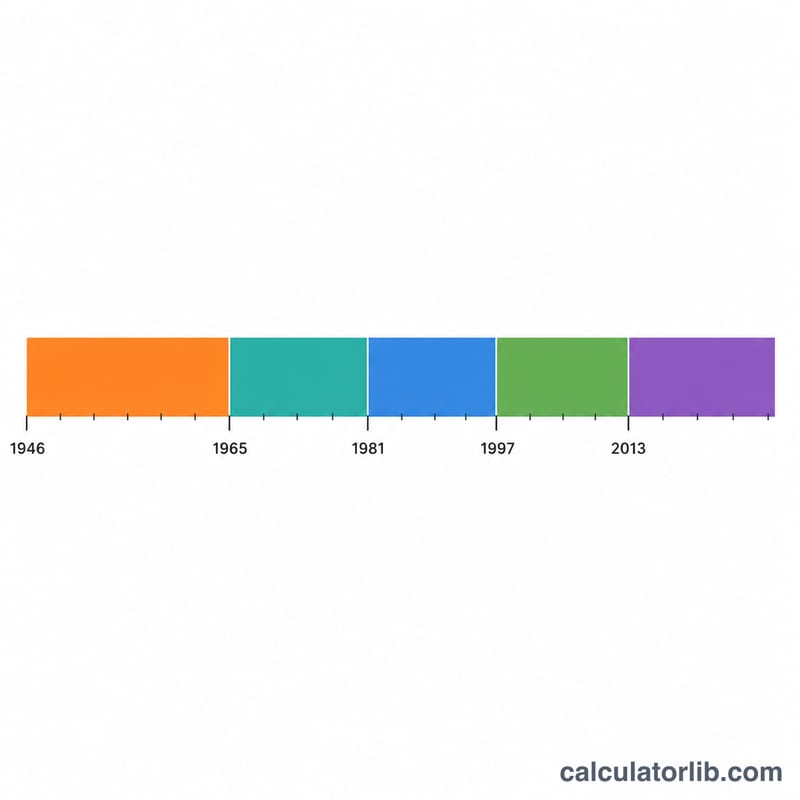
Worked example
Suppose the birth year is 1990. Because \(1981 \le 1990 \le 1996\), the person is a Millennial (Gen Y). Their approximate age as of 2025 is $$2025 - 1990 = 35 \text{ years}.$$
Generation Boundaries by Source
There is no official, universal definition of a generation. Different research organisations draw the lines in different places, and this calculator uses the cohort ranges published by the Pew Research Center (United States), which are the most widely cited in English-language journalism and survey work. The table below compares Pew's ranges with three other commonly referenced sets: the generational theory of William Strauss and Neil Howe (United States), the U.S. Census Bureau, and McCrindle Research (Australia). Note that names differ as well as dates — McCrindle uses "Builders" and "Generation Y", and Strauss & Howe use "13th Generation" for Gen X and "Homeland Generation" for the cohort after Millennials.
| Generation | Pew Research Center (this tool) | Strauss & Howe | U.S. Census Bureau | McCrindle (Australia) |
|---|---|---|---|---|
| Silent Generation | 1928–1945 | 1925–1942 | Not officially defined | 1925–1945 ("Builders") |
| Baby Boomers | 1946–1964 | 1943–1960 | 1946–1964 (official) | 1946–1964 |
| Generation X | 1965–1980 | 1961–1981 ("13th Generation") | Not officially defined | 1965–1979 |
| Millennials | 1981–1996 | 1982–2004 | Not officially defined | 1980–1994 ("Generation Y") |
| Generation Z | 1997–2012 | 2005– ("Homeland Generation") | Not officially defined | 1995–2009 |
| Generation Alpha | 2013 onward (not a formal Pew definition) | Not defined | Not officially defined | 2010–2024 |
Which boundaries are settled and which are not
- Undisputed: Baby Boomers, 1946–1964. This is the only range with a documented demographic basis rather than an analytical convention. U.S. births jumped sharply in 1946 as service members returned after the Second World War, stayed elevated for nearly two decades, and the annual birth total fell away after the 1957 peak until the pattern clearly broke at the end of 1964. It is also the only range with any official standing: the U.S. Census Bureau uses 1946–1964 in its own publications and defines no other generation.
- Contested: the Gen X / Millennial cutoff. Sources place it at 1980, 1981 or 1982 (Pew 1981, McCrindle 1980, Strauss & Howe 1982) — a spread of roughly two years with no agreed evidence favouring any one of them.
- Contested: the Millennial / Gen Z cutoff. Here the spread is wider: Pew uses 1997, McCrindle 1995, and Strauss & Howe's scheme does not line up at all. Depending on the source, a person born in 1995 or 1996 is either a Millennial or a member of Gen Z.
- Contested: the Gen Z / Gen Alpha cutoff, placed at 2010 by McCrindle and commonly at 2013 elsewhere, including by this tool.
Cusp labels (informal)
Because the disputed cutoffs leave people genuinely split between two cohorts, two informal "cusp" labels are in common use. Neither has a standard definition, neither is used by Pew, the Census Bureau or McCrindle, and the year spans below are approximate and vary from writer to writer.
| Cusp label | Approximate birth years | Status |
|---|---|---|
| Xennial | approx. 1977–1983 | Informal; straddles the Gen X / Millennial boundary. No standard definition. |
| Zillennial | approx. 1993–1998 | Informal; straddles the Millennial / Gen Z boundary. No standard definition. |
This calculator reports a single Pew cohort for every birth year and does not output cusp labels. If your birth year falls inside one of the ranges above, treat the result as "the Pew answer", not the only defensible one.
What Your Generation Label Actually Tells You
A generation is a statistical aggregate — a bucket demographers and survey researchers use so they can compare one slice of a population with another. When a study reports that "Gen Z is more likely to do X", it is describing an average across tens of millions of people, usually a difference of a few percentage points, with enormous variation inside the group. It is not a personality type, and it carries no predictive information about any individual. Your cohort label tells a researcher roughly when you were born. It does not tell them, or you, anything about your values, work habits, technology skills or finances.
The boundaries are conventions, not natural breakpoints
Cohort ranges are chosen to bracket a set of shared formative conditions. The Boomer range brackets the post-war birth surge; the Gen Z range brackets people who had no pre-smartphone adolescence; the Gen X range brackets a comparatively small birth cohort that came of age before mass internet adoption. Nothing changes on 1 January of a cutoff year. A person born in 1996 is classified by Pew as a Millennial and a person born in 1997 as Gen Z, yet those two people grew up in effectively the same world and will usually have far more in common with each other than either has with the far end of their own cohort — a 1981-born Millennial and a 1996-born Millennial are fifteen years apart and were shaped by different schooling, different technology and different labour markets.
These labels are U.S.-origin and travel poorly
Every scheme in the comparison table except McCrindle's was built around United States history, and McCrindle's was built around Australia. Their anchors — the American post-war baby boom, specific U.S. recessions, the timing of television, personal computer and smartphone adoption in wealthy Western markets — do not map onto countries with different demographic and economic histories. Many countries had no post-war birth surge, or had one at a different time; several had their steepest fertility decline decades later; smartphone adoption arrived years earlier or later than it did in North America. For someone born in much of Asia, Africa, Latin America or Eastern Europe, the label this tool returns is a classification by birth year alone and may describe very little about their actual formative experience. The same caution applies to any "generational" finding you read: check whether the underlying survey was conducted in the country you are thinking about.
Even Pew has stepped back from the framing
In 2023 the Pew Research Center — the source of the ranges used here — announced that it would reduce its use of generational framing in its analysis, publishing generational comparisons only where the data genuinely support them. Its stated reasoning was that generational categories can obscure differences within a cohort that are often larger than the differences between cohorts, particularly differences by income, education, race and ethnicity, and region. Pew continues to use the 1946–1964 Boomer range and its other cutoffs where they are analytically useful; it simply no longer treats "which generation" as a default way to cut survey data. That is a reasonable standard to apply to your own result: useful as a shorthand for an era, weak as an explanation for anything.
A note on the age shown
Any age this tool displays is an approximation derived from the birth year against a fixed reference year of 2025:
$$\text{Approximate age} = 2025 - \text{Birth year}$$
For a birth year of 1990 this gives \(2025 - 1990 = 35\). Because only the year is known — not the month or day — the figure will be one year too high for anyone whose birthday has not yet occurred in the reference year, and exact only after the birthday. Treat it as a cohort age, not a precise one, and use a date-based age calculation if you need the true figure.
FAQ
Why do generation dates vary by source? There is no official authority on cohort boundaries, so different organizations draw the lines slightly differently. We use the popular Pew Research ranges for consistency.
Are these ranges global? The labels originated in the United States but are widely applied across many Western countries. Local naming and exact years can differ in other regions.
What about someone born in 2024? They belong to Generation Alpha, the cohort beginning in 2013, whose end year is still being defined by demographers.