


What the calculator does now
Enter the weight in grams, troy ounces, tola, chỉ, lượng, don or Taiwan qian and tael, pick the purity (24K 999.9 or 999, 22K 916, 21K 875, 18K 750, 14K 585, 10K 417, 9K 375, or any fineness in parts per thousand), then type the price exactly as your jeweller or bank quotes it: per gram, per 10 grams, per ounce or per tola, for fine gold or for a given karat. The value, the fine gold content and the price per gram of your piece update as you type.
Example: 10 g of 18K gold at an example price of $100 per gram of fine gold holds 7.5 g of fine gold, worth $750.00. The page does not show a market price: type today's price yourself. The numbers you type stay in your browser.
What is the Gold Price Calculator?
The Gold Price Calculator estimates the monetary value of any gold item using three inputs: its weight in grams, its purity measured in karats, and the current market price of pure gold per gram. Because most jewelry is not pure gold, the calculator adjusts the raw weight by the karat purity so you see the true value of the gold actually present in the item.
The formula explained
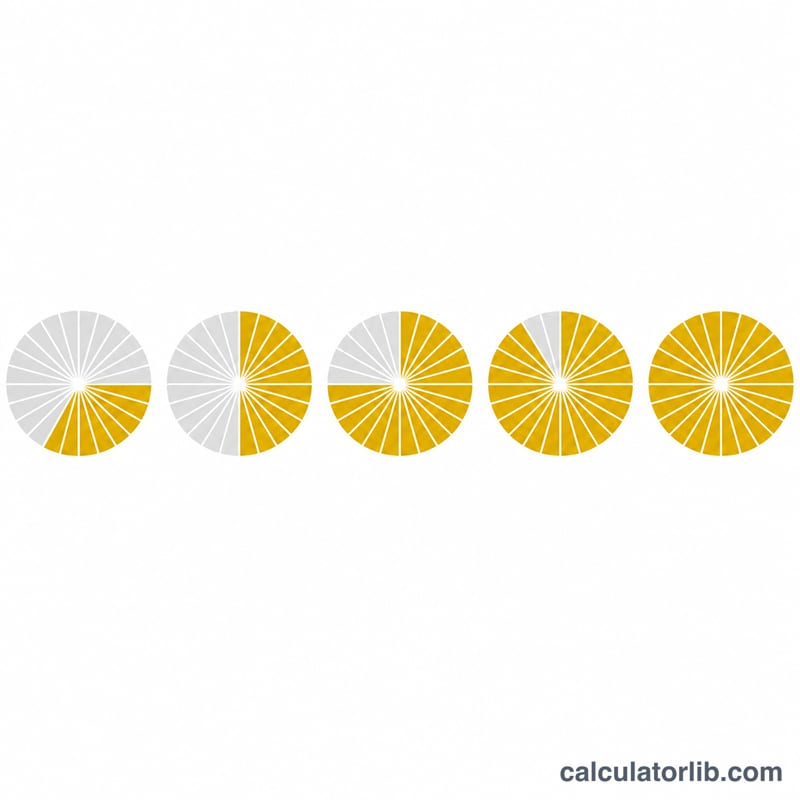
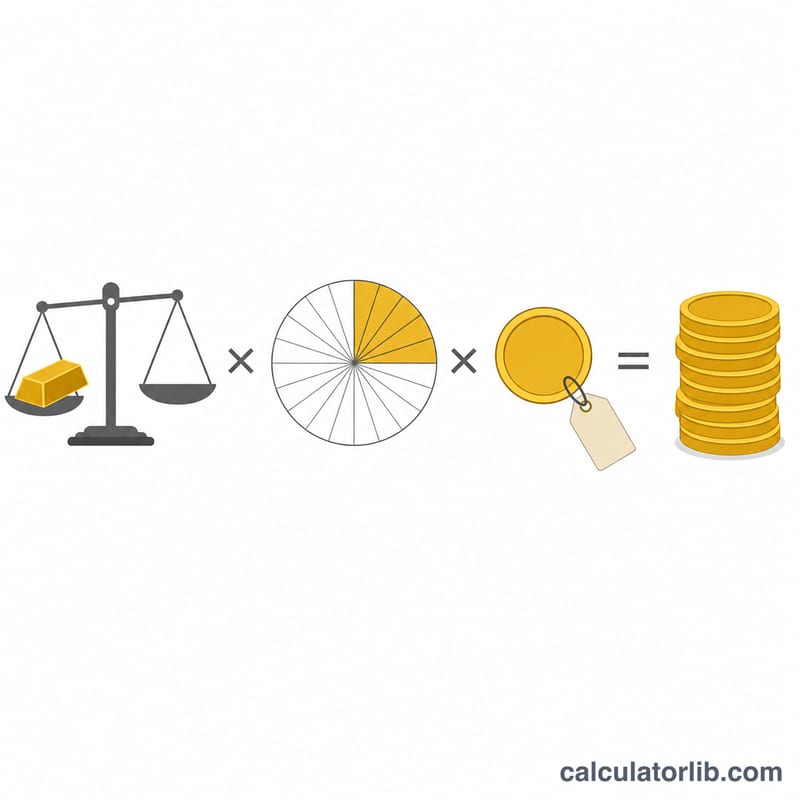
The value is the product of weight, the fractional purity, and the price per gram. Karat is expressed as a fraction of 24, so \(K/24\) gives the purity. The full equation is:
$$\text{Value} = \text{Weight} \times \frac{\text{Karat}}{24} \times \text{Price}_{\text{per gram}}$$Here \(\text{Weight}\) is in grams, \(\text{Karat}\) ranges from 0 to 24, and \(\text{Price}_{\text{per gram}}\) is the market rate for pure (24K) gold.
Worked example
Suppose you have a 20 gram ring made of 18K gold, and pure gold trades at 60 per gram. The purity is \(18/24 = 0.75\), so the pure gold content is \(20 \times 0.75 = 15\) grams, and the value is:
$$\text{Value} = 20 \times \frac{18}{24} \times 60 = 900$$So the ring holds about 900 worth of gold at that market price.
Karat Purity Reference Table
Karat (K) expresses how much of an alloy is pure gold, measured in 24ths. In this calculator the karat value sets the purity factor \(\frac{\text{Karat}}{24}\), which is multiplied by the weight and the price per gram. The values below are the nominal fineness figures used in the calculation; a real hallmarked item may vary slightly from its nominal purity depending on the standard it was assayed under.
| Karat | Fractional purity (K/24) | Purity (%) |
|---|---|---|
| 24K | 1.0000 | 100% |
| 22K | 0.9167 | 91.67% |
| 18K | 0.7500 | 75% |
| 14K | 0.5833 | 58.33% |
| 10K | 0.4167 | 41.67% |
| 9K | 0.3750 | 37.5% |
Example: valuing 10 g of 18K gold when the market price is $65 per gram substitutes directly into the formula:
$$\text{Gold Value} = 10 \times \frac{18}{24} \times 65 = 10 \times 0.75 \times 65 = 487.50$$So the gold content is worth $487.50. This is the value of the gold metal only; it does not include craftsmanship, brand premium, or dealer margins.
FAQ
Does this include jewelry making or resale fees? No. It estimates only the intrinsic melt value of the gold. Dealers may buy below or sell above this figure.
What price should I enter? Use the current spot price for pure 24K gold per gram, which you can find from a live gold price feed.
Can I use ounces? Convert to grams first (1 troy ounce is about 31.1035 grams), or enter a per-gram price to match a per-gram weight.