What Is the Hole Volume Calculator?
This calculator finds the volume of a round, cylindrical hole — such as a post hole, drilled borehole, fence-post hole, or auger hole — from its diameter and depth. Knowing the volume tells you how much concrete, soil, water, or backfill the hole will hold, which is useful for construction, landscaping, drilling, and DIY projects.
How to Use It
Enter the hole's diameter (the width across the opening), the depth (how far down it goes), and choose a unit of measurement. The calculator returns the volume in cubic units, plus handy conversions to liters and US gallons so you can quickly estimate material quantities.
The Formula Explained
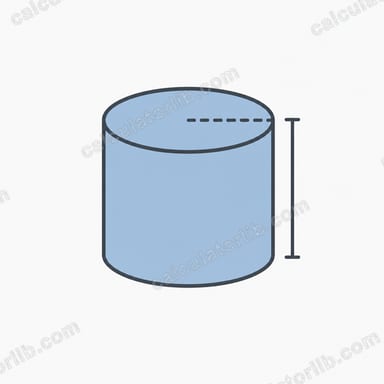
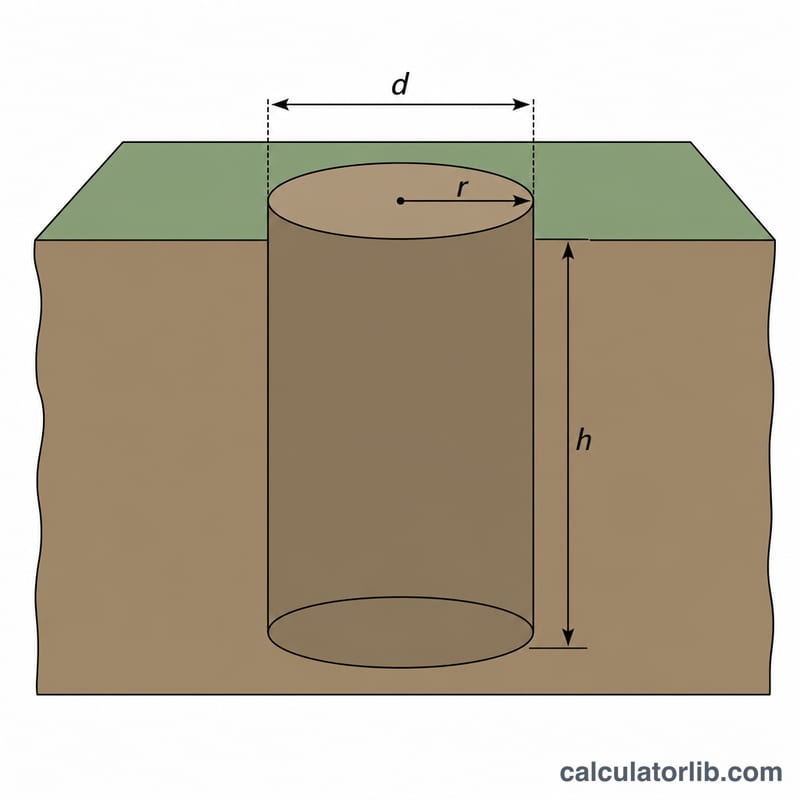
A cylindrical hole's volume equals the area of its circular cross-section multiplied by its depth:
$$V = \pi \times \left(\frac{d}{2}\right)^{2} \times h$$
Here d is the diameter, d/2 is the radius, and h is the depth. The radius is squared and multiplied by π (≈3.14159) to get the circle's area, then multiplied by the depth.
Worked Example
Suppose you dig a post hole 0.5 m in diameter and 2 m deep. The radius is 0.25 m, so the area is \(\pi \times 0.25^{2} \approx 0.19635\) m². Multiply by the 2 m depth:
$$0.19635 \times 2 \approx 0.3927 \text{ cubic meters}$$
or about 392.7 liters (≈103.7 US gallons).
Volume Unit Conversions
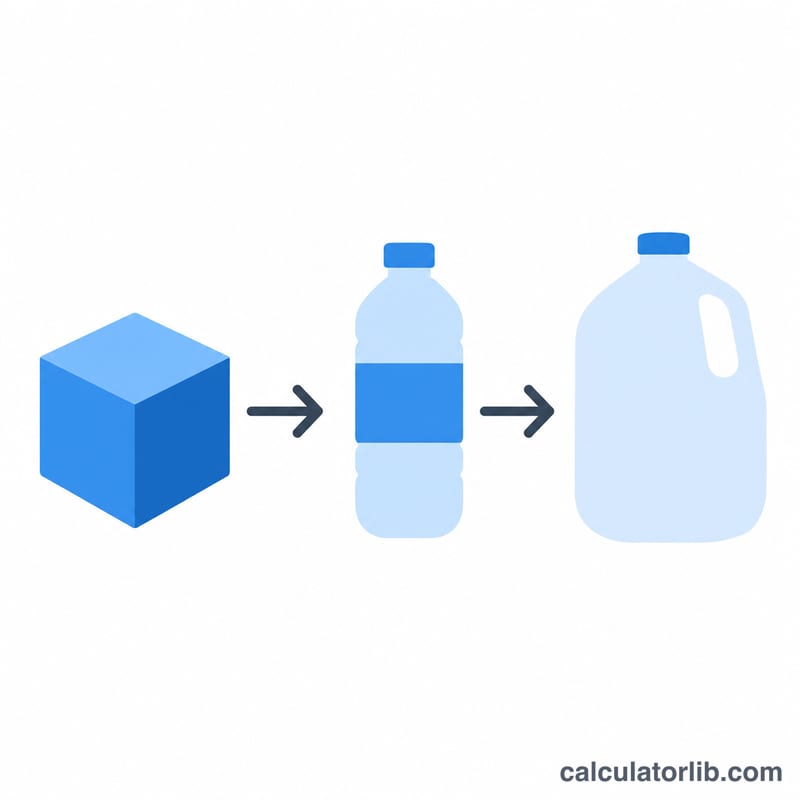
Hole volume is computed in cubic units of the length unit you choose (m³, cm³, ft³ or in³). Use the factors below to convert to other common volume units.
| From | Equivalent |
|---|---|
| 1 m³ | 1000 L = 264.172 US gal = 35.3147 ft³ = 1.30795 yd³ |
| 1 ft³ | 28.3168 L = 7.48052 US gal |
| 1 in³ | 0.016387 L |
| 1 US gal | 3.78541 L |
| 1 yd³ | 27 ft³ = 764.555 L |
Note: gallon figures here are US liquid gallons, not imperial gallons. Also, 1 ft³ = 1728 in³ and 1 m³ = 1,000,000 cm³.
Practical Tips for Estimating Fill Material
- Add a margin. Add about 5-10% extra for over-excavation and irregular walls, since real holes are rarely perfect cylinders.
- Subtract the post. When setting posts, subtract the volume of the post that sits below grade from the hole volume, because the post displaces fill.
- Round up. Round up to whole bags or whole cubic yards, since partial bags or loads are rarely available.
- Check the packaging. Bag yield varies by product and brand. For example, an 80 lb concrete bag yields about 0.6 ft³, but always confirm on the label.
- Measure at the widest point. Measure the diameter at the widest point of the hole so that you do not underestimate the volume.
Example: a hole 1 ft in diameter and 3 ft deep has volume \(V = \pi \left(\frac{1}{2}\right)^{2} \times 3 \approx\) 2.356 ft³. Adding 10% gives about 2.59 ft³. Dividing by 0.6 ft³ per bag gives \(2.59 / 0.6 \approx 4.3\), so buy 5 bags (before subtracting any post volume).
This is general guidance for estimating; always follow the manufacturer's instructions and local building requirements for your project.
FAQ
Does this work for non-round holes? No — it assumes a perfectly cylindrical hole. For square or irregular holes, use a different formula.
How much concrete do I need? The cubic-unit result is the total fill volume. For a post hole, subtract the post's volume to find the concrete needed.
Why are liters and gallons shown? They make it easy to estimate water capacity or compare to bagged-material yields, regardless of the input unit.