What is the IV Flow Rate Calculator?
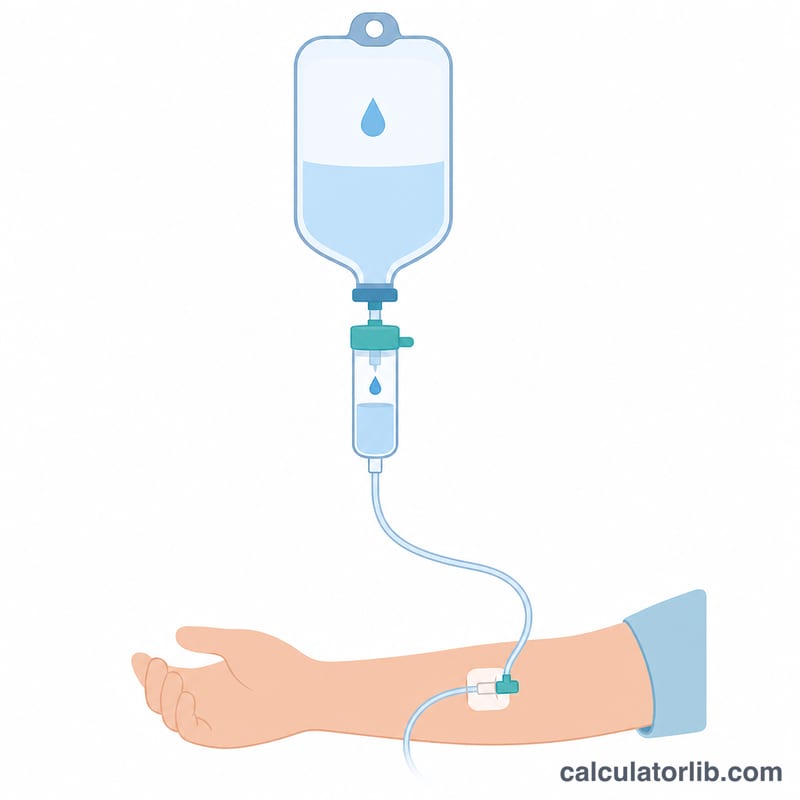
This calculator determines the intravenous (IV) flow rate in milliliters per hour (mL/hr) and, optionally, the manual drip rate in drops per minute (gtt/min). It is a quick bedside tool for nurses, students, and clinicians who need to set an infusion pump or regulate a gravity drip accurately. The math is universal and not tied to any country.
How to use it
Enter the total volume to be infused (mL) and the total infusion time (hours). The calculator returns the pump rate in mL/hr. If you are using gravity tubing, choose the drop factor printed on the tubing package (commonly 10, 15, or 20 gtt/mL for macrodrip, 60 gtt/mL for microdrip) to also get the drip rate in gtt/min. Leave drop factor as "None" if you only need the pump rate.
The formula explained
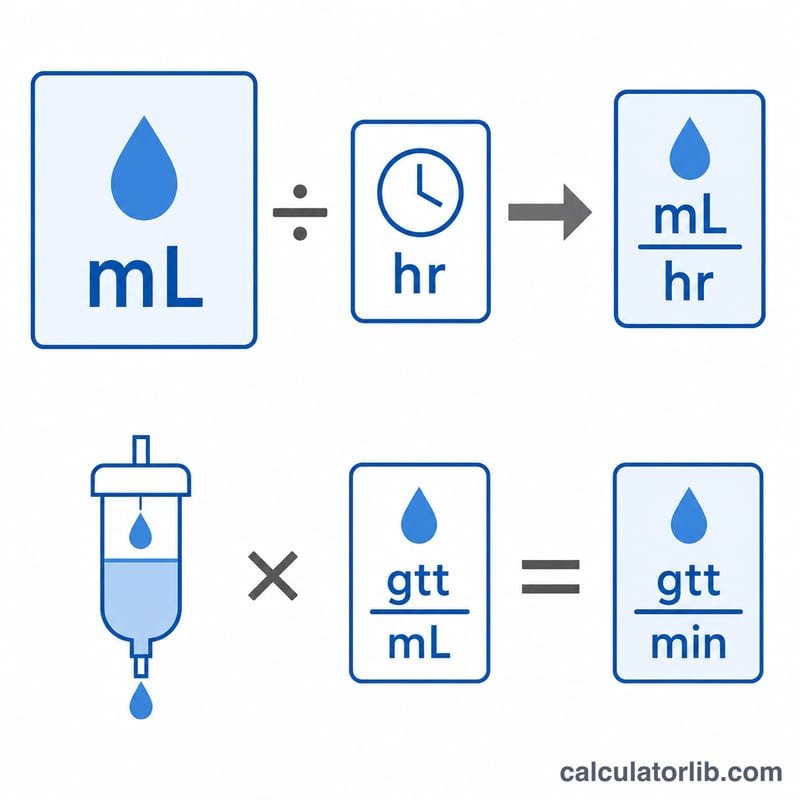
The flow rate is simply total volume divided by time: $$\text{mL/hr} = \frac{\text{Volume}}{\text{Time}}$$ To convert that into drops per minute for a gravity set, multiply by the drop factor and divide by 60 (minutes per hour): $$\text{gtt/min} = \frac{\text{mL/hr} \times \text{drop factor}}{60}$$ Drops per minute are usually rounded to the nearest whole drop in practice.
Worked example
Infusing 1000 mL over 8 hours gives $$1000 \div 8 = \textbf{125 mL/hr}.$$ With a 15 gtt/mL macrodrip set, the drip rate is $$\frac{125 \times 15}{60} = \frac{1875}{60} = \textbf{31.25 gtt/min},$$ which rounds to 31 drops per minute.
Common Drop Factors by Tubing Type
The drop factor is the number of drops (gtt) that make up 1 mL for a particular administration set. It depends on the tubing and manufacturer, so the same infusion gives different drip rates with different sets.
| Tubing type | Drop factor (gtt/mL) | Typical use |
|---|---|---|
| Macrodrip | 10 | Large drops; rapid or high-volume adult infusions (some manufacturers, e.g. Baxter, supply 10 gtt/mL sets) |
| Macrodrip | 15 | Routine adult infusions (commonly Hospira/ICU Medical sets, depending on product) |
| Macrodrip | 20 | General-purpose adult sets for moderate infusion rates |
| Microdrip (pediatric) | 60 | Small, precisely measured volumes, e.g. pediatric or slow infusions; 60 gtt/min equals 60 mL/hr |
Always verify the drop factor printed on the package of the specific set in use. The values above are typical examples, and they vary by manufacturer and product line.
Drip rate formula: \(\text{gtt/min} = \frac{ \text{Volume (mL)} \times \text{Drop factor (gtt/mL)} }{ \text{Time (min)} }\).
Example Infusion Scenarios Compared
Flow rate is volume divided by time in hours. Drip rate is volume × drop factor divided by time in minutes, rounded to the nearest whole drop.
| Total volume | Time | Flow rate (mL/hr) | Drop factor | Drip rate (gtt/min) |
|---|---|---|---|---|
| 1000 mL | 8 hr | 125 | 15 | 1000 × 15 ÷ 480 = 31.25 → 31 |
| 500 mL | 4 hr | 125 | 20 | 500 × 20 ÷ 240 = 41.67 → 42 |
| 250 mL | 2 hr | 125 | 60 | 250 × 60 ÷ 120 = 125 |
| 100 mL | 30 min (0.5 hr) | 200 | 15 | 100 × 15 ÷ 30 = 50 |
| 1000 mL | 12 hr | 83.3 | 15 | 1000 × 15 ÷ 720 = 20.83 → 21 |
The first three rows show how the same 125 mL/hr flow rate requires very different drip rates depending on the drop factor of the set.
Key Terms and Abbreviations
- gtt
- Abbreviation for drops, from the Latin guttae (plural of gutta, a drop).
- gtt/mL (drop factor)
- The number of drops that equal 1 mL for a given administration set; printed on the tubing package.
- mL/hr
- Milliliters per hour; the volume of fluid delivered each hour. Infusion pumps are typically programmed in this unit.
- Macrodrip
- Tubing that produces large drops, with drop factors of 10, 15 or 20 gtt/mL depending on the manufacturer.
- Microdrip
- Tubing that produces small drops, with a drop factor of 60 gtt/mL, used for small or precisely measured volumes.
- Gravity infusion
- Delivery of fluid by gravity through a drip chamber and tubing; the rate is set by adjusting a roller clamp and counting drops.
- Infusion pump
- An electronic device that delivers fluid at a programmed rate, usually in mL/hr.
- Infusion time
- The total duration over which the volume is to be delivered, expressed in hours for mL/hr or in minutes for gtt/min.
- Total volume
- The full amount of fluid to be infused, in milliliters (mL).
This information is educational only and is not clinical advice.
FAQ
Do I need a drop factor? Only for manual gravity drips. Infusion pumps are set directly in mL/hr, so the drop factor is optional.
What is the difference between macrodrip and microdrip? Macrodrip tubing (10–20 gtt/mL) is used for routine and rapid infusions; microdrip tubing (60 gtt/mL) delivers small, precise volumes such as pediatric or critical medications.
What if time is in minutes? Convert minutes to hours (divide by 60) before entering the time, since this tool expects hours.