
What this calculator does
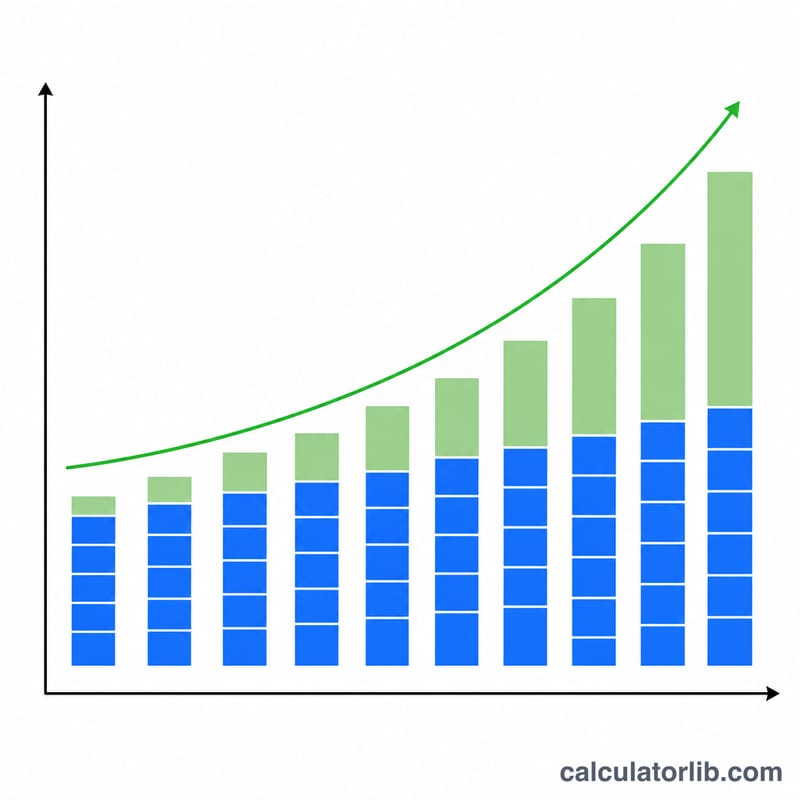
The Future Value of Recurring Deposits Calculator shows how a series of equal, regular deposits grows over time when each deposit earns compound interest. It is ideal for planning a savings plan, recurring deposit account, sinking fund, or any goal where you contribute the same amount on a fixed schedule.
How to use it
Enter the amount you deposit each period, your annual interest rate as a percentage, the number of years you will keep saving, and how often you deposit (monthly, quarterly, etc.). The calculator returns the projected balance at maturity, the total amount you actually deposited, and the interest your money earned.
The formula explained
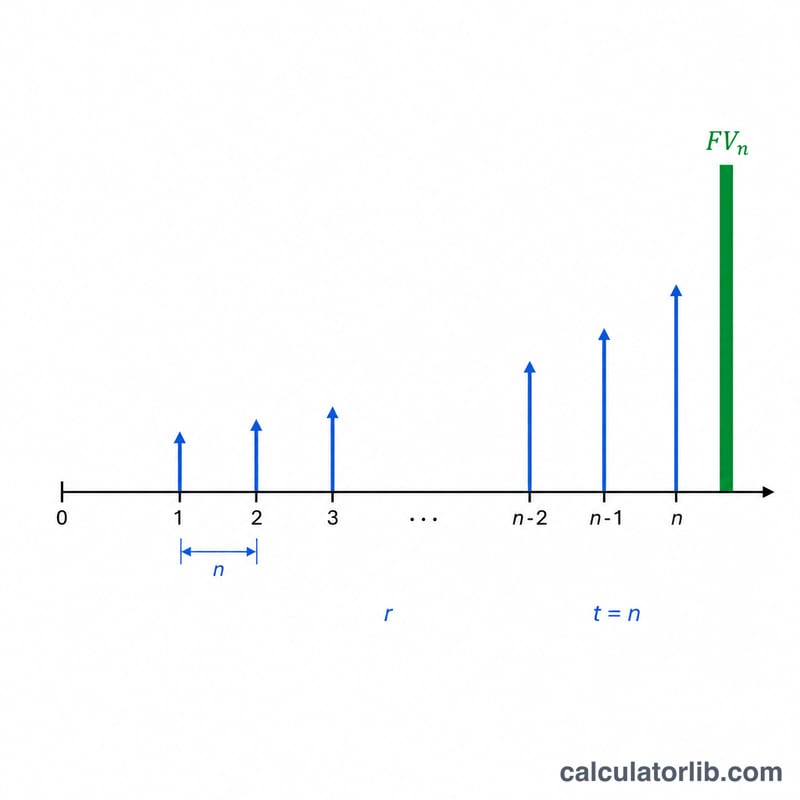
This tool uses the future value of an ordinary annuity formula, where deposits are made at the end of each period:
$$FV = PMT \times \left[ \frac{(1 + r/n)^{n \cdot t} - 1}{r/n} \right]$$
Here \(PMT\) is each deposit, \(r\) is the annual rate written as a decimal, \(n\) is the number of deposits per year, and \(t\) is the number of years. The term \(r/n\) converts the annual rate to a per-period rate, and \(n \cdot t\) is the total number of deposits. If the rate is 0%, the future value simply equals \(PMT \times n \times t\).
Worked example
Suppose you deposit $200 every month for 10 years at 5% annual interest, compounded monthly. Then \(r/n = 0.05/12 = 0.0041667\) and \(n \cdot t = 120\).
$$FV = 200 \times \frac{1.0041667^{120} - 1}{0.0041667} \approx \$31{,}056$$
You deposited $24,000 in total, so roughly $7,056 came from interest.
FAQ
Does this assume deposits at the start or end of each period? It assumes end-of-period deposits (an ordinary annuity), the most common convention.
What if my interest is compounded differently than I deposit? This calculator assumes the compounding frequency matches the deposit frequency, which is standard for recurring deposit and savings plans.
Can I include an initial lump sum? No, this tool models only recurring deposits. Add the future value of any starting balance separately if needed.