What this calculator does
This tool estimates the intramuscular (IM) epinephrine (adrenaline) dose for a child in anaphylaxis based on body weight, and converts that dose into the volume to draw up for a given vial concentration. It is intended for clinical reference and education only — always follow your local resuscitation protocol and verify the vial label before administration.
How to use it
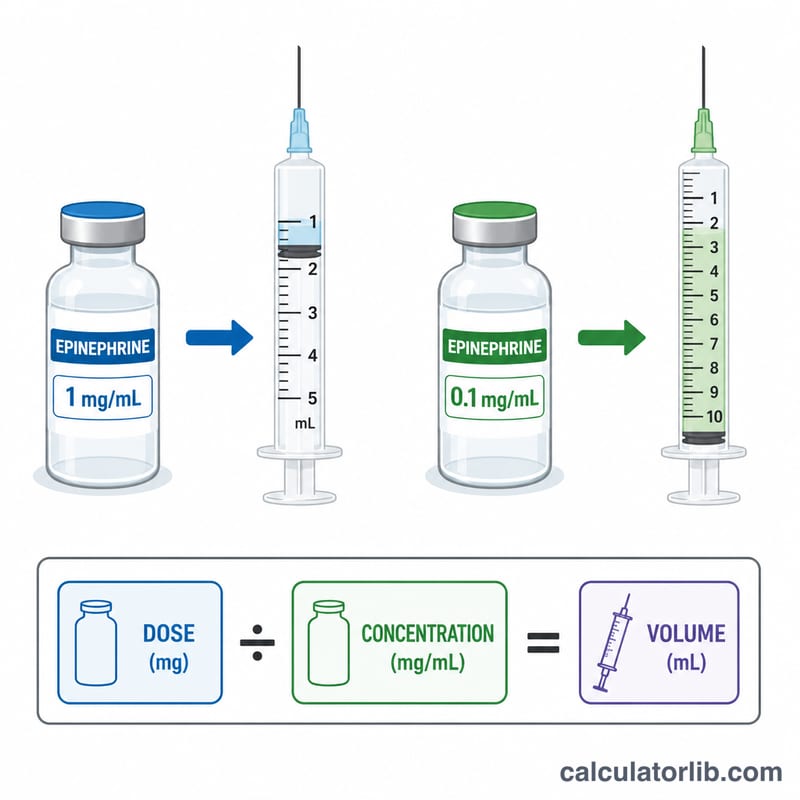
Enter the child's weight in kilograms. The calculator uses 1 mg/mL (1:1000), the only concentration for IM injection, and returns the dose in milligrams and the volume in milliliters to inject. Do not use 0.1 mg/mL (1:10,000) for IM injection.
The formula explained
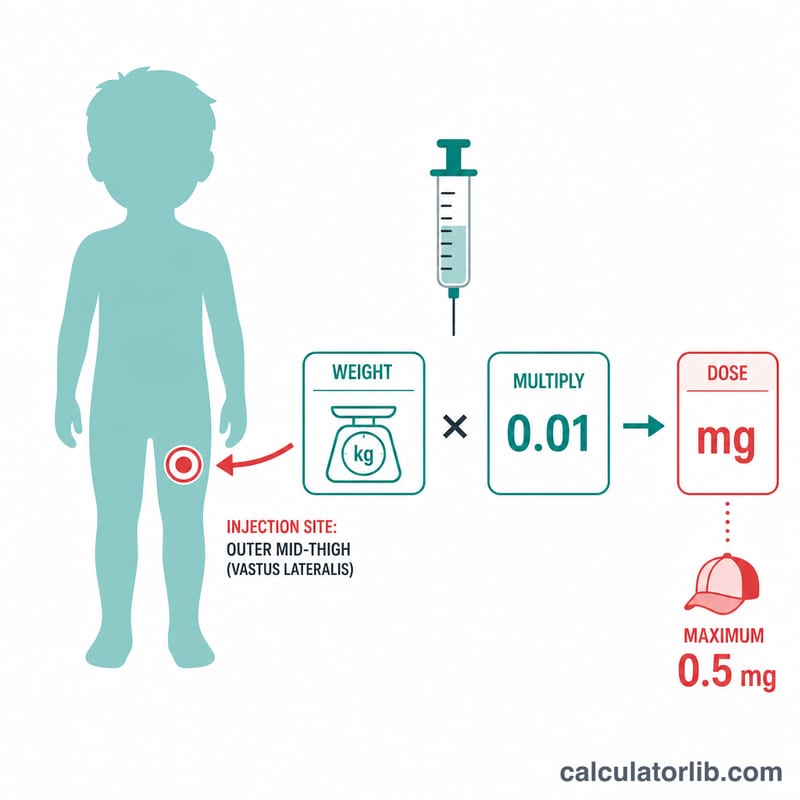
The standard IM anaphylaxis dose is 0.01 mg/kg, with a maximum single dose of 0.5 mg. The volume to administer is the dose divided by the concentration:
$$\text{Volume} = \frac{\text{Dose}}{\text{Concentration}}$$The "cap reached" row tells you whether the weight-based dose exceeded \(0.5\) mg and was therefore limited.
Worked example
A 20 kg child with 1 mg/mL epinephrine:
$$\text{Dose} = 0.01 \times 20 = 0.2 \text{ mg}$$below the 0.5 mg cap.
$$\text{Volume} = \frac{0.2}{1} = 0.2 \text{ mL IM}$$A 70 kg patient gives \(0.7\) mg, which is capped to \(0.5\) mg, so volume = \(0.5\) mL at 1 mg/mL.
Dose and Volume by Weight (1 mg/mL)
The table applies the formula \(\text{Dose (mg)} = \min(0.01 \times \text{weight in kg},\ 0.5)\) and then \(\text{Volume (mL)} = \text{Dose} \div \text{concentration}\). Volumes are for 1 mg/mL (1:1000), the IM concentration. 1:10,000 (0.1 mg/mL) is for intravenous use by healthcare professionals only.
| Weight (kg) | Weight-based dose (mg) | Dose given (mg) | 0.5 mg cap | Volume at 1 mg/mL (mL) |
|---|---|---|---|---|
| 5 | 0.05 | 0.05 | No | 0.05 |
| 10 | 0.10 | 0.10 | No | 0.10 |
| 15 | 0.15 | 0.15 | No | 0.15 |
| 20 | 0.20 | 0.20 | No | 0.2 |
| 30 | 0.30 | 0.30 | No | 0.30 |
| 50 | 0.50 | 0.50 | Reached (equals cap) | 0.5 |
| 70 | 0.70 | 0.50 | Yes, capped | 0.5 |
Worked example (20 kg, 1 mg/mL): dose = 0.01 × 20 = 0.2 mg, which is below 0.5 mg, so no cap applies; volume = 0.2 mg ÷ 1 mg/mL = 0.2 mL. Worked example (70 kg, 1 mg/mL): 0.01 × 70 = 0.7 mg, capped to 0.5 mg; volume = 0.5 ÷ 1 = 0.5 mL.
These values are educational only and must be verified against your local protocol, formulary and current guidelines before any clinical use.
Interpreting the Result
- Dose (mg): This is weight-based at 0.01 mg/kg. A 12 kg child therefore corresponds to 0.12 mg.
- Volume (mL): This is the dose divided by the concentration of the product. A 10-fold difference in concentration gives a 10-fold difference in volume. The same 0.12 mg dose is 0.12 mL at 1 mg/mL but 1.2 mL at 0.1 mg/mL.
- Cap flag: The flag means the weight-based dose exceeded 0.5 mg, so the dose was limited to the 0.5 mg maximum single dose. At exactly 50 kg the weight-based dose equals the cap and is not exceeded.
- Concentration: 1 mg/mL (1:1000) is the standard concentration for IM injection in anaphylaxis. Confusing 1:1000 with 1:10,000 is a recognised source of 10-fold dosing errors, so always check the label for mg/mL, not just the ratio.
- Repeat dosing: Guidelines (for example resuscitation councils and the World Allergy Organization) describe the figure as a single dose. It may be repeated at intervals set by the relevant protocol if symptoms persist. This calculator does not model repeat doses, and some guidelines use weight or age bands rather than a strict per-kg calculation.
This tool is educational only. It is not a substitute for clinical judgement, local protocol or professional training, and it does not give medical advice for any individual patient.
The dose is 0.01 mg/kg injected into the muscle of the outer thigh. It may be repeated every 5 to 10 minutes if needed, and emergency services should be called. Small or prepubertal children usually receive 0.3 mg; under 30 kg the label maximum is 0.3 mg.
Definitions and Glossary
- Anaphylaxis
- A serious, rapid-onset, potentially life-threatening systemic allergic reaction. It typically involves airway, breathing or circulation problems, often together with skin or gastrointestinal symptoms.
- Epinephrine / adrenaline
- Two names for the same medicine. It is the first-line treatment for anaphylaxis. "Epinephrine" is common in the US and "adrenaline" in the UK, Europe and Australia.
- Intramuscular (IM)
- Given by injection into muscle. IM is the usual route for initial anaphylaxis treatment.
- mg/kg dosing
- A dose calculated from body weight. Here it is 0.01 mg for every kilogram.
- Concentration (mg/mL)
- The amount of drug per millilitre of solution. It determines the volume that contains a given dose.
- Ratio notation
- 1:1000 means 1 g in 1000 mL, which is 1 mg/mL. 1:10,000 means 1 g in 10,000 mL, which is 0.1 mg/mL.
- Maximum single dose (cap)
- The upper limit for one dose regardless of weight. This calculator uses 0.5 mg.
- Anterolateral (outer) thigh
- The outer, middle part of the thigh (vastus lateralis muscle). It is the recommended IM injection site for epinephrine in anaphylaxis because it gives reliable absorption.
FAQ
What concentration is used for IM injection? The 1 mg/mL (1:1000) preparation is standard for IM epinephrine in anaphylaxis. The 0.1 mg/mL (1:10,000) form is typically reserved for IV use in cardiac arrest.
Why is the dose capped at 0.5 mg? 0.5 mg is the maximum recommended single IM dose; heavier children and adults receive this fixed maximum rather than a larger weight-based dose.
Can the dose be repeated? Yes — IM epinephrine can be repeated every 5–15 minutes if there is inadequate response, per protocol. This calculator shows a single dose.