What Is Weight Loss Percentage?
Weight loss percentage expresses how much weight you've lost relative to where you started, rather than as a raw number. Losing 10 pounds means something very different for a 150-pound person than for a 300-pound person. Expressing the change as a percentage gives a fair, comparable measure of progress that is widely used in weight-loss challenges, fitness programs, and clinical settings.
How to Use This Calculator
Enter your starting weight (your weight when you began) and your current weight in the same unit — pounds or kilograms, it doesn't matter as long as both match. The calculator returns the percentage of your starting body weight you have lost, along with the absolute amount lost.
The Formula Explained
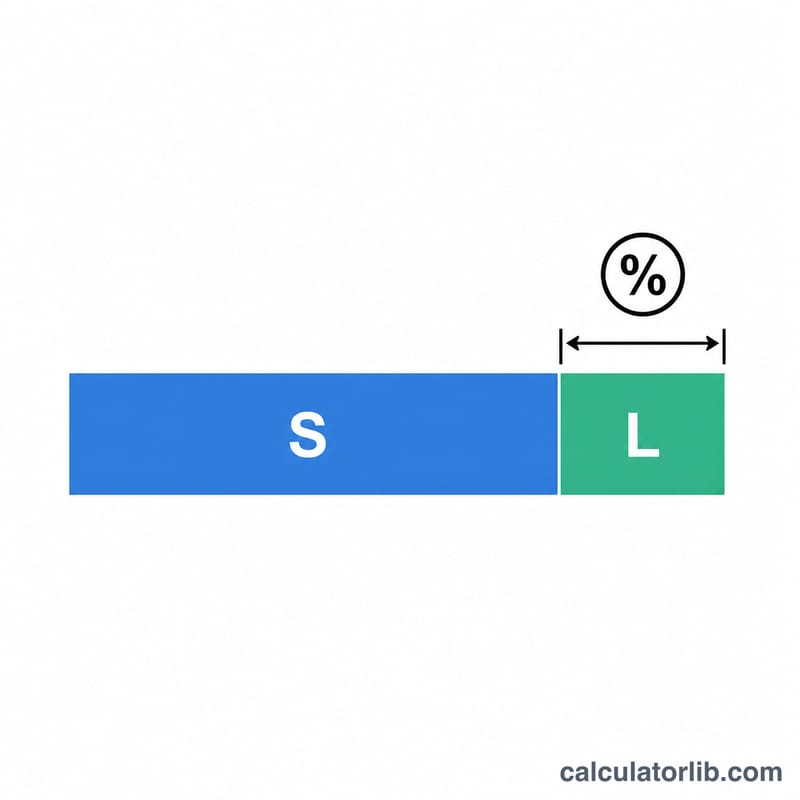
The calculation is simple: subtract your current weight from your starting weight to get the amount lost, divide by your starting weight, and multiply by 100 to get a percentage:
$$\text{Loss \%} = \frac{\text{Starting Weight} - \text{Current Weight}}{\text{Starting Weight}} \times 100$$
A positive result means you've lost weight; a negative result means you've gained.
Worked Example
Suppose you started at 180 pounds and now weigh 162 pounds. The weight lost is \(180 - 162 = 18\) pounds. Divide by the starting weight: \(18 \div 180 = 0.1\). Multiply by 100 to get 10%. You have lost 10% of your starting body weight.
$$\frac{180 - 162}{180} \times 100 = 10\%$$
Interpreting Your Weight Loss Percentage
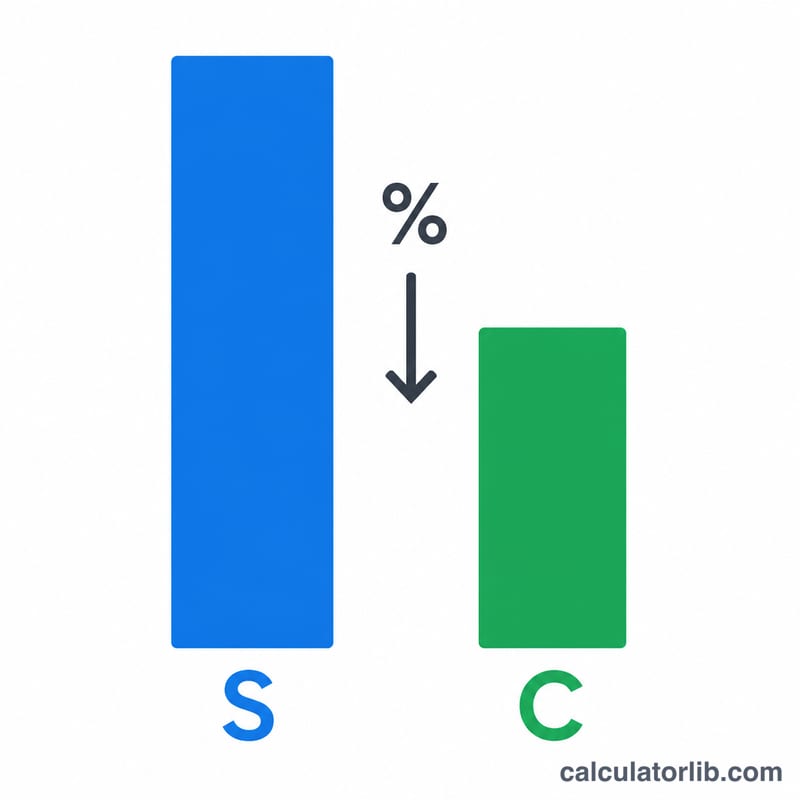
Weight loss percentage expresses how much of your initial body weight you have lost, independent of the unit used:
$$\text{Weight Loss \%} = \frac{\text{Starting Weight} - \text{Current Weight}}{\text{Starting Weight}} \times 100$$Because the result is a ratio, 10 lb lost from 200 lb and 4.5 kg lost from 90.7 kg are the same 5% — which is why clinical research reports outcomes as a percentage rather than an absolute amount.
Thresholds documented in the research literature
The percentage bands below come from the 2013 AHA/ACC/TOS Guideline for the Management of Overweight and Obesity in Adults (a United States clinical guideline) and the trial evidence it summarizes. They describe average findings in study populations, not what will happen to any one person.
| Loss of initial body weight | What the literature documents |
|---|---|
| ~3–5% | The level at which clinically meaningful improvements in triglycerides, blood glucose and HbA1c have been documented. |
| 5–10% | Associated with improvements in blood pressure and in blood lipids (including LDL and HDL cholesterol), in addition to the glycemic changes above. |
| ≥10% | The magnitude used as a target in many clinical weight-management and bariatric programs, and the range where larger changes in cardiometabolic risk factors are typically reported. |
What the percentage does not tell you
- Nothing about body composition. The figure is derived from total scale weight only. It cannot distinguish fat mass from lean (muscle) mass or from body water, so two people with an identical 7% loss can have very different compositional changes.
- Early rapid loss is partly water. When carbohydrate intake drops, stored glycogen is depleted, and glycogen is bound to water in the body. A large first-week percentage therefore commonly reflects a shift in water as well as tissue, and the rate usually slows afterward.
- It is entirely relative to the baseline you chose. The denominator is your starting weight, so moving the baseline date changes the answer even though your current weight is unchanged. Measuring from a short-lived peak weight inflates the percentage; measuring from a lower earlier weight deflates it. Keep the baseline fixed and consistent if you want comparable figures over time.
- Scale weight fluctuates day to day. Hydration, sodium intake, food and fluid in the digestive tract, and (for some people) hormonal cycles can move the reading by amounts comparable to a week's genuine change.
This section is general information about how the metric is defined and reported, not medical advice. What your particular percentage means for your health — and what, if anything, to do about it — depends on your full clinical picture and belongs in a conversation with a doctor, registered dietitian or other qualified healthcare professional.
Typical and Recommended Rates of Weight Loss
Public-health bodies publish rate-of-loss reference ranges rather than percentage targets. The table restates each published range and shows what it works out to as a percentage, using a 90 kg (about 198 lb) person as the worked reference body weight. Each row names its source explicitly; the first two are national health-agency guidance (United States and United Kingdom respectively) and apply to the general adult population those agencies address.
| Source / standard | Published rate | ≈ % of body weight per week (at 90 kg) | Cumulative over ~6 months |
|---|---|---|---|
| CDC (United States) | 1 to 2 pounds (about 0.45–0.9 kg) per week, described as a sustainable rate | 0.5–1.0% | roughly 5–10% if sustained, allowing for slowing |
| NHS (United Kingdom) | 0.5 to 1 kg (1–2 lb) per week | 0.6–1.1% | roughly 5–10% if sustained |
| Commonly cited in sports and clinical nutrition practice | 0.5–1% of body weight per week (scales with the individual) | 0.5–1.0% by definition | roughly 5–10% |
| Diabetes Prevention Program (US NIH trial, lifestyle arm) | Goal of losing 7% of body weight and maintaining it, with ≥150 min/week of physical activity | n/a — stated as a total goal, not a weekly rate | 7% was the trial's target within the first 6 months |
Translating a rate into cumulative percentages
At 0.5–1.0% per week, the arithmetic lands at approximately 2–4% per month and 5–10% over six months — which is why the 5–10% band appears so often in guidelines: it is simply what a sustainable rate adds up to over half a year. In practice the rate usually tapers as weight falls, so later months tend to sit at the lower end.
Worked example
A person starts at 198 lb and reaches 182 lb after about 16 weeks (16 lb, averaging 1 lb per week — within the CDC range):
$$\text{Weight Loss \%} = \frac{198 - 182}{198} \times 100 = \frac{16}{198} \times 100 = 8.08\%$$That gives a loss of 8.08% of initial body weight — above the 7% Diabetes Prevention Program goal and inside the 5–10% band discussed in the previous section. The same calculation in kilograms (89.8 kg to 82.6 kg) returns the same percentage, because the units cancel.
These figures are population-level reference ranges drawn from published guidance, not individualized targets. An appropriate rate for a specific person depends on their starting weight, health conditions, medications and goals, and should be set with a healthcare professional. This is general information and not professional medical advice.
FAQ
Does it matter if I use pounds or kilograms? No. As long as both weights are in the same unit, the percentage is identical.
What is considered a healthy rate of weight loss? Most health authorities suggest 0.5–1% of body weight per week as a sustainable rate, though individual goals vary — consult a healthcare professional.
Can the result be negative? Yes. If your current weight is higher than your starting weight, the result is negative, indicating weight gain rather than loss.