What This Permutations Calculator Does
This calculator works out the number of permutations — written as nPr or \(P(n, r)\) — for a given set of items. A permutation counts how many ordered arrangements you can make when you select r items from a total of n items. Order matters here, so picking A then B is counted separately from B then A. You only need to supply two whole numbers and the result appears instantly.
The Two Inputs
- Total number of items (n): the size of the full set you are choosing from.
- Number of items to arrange (r): how many of those items you select and place in order.
Both values must be non-negative whole numbers, and n must be greater than or equal to r. The calculator accepts large values — anything up to 100,000 — and uses arbitrary-precision arithmetic (BigInteger) so even huge results are computed exactly without rounding.
The Formula
The calculator applies the standard permutation formula:
$$P(n, r) = \frac{\text{n}!}{\left(\text{n} - \text{r}\right)!}$$Here "!" means factorial — the product of every whole number from 1 up to that value. The tool computes \(n!\) and \((n - r)!\) separately, then divides one by the other to give the exact number of ordered arrangements.
Worked Example
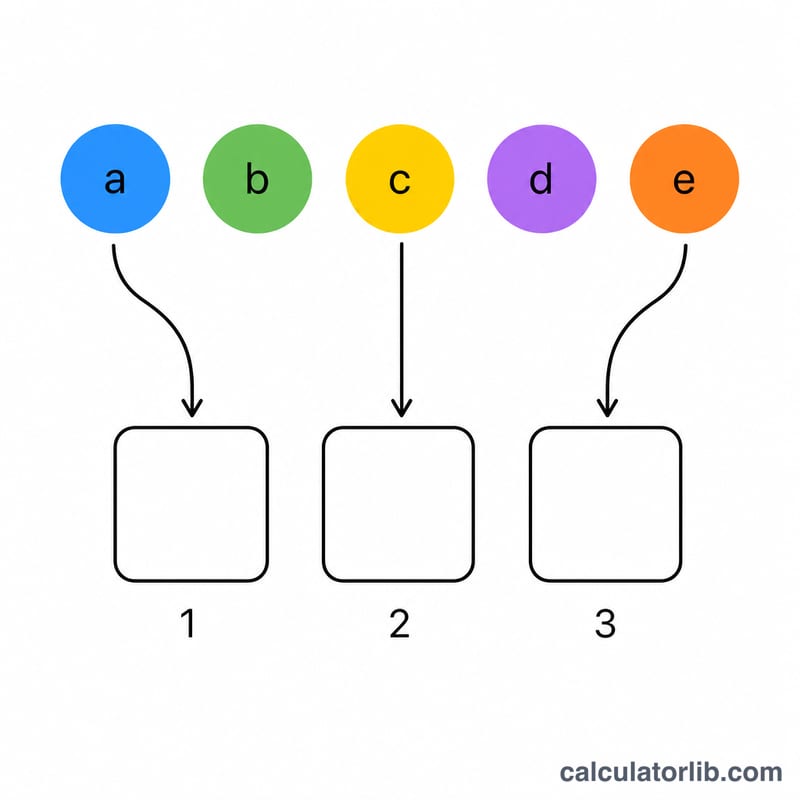
Suppose you want to know how many ways 3 runners can finish first, second and third in a race of 5 athletes. Enter n = 5 and r = 3:
- \(5! = 120\)
- \((5 - 3)! = 2! = 2\)
- $$P(5, 3) = \frac{120}{2} = \mathbf{60}$$
So there are 60 possible ordered finishes for the top three places.
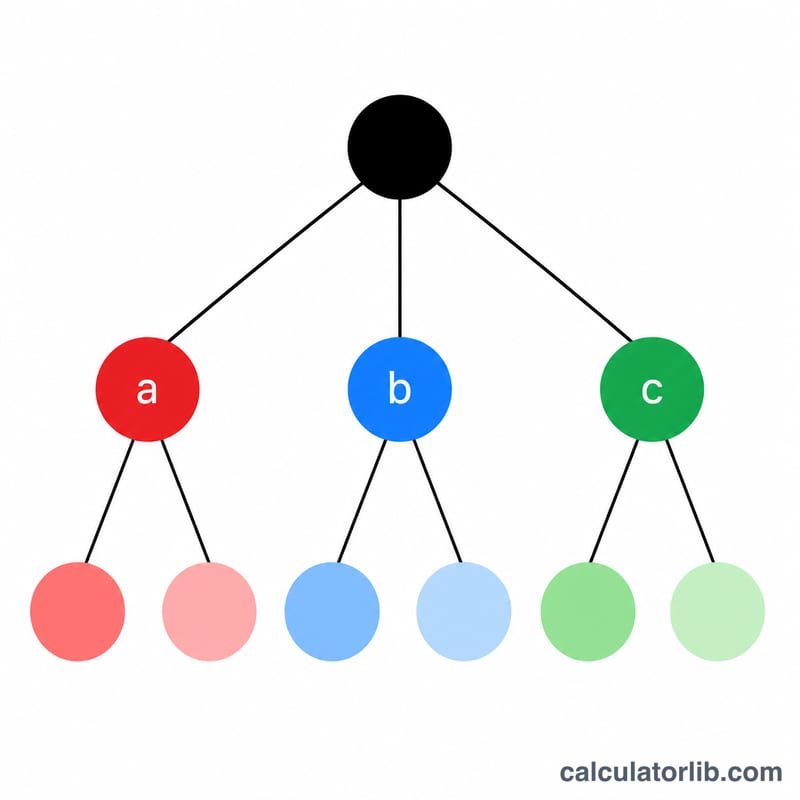
Permutation Values for Common n and r
The number of ordered arrangements of r items chosen from n distinct items is \(P(n,r)=\frac{n!}{(n-r)!}\). The table shows common values.
| n | r | P(n, r) | Product form |
|---|---|---|---|
| 5 | 2 | 20 | 5 × 4 |
| 5 | 3 | 60 | 5 × 4 × 3 |
| 5 | 5 | 120 | 5 × 4 × 3 × 2 × 1 |
| 10 | 3 | 720 | 10 × 9 × 8 |
| 10 | 5 | 30,240 | 10 × 9 × 8 × 7 × 6 |
| 52 | 5 | 311,875,200 | 52 × 51 × 50 × 49 × 48 |
| 26 | 26 | 26! = 403,291,461,126,605,635,584,000,000 | 26 × 25 × … × 1 |
Special cases:
- \(P(n,0)=1\): there is exactly one way to arrange nothing.
- \(P(n,1)=n\): each single item is its own arrangement.
- \(P(n,n)=n!\): all n items are arranged in every possible order.
More Permutation Examples
Because the factors of \((n-r)!\) cancel, \(P(n,r)\) equals the product of the r numbers \(n\times(n-1)\times\dots\times(n-r+1)\).
Example 1: Seating 4 of 8 people in a row
Order matters, so n = 8 and r = 4:
$$P(8,4)=\frac{8!}{(8-4)!}=\frac{8!}{4!}=8\times7\times6\times5$$
8 × 7 = 56, 56 × 6 = 336, 336 × 5 = 1,680 possible seatings.
Example 2: Gold, silver and bronze among 10 contestants
Each medal goes to a different person and the medals are ranked, so n = 10 and r = 3:
$$P(10,3)=\frac{10!}{7!}=10\times9\times8=720$$
There are 720 possible podiums.
Example 3: Drawing 5 ordered cards from a 52-card deck
With n = 52 and r = 5:
$$P(52,5)=\frac{52!}{47!}=52\times51\times50\times49\times48$$
52 × 51 = 2,652; × 50 = 132,600; × 49 = 6,497,400; × 48 = 311,875,200 ordered five-card sequences.
Key Terms in Permutations
- Permutation
- An arrangement of items in which the order matters. ABC and CBA count as different permutations.
- Factorial
- The product of all positive integers up to a number: \(n!=n\times(n-1)\times\dots\times1\). By definition, \(0!=1\).
- n
- The total number of distinct items available to choose from.
- r
- The number of items chosen and arranged, with \(0\le r\le n\).
- Ordered arrangement
- A selection in which the position of each item is part of the outcome, such as a ranking, a seating order or a PIN made of different digits.
- Distinct items
- Items that can be told apart, with no repeats. The formula \(P(n,r)\) assumes each item can be used at most once.
- Combination
- A selection in which order does not matter. It is related to permutations by \(nCr=\frac{nPr}{r!}\). For example, \(5C2=\frac{20}{2}=10\).
Note: Permutations with repetition, where items can be reused and the count is \(n^r\), are not computed by this tool. It handles only arrangements without repetition.
Frequently Asked Questions
How is a permutation different from a combination?
A permutation counts ordered arrangements, while a combination ignores order. This calculator uses the permutation formula, so different orderings of the same items are counted as distinct outcomes.
What happens if r is larger than n?
That is not allowed. The calculator returns an error because you cannot arrange more items than you have. You must keep \(n \geq r\).
Can I use 0 for r?
Yes. \(P(n, 0)\) always equals 1, because there is exactly one way to arrange nothing — the empty arrangement.