What Is Power?
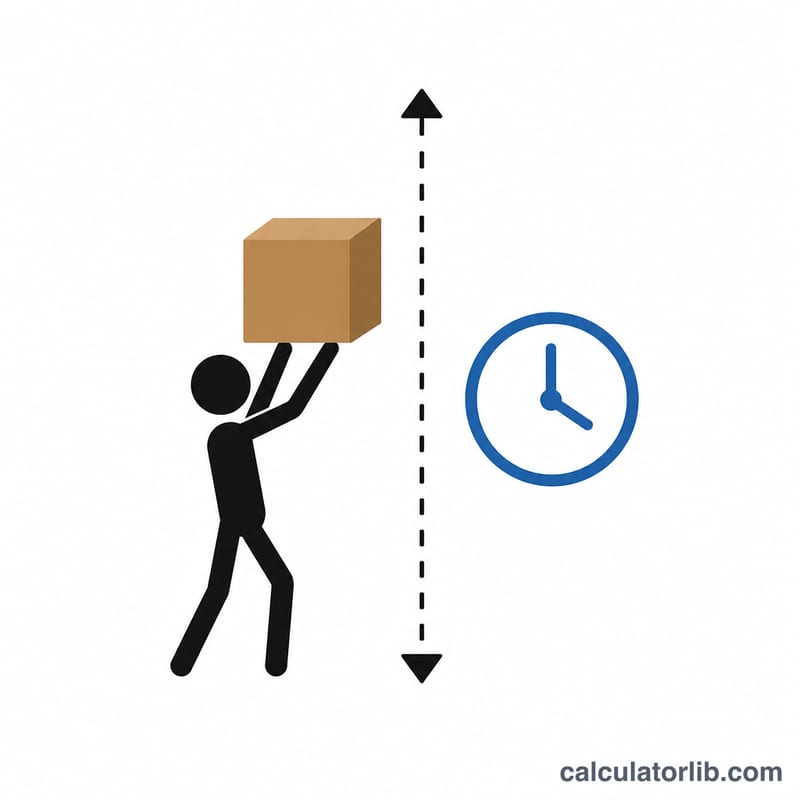
Power is the rate at which work is done or energy is transferred. In physics it is defined as the amount of work performed per unit of time. The standard unit of power is the watt (W), where one watt equals one joule of work per second. This calculator works for any system of consistent units and is universal — it applies anywhere physics does.
How to Use This Calculator
Enter the work or energy transferred in joules and the time taken in seconds, then read the resulting power in watts. The calculator also converts the result into mechanical horsepower so you can compare it against engine or motor ratings.
The Formula Explained
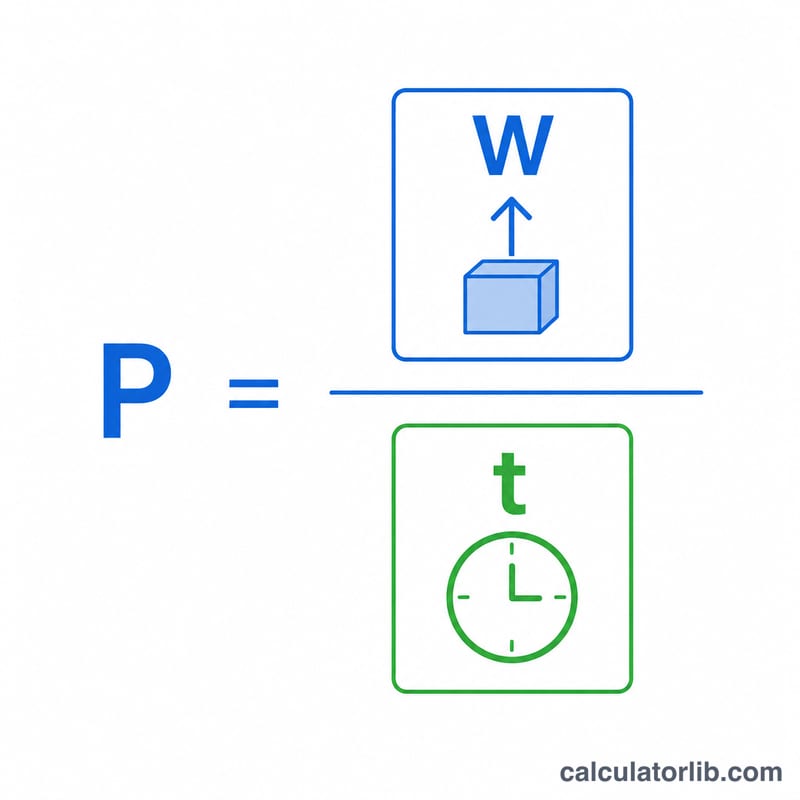
The power equation is $$P = \frac{W}{t}$$ where P is power in watts, W is work or energy in joules, and t is time in seconds. Doubling the work done in the same time doubles the power; doing the same work in half the time also doubles the power. Because dividing by zero is undefined, the time must be greater than zero.
Worked Example
Suppose a motor does 1,000 joules of work in 10 seconds. Then $$P = \frac{1000}{10} = 100 \text{ watts}$$ Converting to horsepower: \(\frac{100}{745.7} \approx 0.134 \text{ hp}\). So the motor outputs 100 W, a little over one-tenth of a horsepower.
Power Unit Conversion Table
The watt (W) is the SI unit of power: \(1\ \text{W} = 1\ \text{J/s}\). The table converts common power units to watts and from watts. Factors are rounded to practical precision.
| Unit | Value in watts | 1 W expressed in this unit |
|---|---|---|
| Kilowatt (kW) | 1 kW = 1,000 W | 1 W = 0.001 kW |
| Megawatt (MW) | 1 MW = \(10^6\) W | 1 W = \(10^{-6}\) MW |
| Mechanical (imperial) horsepower (hp) | 1 hp ≈ 745.7 W | 1 W ≈ 0.001341 hp |
| Metric horsepower (PS, CV, pk) | 1 PS ≈ 735.5 W | 1 W ≈ 0.001360 PS |
| Electrical horsepower | 1 hp(E) = 746 W | 1 W ≈ 0.001340 hp(E) |
| BTU per hour (BTU/h) | 1 BTU/h ≈ 0.2931 W | 1 W ≈ 3.412 BTU/h |
| Foot-pound-force per second (ft·lbf/s) | 1 ft·lbf/s ≈ 1.3558 W | 1 W ≈ 0.7376 ft·lbf/s |
| Kilocalorie per hour (kcal/h) | 1 kcal/h ≈ 1.163 W | 1 W ≈ 0.8598 kcal/h |
Mechanical and metric horsepower are different units. Mechanical horsepower is defined as 550 ft·lbf/s (≈ 745.7 W) and is the usual meaning of "hp" in the United States and the UK. Metric horsepower (PS in Germany, CV in France, Italy and Spain, pk in the Netherlands) is defined as 75 kgf·m/s (≈ 735.5 W), so it is about 1.4% smaller. A 100 PS engine therefore produces about 98.6 mechanical hp. Electrical horsepower (exactly 746 W) is mainly used to rate electric motors. When you read a spec sheet, check which horsepower it uses.
To convert a result from watts to mechanical horsepower, divide by 745.7: $$P_{\text{hp}} = \frac{P_{\text{W}}}{745.7}$$
More Worked Examples
Each example uses \(P = W / t\), with work in joules (J) and time in seconds (s). The result is in watts.
Example 1: Lifting a 50 kg mass 2 m in 4 s
- Find the work done against gravity with \(W = mgh\), using \(g = 9.81\ \text{m/s}^2\): $$W = 50\ \text{kg} \times 9.81\ \text{m/s}^2 \times 2\ \text{m} = 981\ \text{J}$$
- Divide by the time: $$P = \frac{981\ \text{J}}{4\ \text{s}} = 245.25\ \text{W}$$
- Result: about 245.25 W, or roughly 245 W. That is \(245.25 / 745.7 \approx 0.33\) mechanical hp.
Example 2: Converting kWh and minutes to SI first
A device uses 0.5 kWh of energy over 30 minutes. Convert both values to SI units before dividing.
- Energy: \(1\ \text{kWh} = 3.6 \times 10^6\ \text{J}\), so $$W = 0.5 \times 3.6 \times 10^6\ \text{J} = 1.8 \times 10^6\ \text{J} = 1{,}800{,}000\ \text{J}$$ (Energy in kJ converts the same way: multiply by 1,000.)
- Time: $$t = 30\ \text{min} \times 60\ \text{s/min} = 1800\ \text{s}$$
- Power: $$P = \frac{1{,}800{,}000\ \text{J}}{1800\ \text{s}} = 1000\ \text{W}$$
- Result: 1000 W, which is 1 kW. You can check this directly: 0.5 kWh ÷ 0.5 h = 1 kW.
Example 3: A person climbing stairs, converted to horsepower
A 70 kg person climbs stairs with a vertical rise of 10 m (about three storeys) in 20 s.
- Work against gravity: $$W = mgh = 70\ \text{kg} \times 9.81\ \text{m/s}^2 \times 10\ \text{m} = 6867\ \text{J}$$
- Power: $$P = \frac{6867\ \text{J}}{20\ \text{s}} = 343.35\ \text{W}$$
- Convert to mechanical horsepower: $$P_{\text{hp}} = \frac{343.35\ \text{W}}{745.7\ \text{W/hp}} \approx 0.46\ \text{hp}$$
- Result: about 343.35 W, or about 0.46 hp. This counts only the useful work of raising body mass. The body's actual metabolic power is several times higher because muscles are inefficient.
Typical Power Values
These are approximate, typical ranges to help you judge whether a calculated result is reasonable. Individual devices, people and machines vary widely, so check the rating label or datasheet when you need an exact figure.
| Source | Approximate power |
|---|---|
| LED light bulb (household) | ~5–15 W |
| Human resting metabolism (adult) | ~80–100 W |
| Sustained human cycling output (recreational to trained) | ~75–250 W |
| Elite endurance cyclist, sustained | ~400 W |
| Laptop computer | ~30–100 W |
| Microwave oven (cooking output) | ~600–1200 W |
| Electric kettle | ~1.5–3 kW |
| Small car engine (peak) | ~50–100 kW (about 67–134 hp) |
| Large onshore wind turbine (rated) | ~2–5 MW |
Kettle power depends partly on the mains supply. On 230 V grids, such as in the UK and most of Europe, kettles are often rated at around 2–3 kW. On 120 V grids, as in the United States and Canada, they are usually limited to about 1.5 kW. Rated power is the maximum, not the average: a laptop or microwave often draws less than its rating during normal use.
FAQ
What is one watt? One watt is one joule per second — the rate of doing one joule of work each second.
How do I convert watts to horsepower? Divide watts by 745.7 for mechanical horsepower (e.g. 746 W ≈ 1 hp).
Can I use this for electrical power? Yes — electrical energy in joules over time in seconds gives the average power in watts, the same as \(P = VI\) averaged over time.