What is printing ink yield?
Ink yield (also called ink mileage or spreading rate) is the area one kilogram of ink can cover at a given film thickness. It is a key figure for flexo, gravure, screen and offset printers when estimating consumption, ordering ink and quoting a job.
How to use the calculator
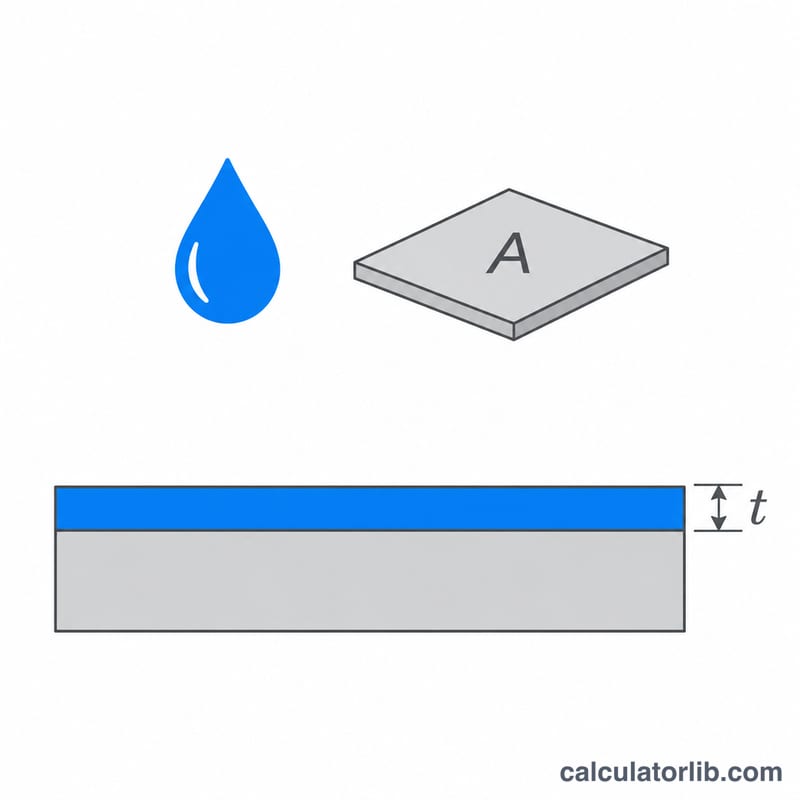
Enter the dry or wet ink film thickness in micrometres, the ink density in g/cm³ (most liquid inks sit between 0.9 and 1.3), and the percentage of the printed area actually covered by ink. Then add your job area in m², a waste allowance for make-ready and cleaning, and the ink price per kg. The tool returns the yield, the laydown in g/m², the ink quantity for the job and the estimated cost.
The formula explained
A film of 1 µm over 1 m² has a volume of 1 cm³, so the mass of ink per square metre at full coverage is simply thickness times density in g/m². Scaling by coverage and converting grams to kilograms gives the yield:
$$Y = \frac{1000}{t \times \rho \times c}$$Here \(t\) = film thickness (µm), \(\rho\) = density (g/cm³), \(c\) = coverage fraction and \(Y\) = yield in m²/kg. The ink for a job is then:
$$M = \frac{A}{Y} \times (1 + w)$$where \(A\) = print area in m² and \(w\) = waste fraction.
Worked example
A job uses a 1.5 µm film of ink with density 1.2 g/cm³ at 100% coverage over 500 m², with no waste and ink at 20 per kg.
$$\text{laydown} = 1.5 \times 1.2 \times 1 = 1.8\,\text{g/m}^2$$$$Y = \frac{1000}{1.8} = 555.56\,\text{m}^2/\text{kg}$$$$M = \frac{500}{555.56} = 0.9\,\text{kg}$$The ink cost is 0.9 × 20 = 18.
Typical Ink Film Thickness and Density by Printing Process
The yield formula \(Y = \dfrac{1000}{t \times \rho \times c/100}\) needs a film thickness \(t\) (µm), an ink density \(\rho\) (g/cm³) and a coverage \(c\) (%). The table gives indicative starting ranges for each process. Real values vary with the ink supplier, the anilox or cell volume, the screen mesh, the substrate and the ink chemistry (water-based, solvent-based, UV or oil-based). Always check the ink's technical data sheet and use the supplier's figures where you have them.
| Printing process | Typical film thickness (µm) | Typical ink density (g/cm³) |
|---|---|---|
| Flexo | about 1 – 3 (dry) | about 0.9 – 1.2 |
| Gravure | about 0.5 – 3 (dry) | about 0.9 – 1.2 |
| Screen | about 3 – 25 (varies widely with mesh and ink type) | about 1.0 – 1.3 |
| Offset (litho) | about 0.5 – 2 | about 0.95 – 1.2 (metallic inks are higher) |
| Inkjet | about 1 – 5 | about 0.9 – 1.15 |
Check whether a quoted thickness refers to wet or dry film. Dry film is the thickness after solvent or water has evaporated, and it is lower than the wet film. Use the thickness that matches the density and solids content you enter.
Ink Yield Comparison for Different Film Thicknesses and Coverages
The ink laydown in g/m² equals \(G = t \times \rho \times c/100\), because µm × g/cm³ = g/m². Yield is \(Y = 1000/G\) in m²/kg. The ink needed is the job area divided by the yield. All rows below use a fixed job of 1,000 m² with no waste allowance.
| Film (µm) | Density (g/cm³) | Coverage (%) | Laydown (g/m²) | Yield (m²/kg) | Ink for 1,000 m² (kg) |
|---|---|---|---|---|---|
| 1.0 | 1.0 | 100 | 1.00 | 1,000.0 | 1.00 |
| 1.5 | 1.1 | 100 | 1.65 | 606.1 | 1.65 |
| 2.5 | 1.0 | 50 | 1.25 | 800.0 | 1.25 |
| 2.5 | 1.2 | 100 | 3.00 | 333.3 | 3.00 |
| 4.0 | 1.2 | 50 | 2.40 | 416.7 | 2.40 |
Worked example (row 3): \(G = 2.5 \times 1.0 \times \dfrac{50}{100} = 1.25\) g/m², so \(Y = \dfrac{1000}{1.25} = 800\) m²/kg. For 1,000 m², \(\dfrac{1000}{800} = 1.25\) kg of ink.
Doubling the film thickness, density or coverage doubles the ink consumption and halves the yield.
Practical Tips for Ordering Ink
- Add a waste allowance. Make-ready, press stabilisation, ink left in the ink train, pumps and hoses, and cleaning all use ink that never reaches the product. Many printers add roughly 5–15% for this. Short runs and frequent colour changes sit at the high end, and long single-colour runs at the low end. Use your own press records where you have them.
- Round up to container sizes. Inks are sold in fixed pack sizes such as pails or drums. Round the calculated quantity up to the next practical container, or to a combination of sizes, so you don't run short mid-job.
- Keep a small margin for colour matching and reruns. Spot colours often need adjustment, and a reprint may be required. A small reserve of the same batch avoids batch-to-batch colour differences. Check the shelf life and storage conditions on the data sheet.
- Verify yield with a test run. Print a measured area on the actual press, anilox or cylinder, and substrate. Weigh the ink used (or the ink returned), then compare it with the calculated yield. Adjust the film thickness input to match, and use that figure for future jobs.
- Account for viscosity and dilution. If you thin the ink with solvent or water, the density and solids content change. Calculate the quantity of ink as supplied, and the additive separately.
- Estimate cost last. Multiply the final order quantity, including waste and margin, by the price per kg. Check the price basis (per kg or per litre) so units match.
This is general information to help with planning. Actual consumption depends on your equipment, materials and ink supplier's specifications.
FAQ
Should I use wet or dry film thickness?
Use the thickness that matches the ink density you enter. For a liquid ink, use wet film with wet density. For solids-only calculations, use dry film and the density of the dry film.
Why is real-world yield lower than the calculated value?
Substrate absorbency, anilox or screen cell transfer, ink left in the press and cleaning all increase consumption. Use the waste allowance to account for them.
Does coverage change the yield?
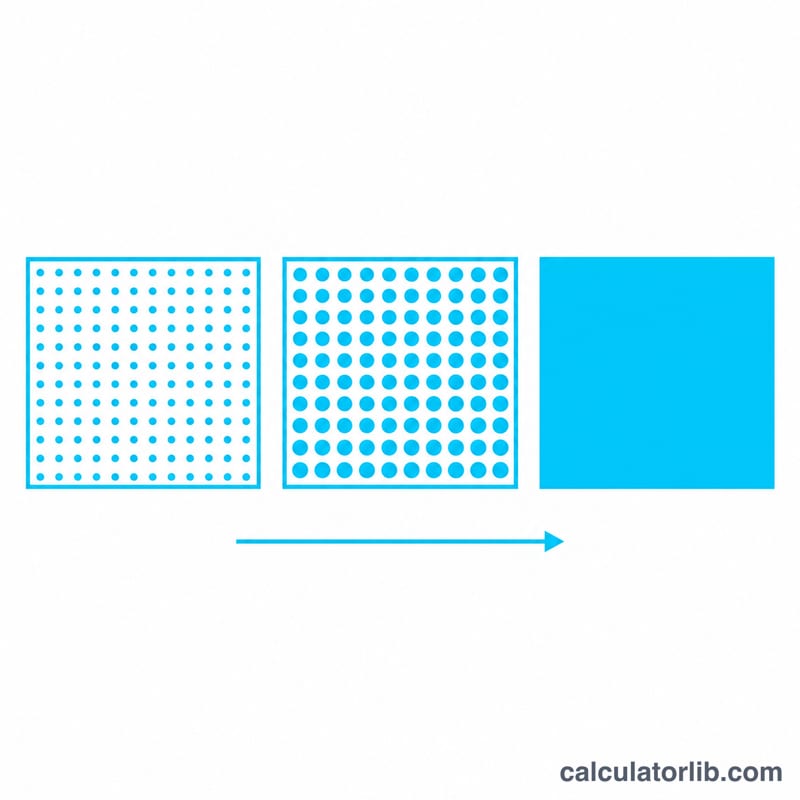
Yes. Halving the coverage halves the ink laid down per square metre of sheet, so the yield doubles.