

What Is the Raise After Tax Calculator?
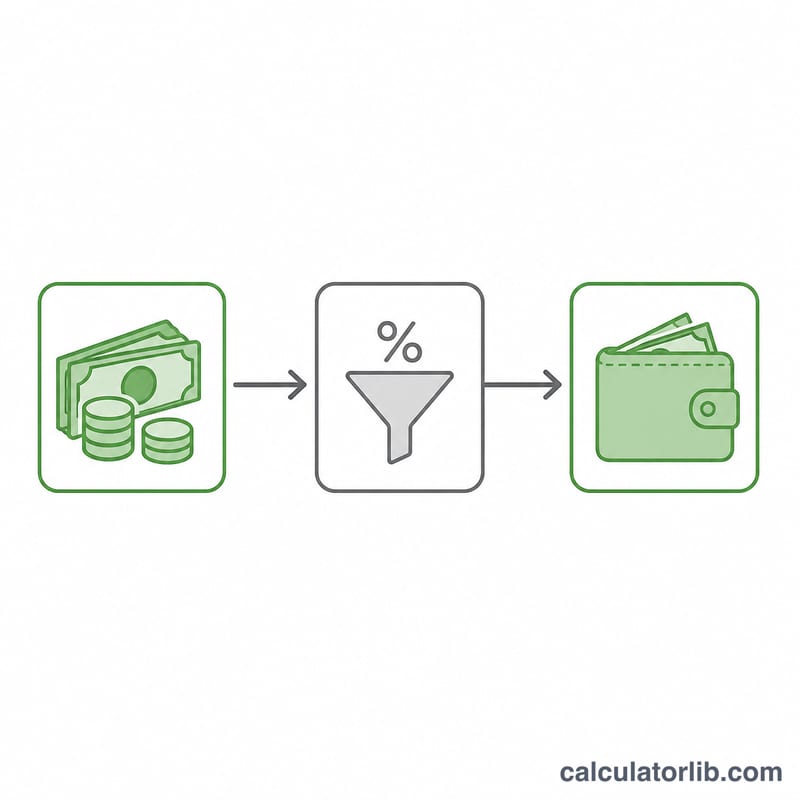
A pay raise rarely lands in your bank account in full. Because additional income is usually taxed at your marginal tax rate — the rate that applies to your next dollar earned — the real increase in your take-home pay is smaller than the headline number. This calculator estimates how much of a raise you actually keep after tax.
How to Use It
Enter the annual gross amount of your raise and your marginal tax rate (the combined percentage that applies to your top band of income — including federal, state, and other payroll taxes if you want a fuller picture). The calculator shows your net (after-tax) annual raise, how much is lost to tax, and the equivalent monthly increase.
The Formula Explained
The math is simple. If your raise is R and your marginal rate is r (as a decimal), then your net raise is \(R \times (1 - r)\). The tax taken is \(R \times r\). For example, a 25% rate means you keep 75 cents of every raised dollar.
$$\text{Net Raise} = \text{Raise (\$)} \times \left(1 - \frac{\text{Tax Rate (\%)}}{100}\right)$$
Worked Example
Suppose you receive a $5,000 annual raise and your marginal tax rate is 25%. Your real after-tax raise is $$\$5{,}000 \times (1 - 0.25) = \$3{,}750$$ per year. Tax claims $1,250, and your monthly take-home rises by about $312.50.
FAQ
What is a marginal tax rate? It is the tax rate applied to your highest dollars of income — the rate your raise is taxed at, not your average rate across all income.
Should I include payroll taxes? For a more accurate take-home figure, add Social Security, Medicare, and any state/local rates to your marginal rate.
Why is my real raise smaller than I expected? A raise often pushes part of your income into a higher bracket, so a large chunk goes to tax. This tool helps you set realistic expectations.