What Is Retail Markup?
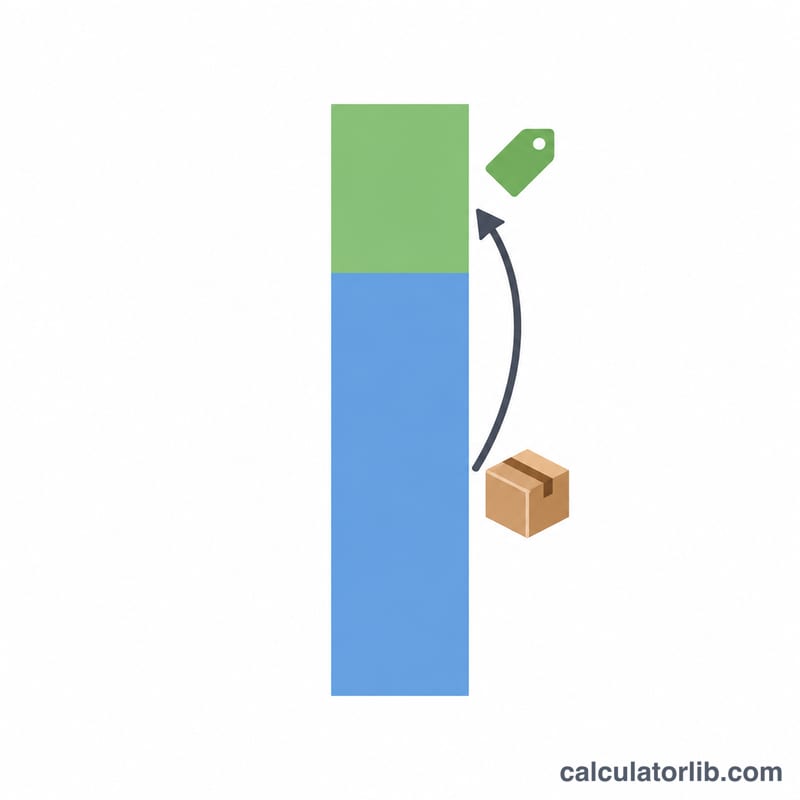
Retail markup is the amount added to an item's cost to set its selling price, expressed as a percentage of the cost. It tells a retailer how much more a product sells for compared with what it was bought for, making it a quick gauge of pricing strategy and profitability. Unlike margin, which is measured against the selling price, markup is always measured against the cost.
The Formula
With \(P\) = selling price and \(C\) = item cost, the markup percentage is:
$$\text{Markup} = \frac{P - C}{C} \times 100\%$$The gross profit on the item is simply the difference between price and cost:
$$\text{Profit} = P - C$$How to Use the Calculator
Enter the item cost (what you paid your supplier) and the selling price (what the customer pays). The calculator returns the markup percentage and the gross profit per unit. Use it to test price points, compare suppliers, or confirm that a planned discount still leaves a healthy markup.
Worked Example
Suppose an item costs $50 and sells for $75. The gross profit is \(75 - 50 = 25\), and the markup is:
$$\text{Markup} = \frac{75 - 50}{50} \times 100\% = \frac{25}{50} \times 100\% = 50\%$$So the product carries a 50% markup and earns $25 of gross profit per unit sold.
Markup to Margin Conversion Table
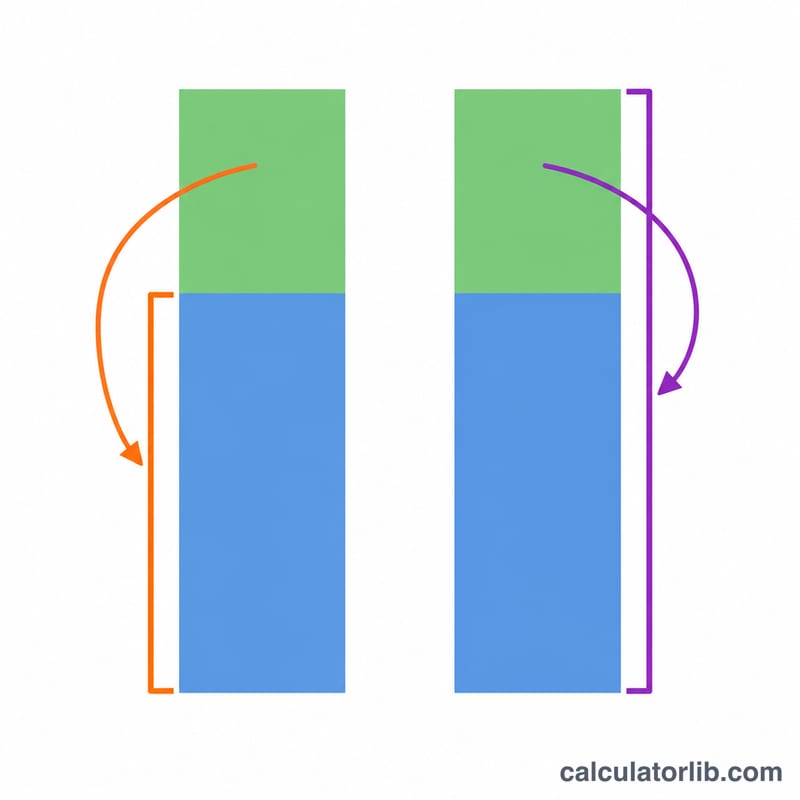
Markup and gross margin both describe the gap between cost and selling price, but they use different bases. Markup divides gross profit by the item cost. Gross margin divides the same profit by the selling price. Because the selling price is always higher than the cost when you make a profit, the margin is always lower than the markup on the same item. The table uses a $100 item cost so you can see the matching selling price and gross profit for each row.
| Markup on cost | Gross margin on price | Selling price (cost $100) | Gross profit |
|---|---|---|---|
| 10% | 9.09% | $110.00 | $10.00 |
| 20% | 16.67% | $120.00 | $20.00 |
| 25% | 20.00% | $125.00 | $25.00 |
| 33.3% (⅓) | 25.00% | $133.33 | $33.33 |
| 50% | 33.33% | $150.00 | $50.00 |
| 75% | 42.86% | $175.00 | $75.00 |
| 100% | 50.00% | $200.00 | $100.00 |
| 150% | 60.00% | $250.00 | $150.00 |
| 200% | 66.67% | $300.00 | $200.00 |
| 300% | 75.00% | $400.00 | $300.00 |
To convert in either direction, write the percentages as decimals. Let \(M\) be the markup and \(G\) the gross margin:
$$\text{Margin} = \frac{M}{1 + M} \qquad\qquad \text{Markup} = \frac{G}{1 - G}$$Markup to margin: a 25% markup gives \(0.25 \div (1 + 0.25) = 0.25 \div 1.25 = 0.20\), which is a 20% margin. A 200% markup gives \(2 \div 3 = 0.6667\), which is a 66.7% margin.
Margin to markup: to reach a 40% gross margin, you need a markup of \(0.40 \div (1 - 0.40) = 0.40 \div 0.60 = 0.6667\), which is about 66.7% on cost. For an item that costs $60, the price is \(\$60 \times 1.6667 = \$100\). Gross profit is $40, which is 40% of the $100 price.
A 100% markup is often called "keystone" pricing. It doubles the cost and always gives a 50% margin. Markup has no upper limit, but margin can never reach 100%. This is why high markups such as 300% add less and less margin.
FAQ
Is markup the same as margin? No. Markup is profit divided by cost, while margin is profit divided by the selling price. For the same item, the markup percentage is always larger than the margin percentage.
Can markup exceed 100%? Yes. Whenever the selling price is more than double the cost, the markup is above 100%. For example, a $20 item sold for $60 has a 200% markup.
What is a good markup? It varies by industry, but many retailers aim for 50% to 100%, balancing competitiveness against overhead and desired profit.