What Is the Reverse BMI Calculator?
A standard BMI calculator tells you your Body Mass Index from your weight and height. This Reverse BMI Calculator flips that around: you choose a target BMI and enter your height, and it tells you the exact body weight that would produce that BMI. It's a practical way to translate an abstract health number into a concrete weight goal you can actually aim for. The calculation uses the metric BMI system used worldwide by the World Health Organization.
How to Use It
There are just two inputs:
- Height (cm): Your height in centimetres — for example, 175.
- BMI: The Body Mass Index you want to target — for example, 22 for a mid-range healthy weight.
The calculator returns your target weight in kilograms and also classifies the BMI you entered into a standard health category, so you immediately know what range you're aiming at.
The Formula Explained
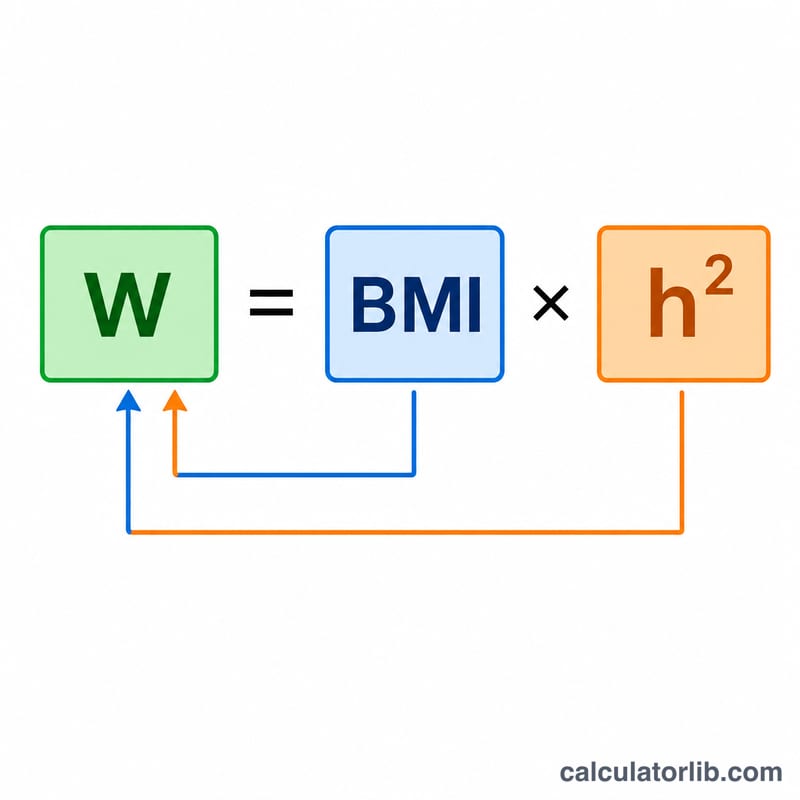
The tool rearranges the classic BMI equation. Normally BMI = weight ÷ height², with height in metres. To find weight instead, it multiplies the BMI by the square of your height:
$$\text{Weight (kg)} = \text{BMI} \times \left(\frac{\text{Height}}{100}\right)^{2}$$Internally it computes \(\frac{\text{BMI} \times \text{Height} \times \text{Height}}{10000}\) — the division by 10,000 converts your height from centimetres to metres squared, since \(100^{2} = 10000\). The result is the same as squaring metres.
Worked Example
Suppose you are 175 cm tall and want a BMI of 22:
- Height in metres: \(175 \div 100 = 1.75\)
- \(1.75^{2} = 3.0625\)
- Weight = \(22 \times 3.0625 = \mathbf{67.4 \text{ kg}}\)
A BMI of 22 falls in the "Normal weight" range, so 67.4 kg would be a healthy target weight for that height.
BMI Categories Used
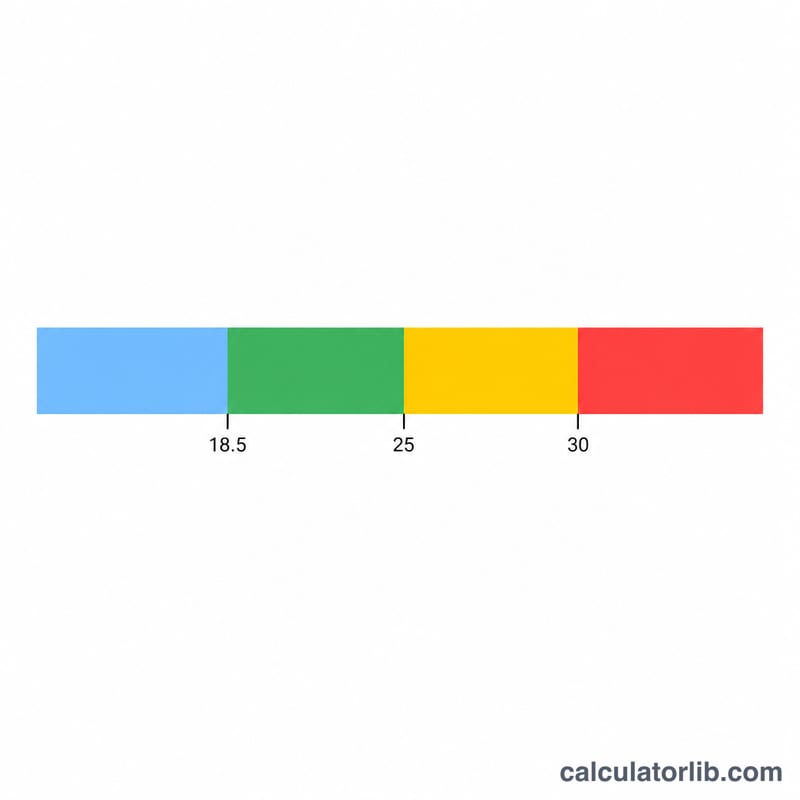
- Underweight: BMI below 18.5
- Normal weight: BMI 18.5 to under 25
- Overweight: BMI 25 to under 30
- Obese: BMI 30 and above
Healthy Weight Range by Height
The table below shows the body weight that matches four BMI values for adult heights from 150 cm to 195 cm. Each value uses the reverse BMI formula, rounded to the nearest 0.1 kg:
$$\text{Weight (kg)} = \text{BMI} \times \left(\frac{\text{Height (cm)}}{100}\right)^{2}$$The columns match the World Health Organization (WHO) adult BMI category boundaries. Below 18.5 is underweight, 18.5 to 24.9 is normal weight, 25.0 to 29.9 is overweight and 30.0 or above is obese. BMI 22 is near the middle of the normal range.
| Height (cm) | Height² (m²) | BMI 18.5 (kg) Start of the normal range |
BMI 22 (kg) Middle of the normal range |
BMI 25 (kg) Start of overweight |
BMI 30 (kg) Start of obesity |
|---|---|---|---|---|---|
| 150 | 2.2500 | 41.6 | 49.5 | 56.3 | 67.5 |
| 155 | 2.4025 | 44.4 | 52.9 | 60.1 | 72.1 |
| 160 | 2.5600 | 47.4 | 56.3 | 64.0 | 76.8 |
| 165 | 2.7225 | 50.4 | 59.9 | 68.1 | 81.7 |
| 170 | 2.8900 | 53.5 | 63.6 | 72.3 | 86.7 |
| 175 | 3.0625 | 56.7 | 67.4 | 76.6 | 91.9 |
| 180 | 3.2400 | 59.9 | 71.3 | 81.0 | 97.2 |
| 185 | 3.4225 | 63.3 | 75.3 | 85.6 | 102.7 |
| 190 | 3.6100 | 66.8 | 79.4 | 90.3 | 108.3 |
| 195 | 3.8025 | 70.3 | 83.7 | 95.1 | 114.1 |
For example, at 175 cm: \(22 \times 1.75^{2} = 22 \times 3.0625 = 67.375\), which rounds to 67.4 kg. At any height, the WHO normal-weight band runs from the BMI 18.5 column up to just below the BMI 25 column.
More Worked Examples
Each example follows the same steps: convert height to metres, square it, then multiply by the target BMI. Categories use the WHO adult thresholds: below 18.5 is underweight, 18.5–24.9 is normal, 25.0–29.9 is overweight and 30.0 or above is obese.
Example 1: 160 cm at BMI 18.5
- Convert height to metres: \(160 \div 100 = 1.60\) m.
- Square it: \(1.60^{2} = 2.56\) m².
- Multiply by the BMI: \(2.56 \times 18.5 = 47.36\) kg.
- Round: 47.4 kg.
Category: a BMI of 18.5 is the lower limit of the WHO normal range. At 160 cm, any weight below about 47.4 kg gives a BMI under 18.5, which is classed as underweight.
Example 2: 185 cm at BMI 24.9
- Convert height to metres: \(185 \div 100 = 1.85\) m.
- Square it: \(1.85^{2} = 3.4225\) m².
- Multiply by the BMI: \(3.4225 \times 24.9 = 85.22025\) kg.
- Round: 85.2 kg.
Category: a BMI of 24.9 is the upper limit of the WHO normal range. Together with the BMI 18.5 value (63.3 kg), this gives a normal-weight band of about 63.3–85.2 kg at 185 cm.
Example 3: 5 ft 7 in at BMI 22 (converting from imperial units)
- Convert to inches: \(5 \times 12 + 7 = 67\) in.
- Convert to centimetres: \(67 \times 2.54 = 170.18\) cm.
- Convert to metres and square: \(1.7018^{2} = 2.89612324\) m².
- Multiply by the BMI: \(2.89612324 \times 22 = 63.7147\) kg.
- Round: 63.7 kg (about 140.5 lb, using \(63.7 \times 2.20462 \approx 140.4\)–\(140.5\) lb).
Category: a BMI of 22 is within the WHO normal range (18.5–24.9).
Interpreting Your Target Weight
The calculator gives the body weight that would produce the BMI you entered at your height. That's all it does. It doesn't measure body fat, muscle, fitness or health, and it doesn't tell you what weight is right for you. BMI is a screening measure for populations. It uses only height and weight, so it can't tell fat from muscle, bone or water, and it doesn't show where fat is stored.
A range, not a single number
The WHO normal-weight category runs from BMI 18.5 up to just below 25, about 6.5 BMI units wide. That means a wide range of weights counts as normal at any height. At 175 cm, for example, the range runs from about 56.7 kg (BMI 18.5) to about 76.6 kg (BMI 25), a gap of roughly 20 kg. A target BMI such as 22 is one point inside that band. It isn't an "ideal" value set by any standard.
Different cut-offs for some populations
A WHO expert consultation on BMI in Asian populations (published in 2004) found that many Asian populations have higher health risks at lower BMI values. It suggested extra public-health action points of 23 for increased risk (often used as the overweight cut-off) and 27.5 for high risk (often used as the obesity cut-off). Some countries use these lower thresholds in their national guidance. If you use them, the matching weights at each height will be lower than in the table above.
Groups the adult cut-offs don't fit
- Children and teenagers: the adult categories (18.5, 25, 30) don't apply. Young people are assessed with BMI-for-age percentiles, which depend on age and sex and come from growth references such as the WHO growth standards or national charts.
- Muscular people: athletes and people with a lot of muscle can have a BMI in the overweight or obese range without excess body fat.
- Older adults: muscle and height tend to decrease with age, so BMI may underestimate body fat. Studies on the BMI ranges linked to the lowest risk in older age don't all agree.
- Pregnant people: BMI during pregnancy doesn't reflect body fat. Pregnancy weight gain is usually judged against BMI from before pregnancy.
This is general information, not medical advice. If you want to set a personal weight goal, especially if you have a health condition, are pregnant, or are setting goals for a child, a qualified health professional can take into account things BMI leaves out.
Frequently Asked Questions
What is the formula for calculating weight from BMI?
Rearrange the standard BMI equation. Since BMI equals weight in kilograms divided by height in metres squared, target weight equals BMI multiplied by height (in metres) squared. For example, a BMI of 22 at 1.75 m gives 22 × 1.75 × 1.75 = 67.4 kg.
Can I calculate my height from BMI and weight instead?
Yes. Rearranging the formula, height in metres equals the square root of weight divided by BMI. For instance, 70 kg at a BMI of 23 gives the square root of 70 ÷ 23, which is about 1.745 m, or roughly 175 cm.
What BMI should I target?
For most adults, a BMI between 18.5 and 24.9 is considered healthy. Many people aim for the middle of that band, around 21 to 23, to leave room for normal day-to-day weight fluctuations. The right target depends on your age, build and personal health goals.
Can I enter my height in feet and inches?
No, this calculator requires height in centimetres. Convert first: multiply total inches by 2.54, or feet by 30.48. For example, 5 feet 9 inches is 69 inches × 2.54 = 175.3 cm. Enter that figure to get your target weight.
Is BMI accurate for everyone?
BMI is a useful general guide but doesn't distinguish muscle from fat or account for bone density and fat distribution. Athletes and very muscular people may show a high BMI while being healthy, so treat the target weight as a guideline rather than a strict rule.
What are the standard BMI categories?
The widely used categories are: underweight below 18.5, healthy weight 18.5 to 24.9, overweight 25 to 29.9, and obese 30 or above. This calculator uses these standard adult ranges, so you can pick a target BMI that places you within a healthy band.