What Is Rounding to the Nearest Tenth?
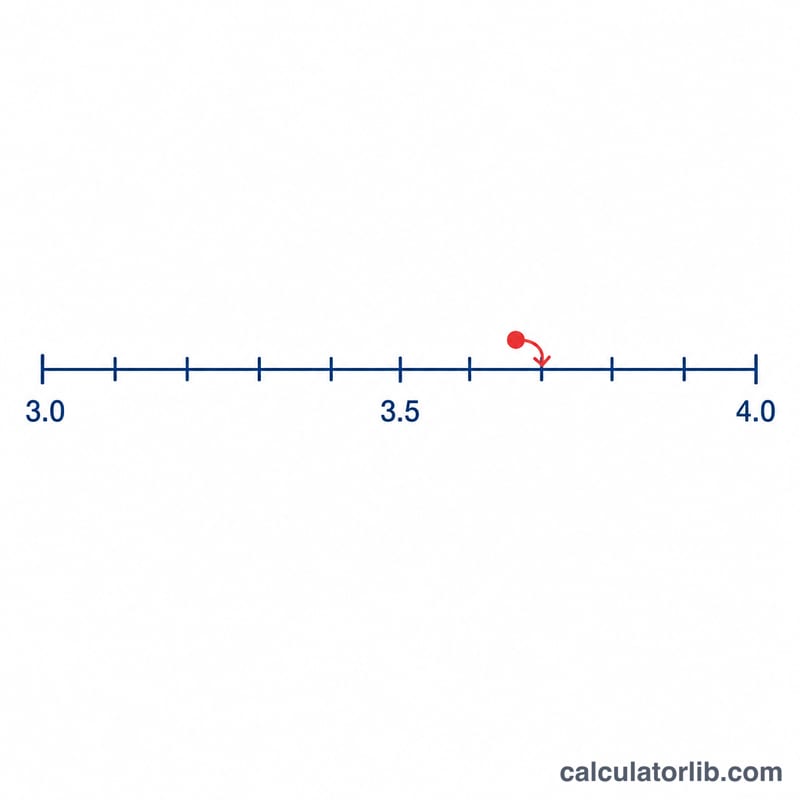
The tenths place is the first digit to the right of the decimal point. Rounding a number to the nearest tenth means expressing it with just one decimal digit, keeping the value as close as possible to the original. This calculator does it instantly for any number you enter.
How to Use It
Type any number — positive or negative, with as many decimals as you like — into the input box and submit. The calculator returns the value rounded to one decimal place along with your original number for reference.
The Formula Explained
The standard method is \( \text{Rounded} = \dfrac{\left\lfloor \text{Number} \times 10 + 0.5 \right\rfloor}{10} \). Multiplying by 10 shifts the tenths digit into the ones place; rounding to the nearest whole number applies the round-half-up rule; dividing by 10 shifts it back. Look at the hundredths digit (the second decimal): if it is 5 or more, round the tenths digit up; if it is 4 or less, leave it unchanged.
$$\text{Rounded} = \frac{\left\lfloor \text{Number} \times 10 + 0.5 \right\rfloor}{10}$$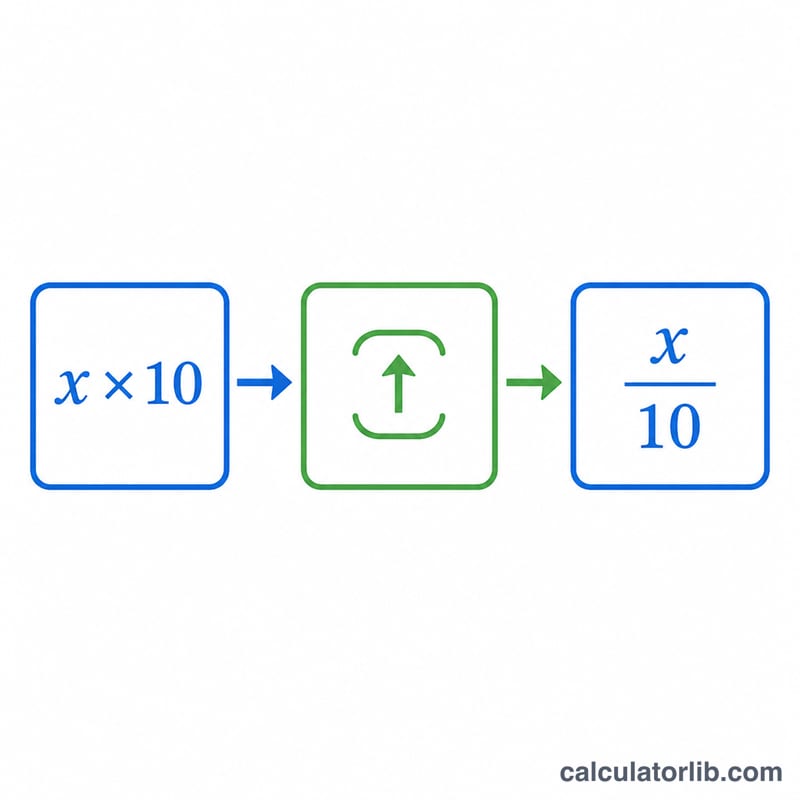
Worked Example
Round 3.14159 to the nearest tenth. The hundredths digit is 4, which is less than 5, so the tenths digit stays the same: the result is 3.1. Using the formula:
$$\text{round}(3.14159 \times 10) = \text{round}(31.4159) = 31, \quad \frac{31}{10} = 3.1$$Rounding Examples Across Different Inputs
The table shows how the calculator rounds a range of inputs using the round-half-up formula \(\lfloor x \times 10 + 0.5 \rfloor / 10\). Only the hundredths digit decides whether the tenths digit stays or goes up by 1.
| Input | Hundredths digit | Rounded to tenth |
|---|---|---|
| 3.14159 | 4 | 3.1 |
| 2.45 | 5 | 2.5 |
| 7.96 | 6 | 8.0 (carry into the ones place) |
| 0.049 | 4 | 0.0 |
| -2.36 | 6 | -2.4 |
| 12.05 | 5 | 12.1 |
| 7 | 0 (no decimals) | 7.0 |
| 0.95 | 5 | 1.0 (carry into the ones place) |
Carry-over cases: when the tenths digit is 9 and the hundredths digit is 5 or more, rounding up pushes the tenths digit past 9. It resets to 0 and adds 1 to the ones place. That is why 7.96 becomes 8.0 and 0.95 becomes 1.0. Note that the ones digit changes even though you are rounding at the tenths place.
Whole numbers such as 7 are already exact to the tenth, so the result is written as 7.0. Very small values such as 0.049 round to 0.0 because the hundredths digit is below 5.
How to Round to the Nearest Tenth by Hand
- Identify the tenths digit. This is the first digit after the decimal point. In 4.87 it is 8.
- Look at the hundredths digit immediately to its right. In 4.87 it is 7.
- Decide whether to round up. If the hundredths digit is 5 or more, increase the tenths digit by 1. If the tenths digit is 9, it becomes 0 and 1 is carried into the ones place. If the hundredths digit is 4 or less, leave the tenths digit unchanged.
- Drop all digits after the tenths place. Everything from the hundredths digit onward is discarded.
- Write exactly one decimal digit. A whole number such as 7 is written as 7.0.
Worked example: for 4.87 the hundredths digit is 7, which is 5 or more, so the tenths digit 8 becomes 9. Formula check: \(\lfloor 4.87 \times 10 + 0.5 \rfloor / 10 = \lfloor 49.2 \rfloor / 10 = 49/10 = \)4.9.
Negative numbers and exact ties: the round-half-up formula \(\lfloor x \times 10 + 0.5 \rfloor / 10\) always rounds an exact tie toward positive infinity. For positive numbers this is the same as rounding away from zero. For negatives it is not. For -2.45: \(\lfloor -24.5 + 0.5 \rfloor / 10 = \lfloor -24 \rfloor / 10 = -2.4\). A round-half-away-from-zero convention would give -2.5 instead. For negative values that are not exact ties, such as -2.36, both methods agree (-2.4). If your course or software uses the away-from-zero rule, check negative ties by hand.
Conventions and edge cases
Each case below was run through this calculator; the result column is what it actually returns.
| Case | Input | Result | Note |
|---|---|---|---|
| Exactly half-way: 0.25 | 0.25 | 0.3 | |
| Exactly half-way: −0.25 | -0.25 | -0.2 | Halves round up, toward +∞. |
Checked on 2026-11-08
FAQ
What happens with exactly .x5? The hundredths digit of 5 rounds up, so \(2.45\) becomes \(2.5\).
How are negative numbers handled? Standard rounding applies; for example \(-2.36\) rounds to \(-2.4\).
What if my number has no decimals? A whole number like \(7\) stays \(7.0\) — it is already exact at the tenths place.