What Is the Solar Panel Tilt Angle Calculator?
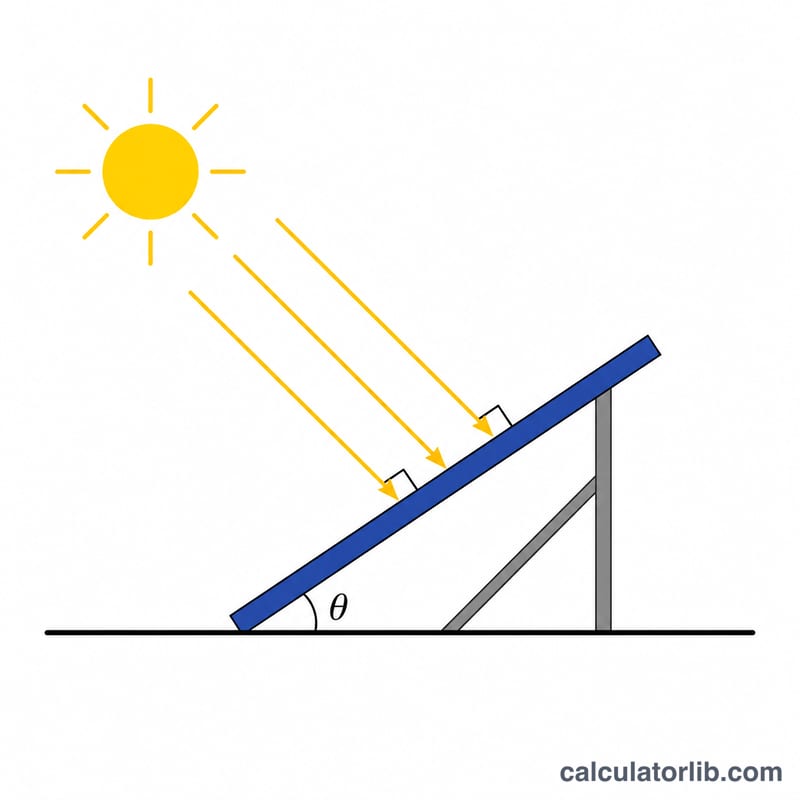
The tilt angle is the vertical angle between your solar panels and the horizontal ground. Getting it right is one of the cheapest ways to squeeze more energy out of a photovoltaic system. This calculator uses your location's latitude to estimate the optimal fixed tilt for year-round output, plus recommended seasonal adjustments for summer and winter.
How to Use It
Enter the absolute value of your latitude (between 0° and 90°). You can look it up by searching your city on any map service. The calculator returns three angles: a year-round angle equal to your latitude, a summer angle (latitude minus 15°), and a winter angle (latitude plus 15°). All angles are measured from the horizontal — 0° is flat, 90° is vertical.
The Formula Explained
The sun's average height in the sky over a year is closely tied to your latitude, so a fixed panel tilted to match your latitude captures sunlight near-perpendicularly on average. In summer the sun rides higher, so reducing the tilt by about 15° points panels more skyward. In winter the sun sits low, so adding about 15° aims them lower toward the horizon. The result is clamped to the valid 0°–90° range.
$$\begin{gathered} \theta_{\text{annual}} = \left|\,\text{Latitude}\,\right| \\[1.5em] \text{where}\quad \left\{ \begin{aligned} \theta_{\text{summer}} &= \left|\,\text{Latitude}\,\right| - 15^{\circ} \\ \theta_{\text{winter}} &= \left|\,\text{Latitude}\,\right| + 15^{\circ} \end{aligned} \right. \end{gathered}$$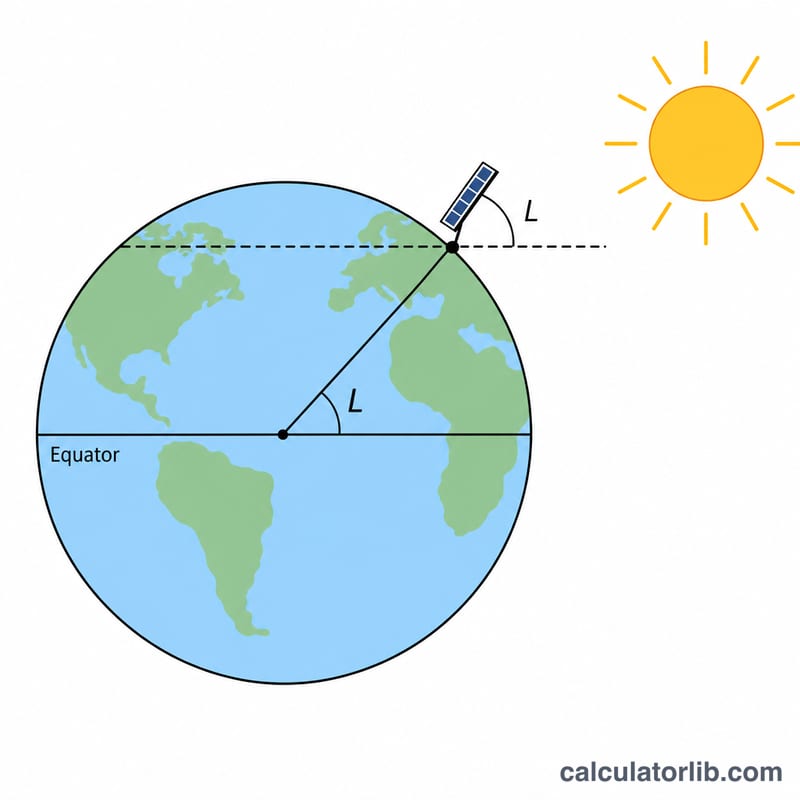
Worked Example
For a site at latitude 40°: the year-round tilt is 40°, the summer tilt is \(40 - 15 = 25^{\circ}\), and the winter tilt is \(40 + 15 = 55^{\circ}\). A two-season adjustment between 25° and 55° can boost annual output by a few percent compared with a single fixed angle.
Tilt Angles for Different Latitudes
The calculator uses the common rule of thumb: the year-round tilt equals the absolute latitude, the summer tilt is latitude − 15°, and the winter tilt is latitude + 15°. Because tilt is measured from horizontal, results are limited to the 0°–90° range. The same numbers apply in both hemispheres. Use the absolute value of the latitude (for example 35° S is treated as 35).
| Latitude | Example location (approx.) | Year-round tilt | Summer tilt | Winter tilt |
|---|---|---|---|---|
| 0° | Equator | 0° | 0° (−15° clamped) | 15° |
| 15° | — | 15° | 0° | 30° |
| 25° | Miami, USA (about 26° N) | 25° | 10° | 40° |
| 35° | Albuquerque, USA (about 35° N) | 35° | 20° | 50° |
| 40° | Madrid, Spain (about 40° N) | 40° | 25° | 55° |
| 50° | Frankfurt, Germany (about 50° N) | 50° | 35° | 65° |
| 60° | Oslo, Norway (about 60° N) | 60° | 45° | 75° |
| 80° | Arctic regions | 80° | 65° | 90° (95° clamped) |
Where the clamp applies: Near the equator (latitudes below 15°), latitude − 15° would be negative, so the summer tilt is set to 0° (flat). At latitudes above 75°, latitude + 15° would exceed 90°, so the winter tilt is capped at 90° (vertical). City latitudes are rounded and given only to illustrate the table.
Practical Installation Tips
- Face the right way: In the Northern Hemisphere, point panels toward true south. In the Southern Hemisphere, point them toward true north. Use true direction, not magnetic. Magnetic declination can shift a compass reading by several degrees or more, depending on location, so correct for it or use a map or app that shows true bearing.
- Fixed tilt vs. seasonal adjustment: A fixed tilt at the year-round angle is simplest, cheapest and needs no maintenance. Adjusting twice a year (summer and winter angles) can capture somewhat more energy, but it requires adjustable mounts, access to the array and some effort. Many owners find the extra gain is not worth the hassle. The benefit varies by site and climate.
- Minimum tilt for self-cleaning: Try to keep at least roughly 10° so rain can wash off dust and debris. Nearly flat panels tend to collect dirt and standing water.
- Snowy regions: Steeper angles help snow slide off. In heavy-snow areas, a winter-oriented tilt (higher than the year-round value) is often sensible, since winter production matters and snow cover blocks output.
- Roof pitch constraints: For roof-mounted systems, the roof pitch and direction often set the angle. Panels mounted flush to a roof that is somewhat off the ideal tilt or orientation usually lose only a modest share of output compared with the optimum. Tilt-up racks add cost, wind load and structural considerations.
- Row spacing: When installing several rows on flat ground or a flat roof, space them so one row does not shade the next, especially at low winter sun. Steeper tilts need greater spacing. Even partial shading of cells can reduce a string's output disproportionately.
- Check local conditions: Shade from trees and buildings, local weather, wind loads, building codes and utility rules all affect the best design. Verify your plan with a simulation tool such as NREL's PVWatts (which covers many locations) or with a qualified installer. Real-world output depends on many factors, so treat any estimate as approximate rather than guaranteed.
This is general information, not professional engineering or installation advice. The latitude-based rule of thumb is a starting point only.
FAQ
Does hemisphere matter? Use the absolute latitude value for the tilt. Only the panel's facing direction changes — south in the Northern Hemisphere, north in the Southern Hemisphere.
How often should I adjust the tilt? Twice a year (spring and autumn) captures most of the seasonal benefit. Monthly tuning adds only marginal gains.
Is latitude the perfect angle? It's an excellent rule of thumb. Local climate, shading, and snow can shift the ideal by a few degrees, but latitude-based tilt is reliable for most installations.