
What is the decay constant?
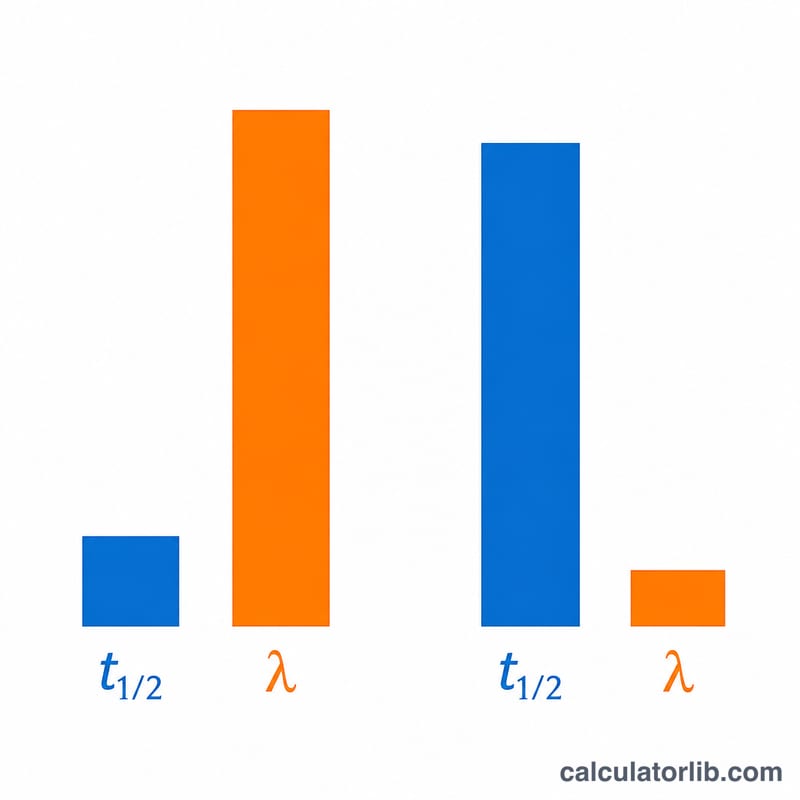
The decay constant (\(\lambda\)) is the probability per unit time that a given radioactive nucleus will decay. It is a fundamental property of each radionuclide and is directly related to the half-life — the time required for half of a sample to decay. A large \(\lambda\) means rapid decay (short half-life); a small \(\lambda\) means slow decay (long half-life). This is a universal physics calculation valid for any radioactive isotope.
How to use this calculator
Enter the half-life (t½) of your radionuclide and pick the matching time unit (seconds, minutes, hours, days or years). The calculator returns the decay constant expressed in your chosen unit, the decay constant converted to per-second (s⁻¹), the mean lifetime τ, and the half-life converted to seconds for reference.
The formula explained
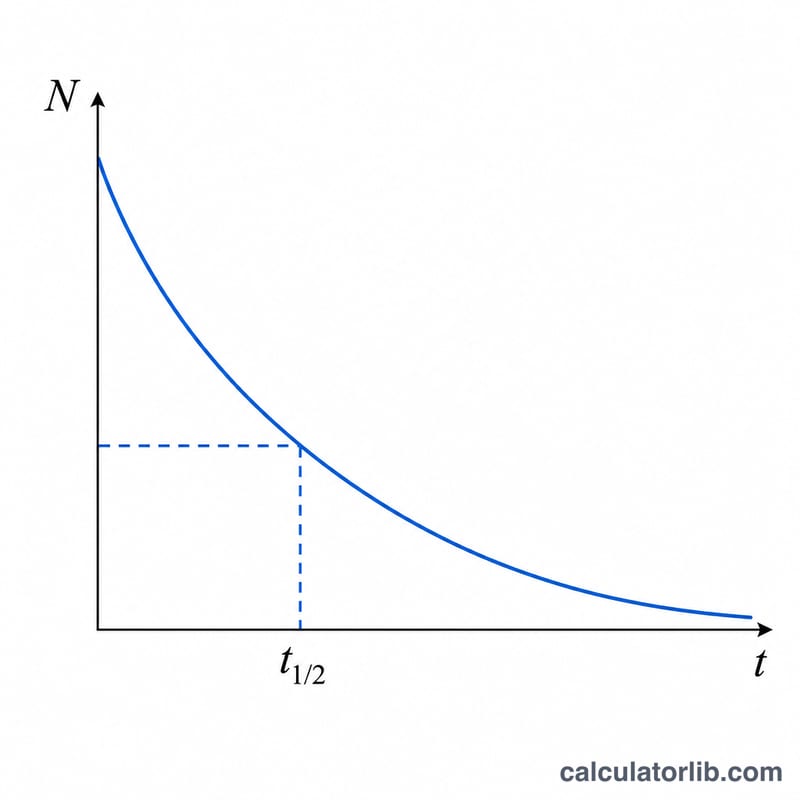
The relationship comes from the exponential decay law \(N(t) = N_0 e^{-\lambda t}\). Setting \(N(t) = N_0/2\) gives \(\tfrac{1}{2} = e^{-\lambda t_{1/2}}\). Taking the natural logarithm of both sides yields \(\ln(\tfrac{1}{2}) = -\lambda t_{1/2}\), so
$$\lambda = \frac{\ln 2}{t_{1/2}}$$where \(\ln(2) \approx 0.693147\). The mean lifetime is simply \(\tau = 1/\lambda = t_{1/2}/\ln(2)\).
Worked example
Iodine-131 has a half-life of about 8.02 days. Then
$$\lambda = \frac{0.693147}{8.02} \approx 0.086428 \text{ per day}$$Converting to seconds: \(8.02 \text{ days} \times 86{,}400 = 692{,}928 \text{ s}\), so
$$\lambda \approx \frac{0.693147}{692{,}928} \approx 1.0003 \times 10^{-6} \text{ s}^{-1}$$The mean lifetime is \(8.02 / 0.693147 \approx 11.57\) days.
FAQ
Is the decay constant the same as the decay rate? No. \(\lambda\) is a fixed per-nucleus probability; the activity (decays per second) is \(A = \lambda N\), which depends on how many atoms \(N\) are present.
Why use ln(2)? Because half-life is defined as the time to reach exactly half the original amount, and solving the exponential decay law for that point introduces the natural log of 2.
Does the unit matter? Yes. \(\lambda\) has units of inverse time, so a half-life in years gives \(\lambda\) per year. We also report \(\lambda\) per second for convenience.