
What is the Mass-Spring Oscillation Period?
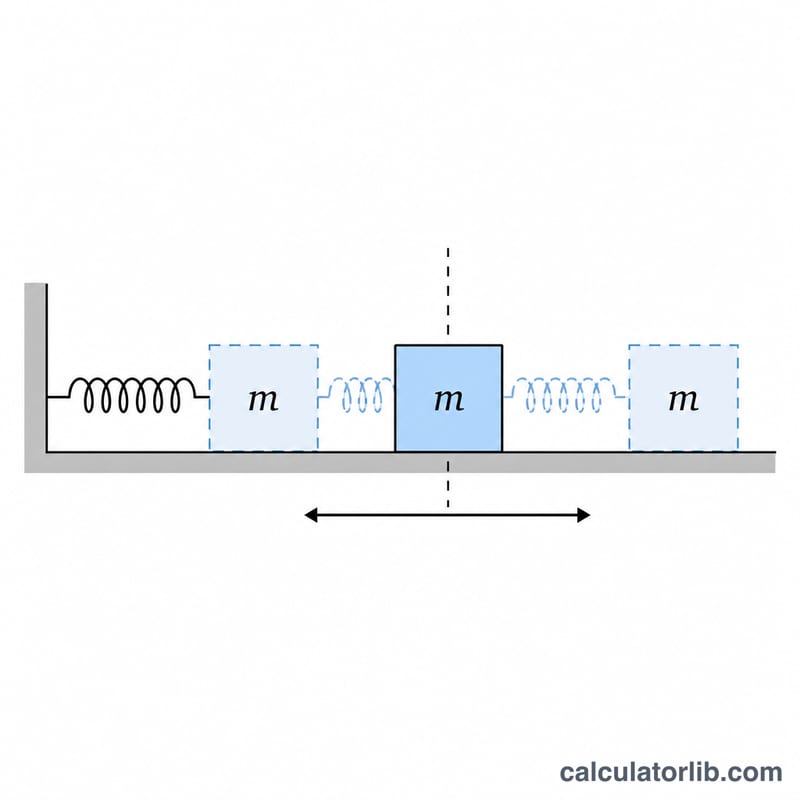
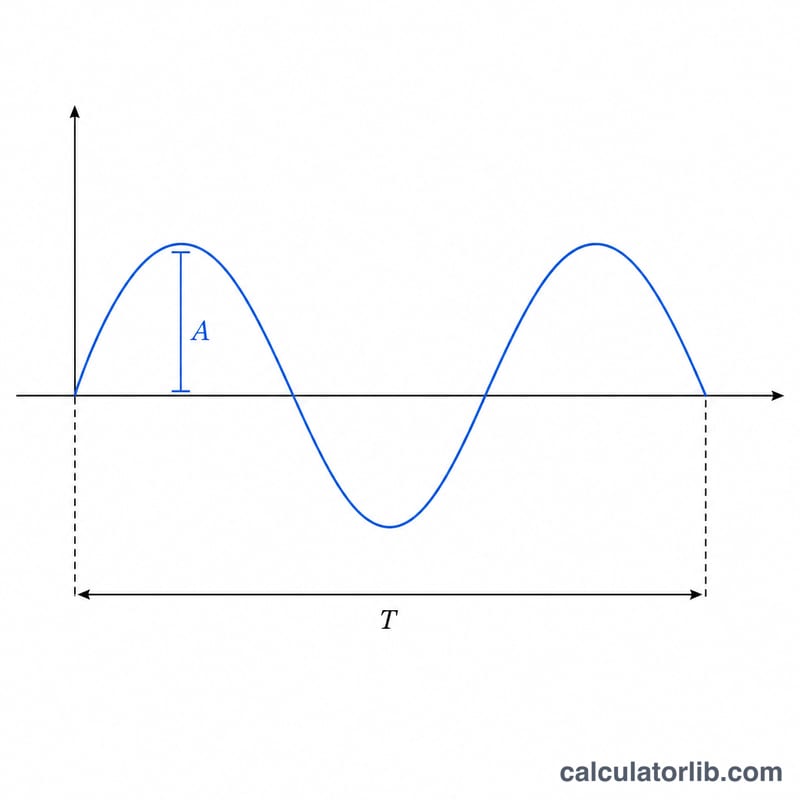
A mass attached to an ideal spring undergoes simple harmonic motion when displaced from equilibrium. The period \(T\) is the time it takes to complete one full back-and-forth cycle. It depends only on the mass \(m\) and the spring's stiffness \(k\) — not on the amplitude of the oscillation. This calculator returns the period, the frequency, and the angular frequency from your two inputs.
How to Use It
Enter the oscillating mass in kilograms and the spring constant in newtons per metre (N/m). The spring constant describes stiffness: a larger \(k\) means a stiffer spring and a faster oscillation. Click calculate to see the period in seconds along with frequency (Hz) and angular frequency (rad/s).
The Formula Explained
The governing equation is $$T = 2\pi \sqrt{\dfrac{m}{k}}$$ A heavier mass increases the period (slower oscillation), while a stiffer spring (larger \(k\)) decreases it. The angular frequency is \(\omega = \sqrt{\dfrac{k}{m}}\), and the ordinary frequency is \(f = \dfrac{1}{T}\). These three quantities are all linked: \(\omega = 2\pi f\).
Worked Example
Suppose \(m = 1\) kg and \(k = 20\) N/m. Then \(m/k = 0.05\), and \(\sqrt{0.05} \approx 0.2236\). Multiply by \(2\pi \approx 6.2832\) to get $$T \approx 1.4050 \text{ s}$$ The frequency is \(f = \dfrac{1}{1.4050} \approx 0.7118\) Hz, and the angular frequency is \(\omega = \sqrt{20} \approx 4.4721\) rad/s.
FAQ
Does amplitude affect the period? No. For an ideal spring obeying Hooke's law, the period is independent of how far you pull the mass.
Does gravity change the period? No. For a vertical spring, gravity only shifts the equilibrium position; the period still follows \(T = 2\pi\sqrt{\dfrac{m}{k}}\).
What units should I use? Use kilograms for mass and N/m for the spring constant to get the period in seconds.