What the Time Zone Converter Does
This Time Zone Converter takes a single moment in time in one location and tells you the exact equivalent clock time in another location anywhere in the world. Instead of doing fragile mental arithmetic across "hours ahead" and "hours behind", you enter a date and time, pick the originating zone, pick the destination zone, and the tool returns the matching instant in the target zone — perfect for booking international calls, webinars, flights and deadlines.
The Inputs You Provide
- Local Time — the date and time you already know, entered in ISO format (for example
2024-06-15T14:30). This is the moment as it reads on the clock in the "From" zone. - From Time Zone — the IANA zone identifier the local time belongs to, such as
America/New_YorkorEurope/London. - To Time Zone — the zone you want the time converted into, such as
Asia/Tokyo.
How the Conversion Works
The calculator parses your local time and "anchors" it to the From zone, creating a precise zoned timestamp. It then keeps the same absolute instant and re-expresses it in the To zone (withZoneSameInstant). In plain terms: the actual moment in the universe does not change — only the clock reading does.
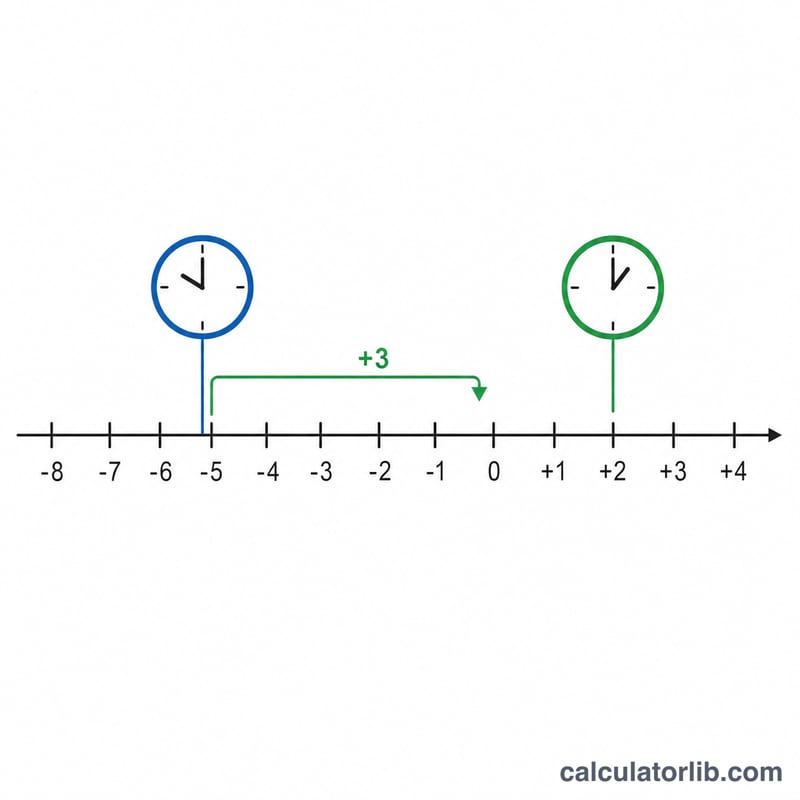
The raw offset difference is also shown. The formula is simply:
- Difference = To zone offset − From zone offset
That difference is reported in hours, minutes and seconds, and each zone is labelled with its GMT offset (e.g. GMT+9:00 Asia/Tokyo).
Worked Example
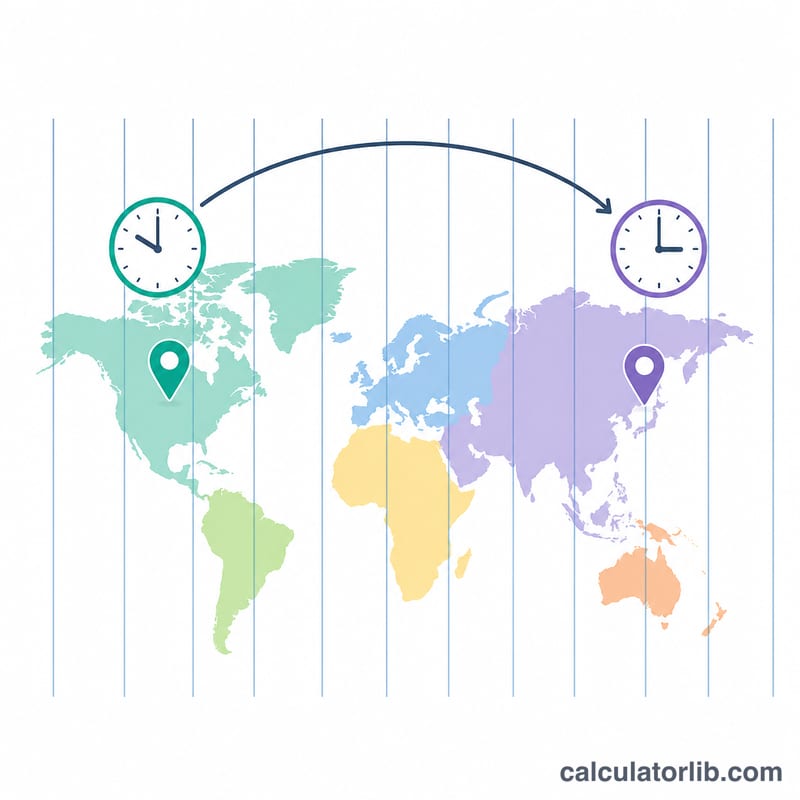
Suppose you enter Local Time = 2024-06-15T14:30, From = America/New_York (GMT−5), and To = Asia/Tokyo (GMT+9). The raw offset difference is +9 − (−5) = 14 hours. So 2:30 PM in New York converts to 4:30 AM the next day (June 16) in Tokyo. The tool displays both zoned timestamps so the date roll-over is unmistakable.
Key Time Zone Terms Defined
- UTC (Coordinated Universal Time)
- The primary global time standard against which all civil time zones are defined. It is not adjusted for Daylight Saving Time and does not itself belong to any country. Every other zone is expressed as a positive or negative offset from UTC.
- GMT (Greenwich Mean Time)
- The mean solar time at the Royal Observatory in Greenwich, London. For everyday purposes GMT is effectively equal to UTC+00:00, though UTC is the modern, more precise atomic-clock-based standard. In common usage the two terms are often interchanged.
- IANA time zone identifier
- A standardized name in the form Area/Location (for example America/New_York or Asia/Kolkata) from the IANA Time Zone Database. Each identifier encodes the full history of offset and DST rules for that region, which is why it is preferred over ambiguous abbreviations like “CST” or “IST.”
- UTC offset
- The fixed difference, written as ±HH:MM (e.g. +05:30, −08:00), between a location's local time and UTC at a given moment. A zone's offset can change through the year when DST is in effect.
- Daylight Saving Time (DST)
- The seasonal practice of advancing clocks (usually by one hour) during warmer months to extend evening daylight. When DST is active, a zone's UTC offset increases by the shift amount; the exact start and end dates vary by country.
- Absolute instant
- A single, unambiguous point on the global timeline—the same moment for everyone on Earth—independent of any time zone. It can be expressed as a UTC timestamp or as an epoch value (seconds since 1970-01-01T00:00:00Z).
- Zoned timestamp
- An absolute instant paired with a specific time zone so it can be displayed as local wall-clock time. For example, the same instant is a zoned timestamp of 12:00 in London and 21:00 in Tokyo—two representations of one absolute instant.
Frequently Asked Questions
Does it handle Daylight Saving Time? The converted clock time uses full zone rules, so the instant is correct. Note that the headline hour difference is based on each zone's standard raw offset, which may differ from the live DST gap by an hour.
What format should I enter the time in? Use ISO date-time, like YYYY-MM-DDThh:mm, for example 2024-12-01T09:00.
Why do half-hour zones appear? Some regions (like India, GMT+5:30) use non-whole-hour offsets, so results may show minutes such as GMT+5:30.