
Compound Interest Calculator
A compound interest calculator is a financial tool that helps you determine how your investments or savings will grow over time when the interest earned is added back to the principal amount, generating interest on previously earned interest.
When to Use a Compound Interest Calculator
You can use a compound interest calculator in the following scenarios:
- Planning for long-term investments such as retirement funds or education savings
- Comparing different investment options with varying interest rates and compounding frequencies
- Understanding how your debt (like credit cards or loans) grows if not paid off promptly
How to Calculate Compound Interest
The formula for calculating compound interest is:
A = P(1 + r/n)nt
Where:
- A = Final amount (principal + interest)
- P = Principal (initial investment)
- r = Annual interest rate (decimal)
- n = Compounding frequency per year
- t = Time in years
Interest earned = A - P
Compounding Frequency Options
The compound frequency determines how often the interest is calculated and added to your principal amount:
- Annually (1 time per year)
- Semi-annually (2 times per year)
- Quarterly (4 times per year)
- Monthly (12 times per year)
- Daily (365 times per year)
Examples
Example 1: Basic Compound Interest
Suppose you invest $5,000 at an interest rate of 5% compounded annually for 10 years. What will be the final amount and interest earned?
| Parameter | Value |
|---|---|
| Initial Principal (P) | $5,000 |
| Annual Interest Rate (r) | 5% |
| Time Period (t) | 10 years |
| Compounding Frequency (n) | 1 (Annually) |
| Final Amount (A) | $8,144.47 |
| Interest Earned | $3,144.47 |
Example 2: Different Compounding Frequencies
If you invest $10,000 at an interest rate of 6% for 5 years, how does the compounding frequency affect your returns?
| Compounding Frequency | Final Amount | Interest Earned |
|---|---|---|
| Annually (1) | $13,382.26 | $3,382.26 |
| Semi-annually (2) | $13,468.55 | $3,468.55 |
| Quarterly (4) | $13,513.59 | $3,513.59 |
| Monthly (12) | $13,548.13 | $3,548.13 |
Example 3: Long-Term Investment Growth
How much would $1,000 grow over 30 years at 7% interest compounded monthly?
| Parameter | Value |
|---|---|
| Initial Principal (P) | $1,000 |
| Annual Interest Rate (r) | 7% |
| Time Period (t) | 30 years |
| Compounding Frequency (n) | 12 (Monthly) |
| Final Amount (A) | $8,115.31 |
| Interest Earned | $7,115.31 |
The Power of Compound Interest
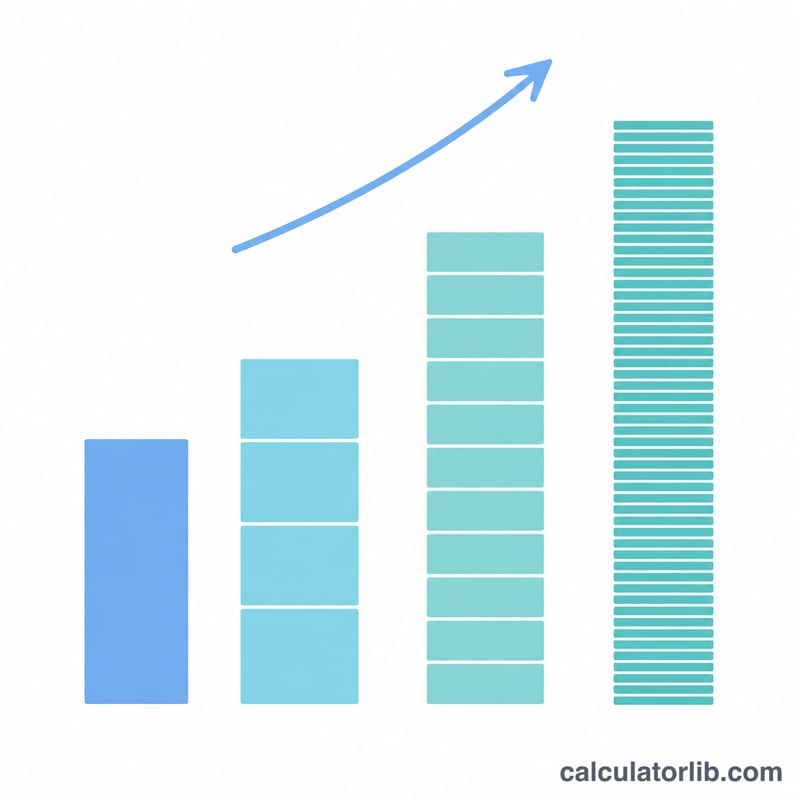
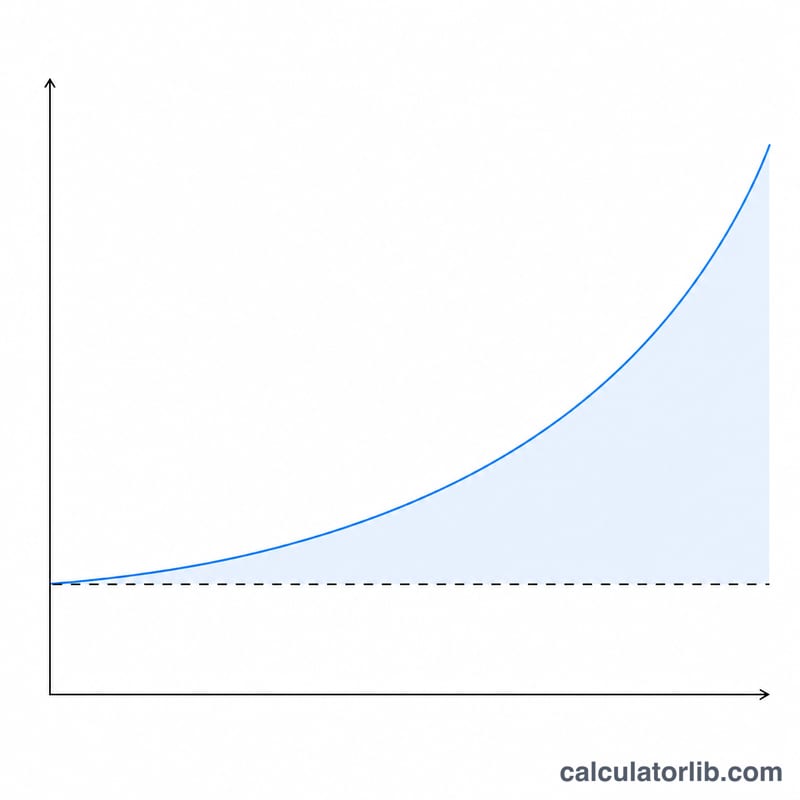
Compound interest demonstrates how small initial investments can grow significantly over time. The three key factors affecting compound interest growth are:
- Time: Longer investment periods lead to exponentially greater returns
- Interest rate: Higher rates produce larger growth
- Compounding frequency: More frequent compounding leads to greater returns
Key Terms & Definitions
Understanding the inputs and outputs of compound interest makes the result meaningful. The terms below correspond directly to the calculator's fields and formula.
- Principal
- The initial sum of money deposited or invested before any interest is added. In the formula \(A = P\left(1 + \frac{r/100}{n}\right)^{n t}\) this is \(P\). It is the starting balance from which all growth is measured.
- Annual interest rate (nominal)
- The stated yearly rate, \(r\), expressed as a percentage (entered in the rate field). The nominal rate does not by itself account for how often interest is compounded within the year.
- Effective annual rate (APY)
- The annual yield once compounding is included, calculated as \(\text{APY} = \left(1 + \frac{r/100}{n}\right)^{n} - 1\). For any compounding more frequent than once per year, the APY is higher than the nominal rate. APY lets you compare accounts with different compounding schedules on equal terms.
- Compounding frequency
- The number of times per year, \(n\), that interest is calculated and added to the balance — annually (1), semi-annually (2), quarterly (4), monthly (12), or daily (365). More frequent compounding means interest begins earning interest sooner.
- Term (time)
- The length of the investment in years, \(t\) (the time field). Because compounding growth is exponential, longer terms have a disproportionately large effect on the final amount.
- Final amount (maturity value)
- The total balance \(A\) at the end of the term — the original principal plus all accumulated interest. This is the headline result the calculator returns.
- Total interest earned
- The growth attributable to interest alone, found by subtracting the principal from the final amount: \(\text{Interest} = A - P\).
Understanding Your Result
The calculator returns two figures. The final amount is what your balance grows to by the end of the term, and the total interest earned is that final amount minus your original principal — the pure earnings produced by compounding.
For example, $10,000 at a 5% nominal rate compounded monthly for 10 years grows to a final amount of $16,470.09, meaning the total interest earned is about $6,470.09.
Why more frequent compounding helps less than you might expect
Switching from annual to monthly compounding raises returns, but the extra gain shrinks rapidly as frequency increases — a case of diminishing returns. At 5% on $10,000 over 10 years, annual compounding yields $16,288.95, while daily compounding yields only $16,486.65. The jump from monthly to daily adds just a few dollars, because the balance is mathematically approaching the limit of continuous compounding.
Nominal rate vs. effective yield (APY)
The rate you enter is the nominal rate. The rate you actually realize is the effective annual rate (APY), which rises with compounding frequency. A 5% nominal rate compounded monthly has an APY of about 5.12%, compounded daily about 5.13%. When comparing real-world accounts, compare APYs rather than nominal rates.
What the result does not include
These figures are a mathematical projection under simplifying assumptions. They exclude inflation (so purchasing power of the final amount is lower than it appears), taxes on interest earned, and any account fees. The calculation also assumes a single fixed rate for the entire term and no additional deposits or withdrawals. Real returns on variable-rate accounts, or with contributions, will differ — treat the result as a clean baseline estimate, not a guarantee.