What is the Volumetric Flow Rate Conversion Calculator?
This tool converts a single volumetric flow rate into 21 common flow-rate units at once, spanning metric (liters, milliliters, cubic meters, cubic millimeters), US customary (cubic feet, US gallons) and imperial UK (UK gallons) systems, each expressed per hour, per minute and per second. It is a pure unit conversion and applies identically everywhere in the world.
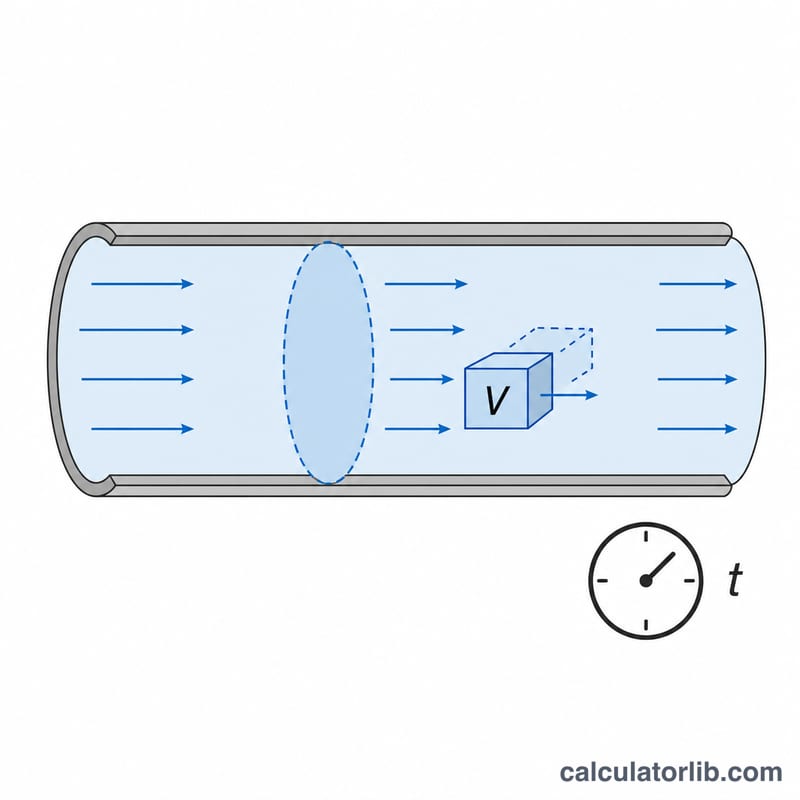
How to use it
Enter the numeric flow value, then pick the unit that value is expressed in. The calculator instantly shows the equivalent flow in every other supported unit. The value may be zero or negative; the conversion is linear so the sign is preserved.
The formula explained
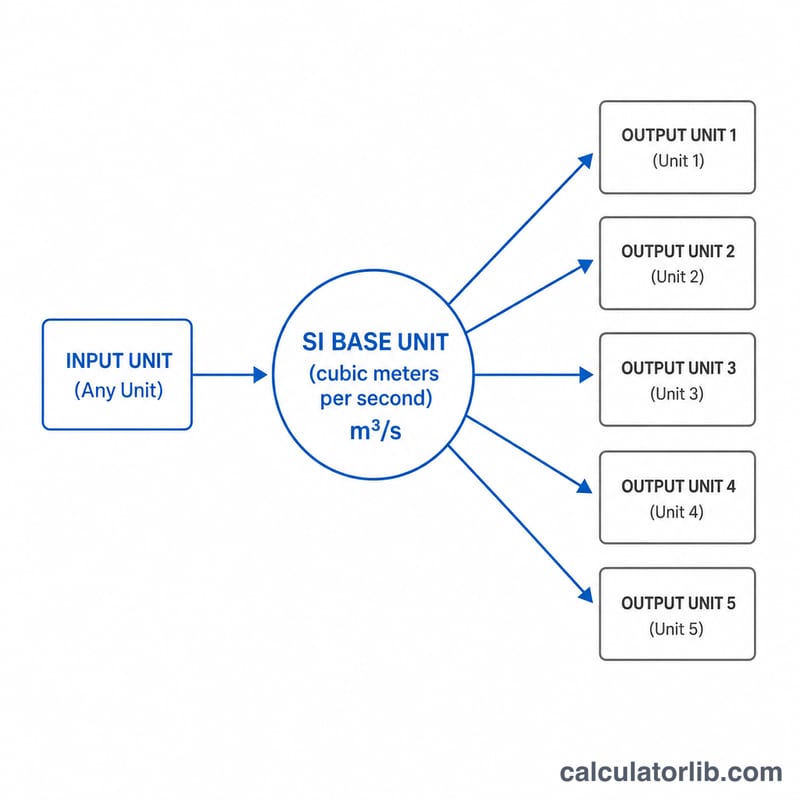
Every unit has a fixed factor equal to its value in the SI base unit, cubic meters per second (m3/s). A unit's factor is its volume in cubic meters divided by its time span in seconds. For example one liter per minute equals 0.001 m3 divided by 60 s = 1.6666...e-5 m3/s.
First the input is normalized to SI: $$Q_{\text{SI}} = \text{Flow value} \times \text{factor}\!\left(\text{Input unit}\right)\ \left[\text{m}^3/\text{s}\right]$$ Then each output is output[u] = q_SI / factor[u]. Equivalently output[u] = flowValue x factor[inputUnit] / factor[u].
Worked example
For flowValue = 1 and inputUnit = Liters per minute: $$q_{\text{SI}} = 1 \times 1.6666\mathrm{e}{-5} = 1.6666\mathrm{e}{-5}\ \text{m}^3/\text{s}$$ Dividing by each target factor gives 60 L/hour, 1 L/min, 0.016667 L/sec, 60,000 mL/hour, 1,000 mL/min, and 60,000,000 mm3/hour, matching standard references.
Common Flow Rate Conversion Table
Each row shows the equivalent of 1 unit (left column) in the other units. Values are rounded to about 6 significant figures. US GPM means US gallons per minute and UK GPM means imperial gallons per minute. CFM is cubic feet per minute.
| 1 unit of… | L/min | m³/h | L/s | US GPM | UK GPM | CFM | mL/s |
|---|---|---|---|---|---|---|---|
| L/min | 1 | 0.06 | 0.0166667 | 0.264172 | 0.219969 | 0.035315 | 16.6667 |
| m³/h | 16.6667 | 1 | 0.277778 | 4.402868 | 3.66615 | 0.588578 | 277.778 |
| L/s | 60 | 3.6 | 1 | 15.8503 | 13.1981 | 2.11888 | 1000 |
| US GPM | 3.785412 | 0.227125 | 0.063090 | 1 | 0.832674 | 0.133681 | 63.0902 |
| UK GPM | 4.54609 | 0.272765 | 0.075768 | 1.20095 | 1 | 0.160544 | 75.7682 |
| CFM | 28.3168 | 1.69901 | 0.471947 | 7.48052 | 6.2288 | 1 | 471.947 |
| mL/s | 0.06 | 0.0036 | 0.001 | 0.0158503 | 0.0131981 | 0.00211888 | 1 |
Also: 1 L/min = 0.001 m³/min.
Unit Definitions and SI Factors
The converter works through the SI unit of volumetric flow, cubic metres per second (m³/s). The input is multiplied by a factor to get m³/s, then divided by the target unit's factor:
$$Q_{\text{SI}} = Q_{\text{input}} \times \text{factor}(\text{input unit}) \quad [\text{m}^3/\text{s}]$$
Volume definitions
- 1 L = 0.001 m³ (exact)
- 1 mL = 10⁻⁶ m³ (exact)
- 1 mm³ = 10⁻⁹ m³ (exact)
- 1 US gallon = 3.785411784 L = 231 in³ (exact, US liquid gallon)
- 1 UK (imperial) gallon = 4.54609 L (exact)
- 1 ft³ = 0.3048³ m³ = 0.028316846592 m³ (exact)
Time bases
- 1 min = 60 s
- 1 h = 3600 s
Resulting factors to m³/s
| Unit | Factor (m³/s per 1 unit) |
|---|---|
| L/min | 1.6667 × 10⁻⁵ |
| L/s | 1 × 10⁻³ |
| m³/h | 2.7778 × 10⁻⁴ |
| US GPM | 6.3090 × 10⁻⁵ |
| UK GPM | 7.5768 × 10⁻⁵ |
| CFM | 4.7195 × 10⁻⁴ |
| mL/s | 1 × 10⁻⁶ |
| mm³/s | 1 × 10⁻⁹ |
Example: for US GPM, \(3.785411784\times10^{-3}\ \text{m}^3 \div 60\ \text{s} = 6.3090\times10^{-5}\ \text{m}^3/\text{s}\).
Typical Flow Rates in Different Units
The figures below are approximate typical values for illustration. Real flow depends on fixture design, pressure, pipe size and local regulations (US-style gallons are used for the GPM column).
| Application | L/min | m³/h | US GPM |
|---|---|---|---|
| Kitchen faucet | ≈ 8 | ≈ 0.48 | ≈ 2.1 |
| Shower head | ≈ 9.5 | ≈ 0.57 | ≈ 2.5 |
| Garden hose | ≈ 20 | ≈ 1.2 | ≈ 5.3 |
| Residential pump | ≈ 60 | ≈ 3.6 | ≈ 15.9 |
| Small HVAC fan (500 CFM) | ≈ 14,160 | ≈ 850 | ≈ 3,740 |
Worked check for the fan: \(500\ \text{CFM} \times 28.3168 = 14{,}158\ \text{L/min}\), and \(500 \times 1.69901 = 849.5\ \text{m}^3/\text{h}\). Note that air flow is often rated in CFM or m³/h, while liquid flow is more often given in L/min or GPM, so the same converter helps compare equipment from different regions.
FAQ
Why is the "per hour" number larger than "per second"? The same physical flow expressed over a longer time window accumulates a bigger count, so 1 L/min equals 60 L/hour.
Which gallon is used? Both: US gallon = 3.785411784 L and UK imperial gallon = 4.54609 L are shown separately.
Does country matter? No. These are universal physical unit definitions with no regional assumptions.