What Is the Wave Speed Calculator?
The wave speed calculator computes how fast a wave travels through a medium using the fundamental wave equation \(v = f \times \lambda\), where \(v\) is the wave speed, \(f\) is the frequency, and \(\lambda\) (lambda) is the wavelength. It applies to any periodic wave — sound, light, water ripples, or vibrations on a string.
How to Use It
Enter the frequency in hertz (Hz) and the wavelength in meters (m). The calculator multiplies the two values to return the wave speed in meters per second (m/s). Make sure your units are consistent: frequency in Hz and wavelength in meters give a speed in m/s.
The Formula Explained
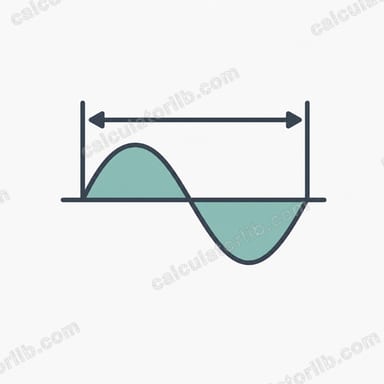
Frequency measures how many wave cycles pass a point each second, while wavelength is the distance between two successive crests. Multiplying cycles per second by meters per cycle leaves meters per second — the speed at which the wave's energy propagates. Rearranging the equation lets you solve for frequency (\(f = v / \lambda\)) or wavelength (\(\lambda = v / f\)) when the speed is known.

Worked Example
A sound wave has a frequency of 500 Hz and a wavelength of 0.68 m. Its speed is $$v = 500 \times 0.68 = 340 \text{ m/s}$$ which is approximately the speed of sound in air at room temperature.

Typical Wave Speeds in Common Media
The table lists approximate wave speeds. Real values depend on the material and its temperature, pressure and composition. Sound speeds in particular vary noticeably with temperature.
| Wave type | Medium | Approx. speed (m/s) |
|---|---|---|
| Sound | Air at 0°C | 331 |
| Sound | Air at 20°C | 343 |
| Sound | Fresh water | ~1,480 |
| Sound | Steel | ~5,960 |
| Sound | Glass | ~5,640 |
| Light | Vacuum | 299,792,458 |
| Light | Water | ~2.25×10⁸ |
| Light | Glass | ~2.0×10⁸ |
Sound speeds in solids vary with the type of wave (longitudinal or shear) and the exact alloy or glass type. Light speeds in water and glass depend on wavelength and on the specific material.
Frequency and Wavelength Unit Conversions
The calculator uses SI units: frequency in hertz (Hz) and wavelength in metres (m). Convert other units first.
| Quantity | Unit | Equivalent in SI |
|---|---|---|
| Frequency | 1 kHz | 103 Hz |
| Frequency | 1 MHz | 106 Hz |
| Frequency | 1 GHz | 109 Hz |
| Wavelength | 1 km | 103 m |
| Wavelength | 1 cm | 10-2 m |
| Wavelength | 1 mm | 10-3 m |
| Wavelength | 1 µm | 10-6 m |
| Wavelength | 1 nm | 10-9 m |
Quick example (frequency): a 100 MHz radio wave has \(f = 100 \times 10^{6}\ \text{Hz} = 10^{8}\ \text{Hz}\).
Speed conversion: to convert m/s to km/h, multiply by 3.6. For example, \(343 \times 3.6 = 1234.8\) km/h.
Key Constants for Wave Speed
- Speed of light in vacuum: \(c = 299{,}792{,}458\ \text{m/s}\) (exact, by definition of the metre).
- Speed of sound in dry air at 20°C: about 343 m/s.
- Sound in air versus temperature: \(v \approx 331 + 0.6\,T\), with T in °C. At 20°C: \(331 + 0.6 \times 20 = 343\) m/s.
- Light in a medium: \(v = \dfrac{c}{n}\), where n is the refractive index. For water, n ≈ 1.33 gives \(v \approx 2.25 \times 10^{8}\) m/s. For typical glass, n ≈ 1.5 gives \(v \approx 2.0 \times 10^{8}\) m/s.
Worked check: a 440 Hz tone in 20°C air has a wavelength of about 0.78 m. Then \(v = f \times \lambda = 440 \times 0.78 = \) 343.2 m/s, which matches the speed of sound in air at 20°C.
FAQ
Does this work for light? Yes. Light in a vacuum travels at about \(3 \times 10^8\) m/s; entering its frequency and wavelength yields that value.
What units should I use? Use hertz for frequency and meters for wavelength to get speed in meters per second.
Can I find frequency instead? Rearrange to \(f = v / \lambda\), or simply try different inputs until the speed matches your medium's known value.