What Is the Weight on the Moon Calculator?
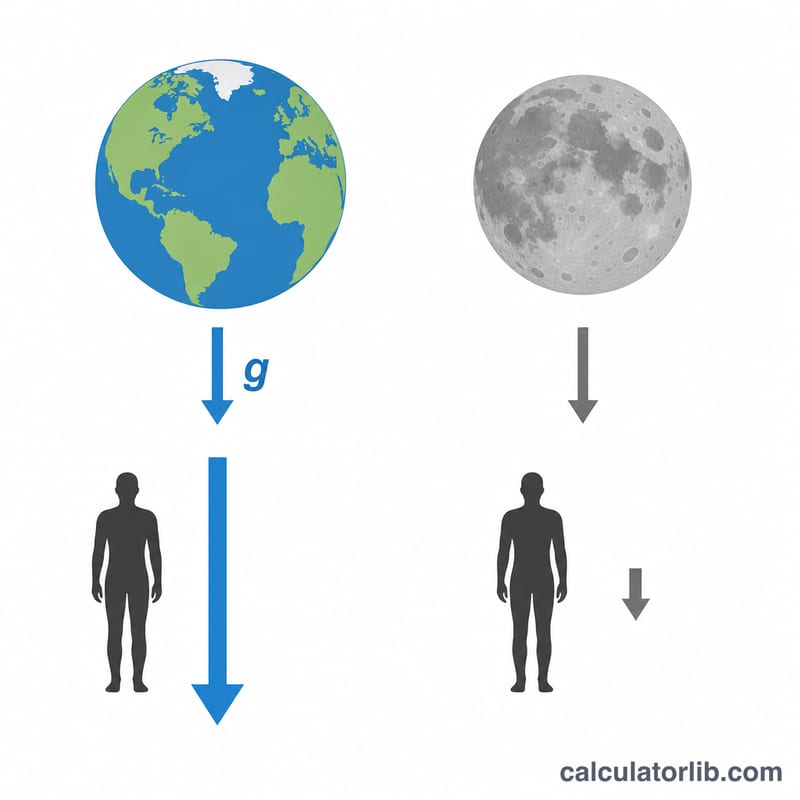
This tool tells you how much you would weigh standing on the surface of the Moon. The Moon is far less massive than Earth, so its surface gravity is only about 16.57% of Earth's. That means an object weighs roughly one-sixth as much on the Moon as it does on Earth, even though its mass never changes.
How to Use It
Enter your current weight, choose whether it's in kilograms or pounds, and the calculator instantly multiplies it by the lunar gravity factor. Your result is shown in the same unit you entered, so kilograms stay kilograms and pounds stay pounds.
The Formula Explained
The calculation is a simple proportion of surface gravities:
$$W_{moon} = W_{earth} \times 0.1657$$The factor \(0.1657\) comes from dividing the Moon's surface gravity (about 1.625 m/s²) by Earth's surface gravity (about 9.807 m/s²). Note that "weight" here is the everyday reading on a scale; your actual mass is unchanged anywhere in the universe.
Worked Example
Suppose you weigh 70 kg on Earth. Multiply by the factor: $$70 \times 0.1657 = 11.599 \text{ kg}$$ So on the Moon a scale would read just under 11.6 kg. A 180 lb person would weigh about \(180 \times 0.1657 = 29.83\) lb.
Weight on Other Celestial Bodies Compared
Your weight on another body depends on its surface gravity. The table gives the approximate surface gravity of each body and its ratio to Earth's standard gravity (9.807 m/s²). Multiply your Earth weight by the ratio to find your weight there. Values are approximate and based on commonly published NASA figures. Gas giants have no solid surface, so their values refer to the level of the 1-bar atmospheric pressure.
| Body | Surface gravity (m/s²) | Ratio to Earth |
|---|---|---|
| Moon | 1.625 | 0.1657 |
| Mercury | 3.70 | 0.377 |
| Venus | 8.87 | 0.904 |
| Earth | 9.807 | 1.000 |
| Mars | 3.71 | 0.378 |
| Jupiter | 24.79 | 2.528 |
| Saturn | 10.44 | 1.065 |
| Uranus | 8.87 | 0.904 |
| Neptune | 11.15 | 1.137 |
| Pluto | 0.62 | 0.063 |
For the Moon, the ratio comes from \(1.625 \div 9.807 \approx 0.1657\), so you weigh about one-sixth of your Earth weight there. Your mass does not change; only the force of gravity on it does.
Moon Weight for Common Earth Weights
Each value below is the Earth weight multiplied by 0.1657 and rounded to 2 decimals (halves rounded up). The unit stays the same as the input, so kilograms give kilograms and pounds give pounds.
| Earth weight | Calculation | Moon weight |
|---|---|---|
| 5 kg | \(5 \times 0.1657\) | 0.83 kg |
| 20 kg | \(20 \times 0.1657\) | 3.31 kg |
| 50 kg | \(50 \times 0.1657\) | 8.29 kg |
| 70 kg | \(70 \times 0.1657\) | 11.60 kg |
| 90 kg | \(90 \times 0.1657\) | 14.91 kg |
| 100 kg | \(100 \times 0.1657\) | 16.57 kg |
| 110 lb | \(110 \times 0.1657\) | 18.23 lb |
| 150 lb | \(150 \times 0.1657\) | 24.86 lb |
| 180 lb | \(180 \times 0.1657\) | 29.83 lb |
| 200 lb | \(200 \times 0.1657\) | 33.14 lb |
Strictly, kilograms measure mass and pounds are often used for either mass or force. These figures show what a scale calibrated for Earth would read on the Moon.
FAQ
Does my mass change on the Moon? No. Only your weight (the force of gravity on you) changes. Your mass stays the same everywhere.
Why is the factor 0.1657 and not exactly 1/6? One-sixth (0.1667) is a popular rounding. The more precise ratio of lunar to Earth gravity is about \(0.1657\).
Can I use pounds? Yes. The factor applies to any weight unit, so the answer comes out in whatever unit you entered.