What is the angle of elevation?
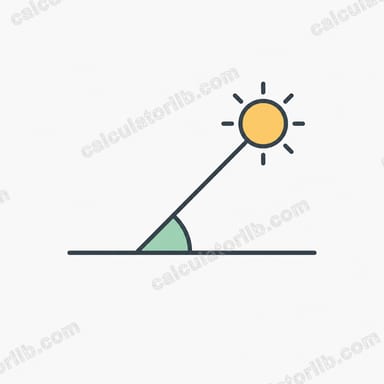
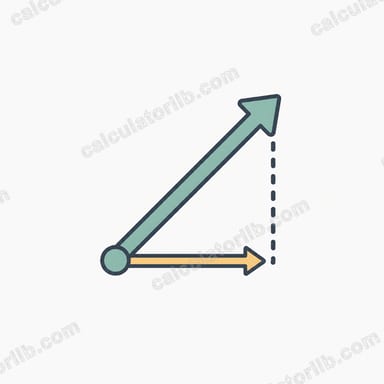
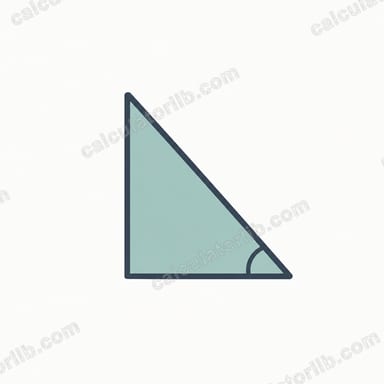
The angle of elevation is the angle formed between the horizontal line of sight and the line drawn from an observer up to an object that is higher than the observer. It is a fundamental concept in trigonometry used in surveying, navigation, astronomy, and construction. This calculator finds that angle from two simple measurements: the vertical height of the object above eye level and the horizontal distance to its base.

How to use this calculator
Enter the height (the vertical, or "opposite", side) and the horizontal distance (the "adjacent" side) in the same units. The calculator returns the angle of elevation in degrees and radians, along with the line-of-sight distance (the hypotenuse). Because the angle depends only on the ratio of height to distance, you can use any consistent unit — metres, feet, or kilometres.
The formula explained
For a right triangle, the tangent of the elevation angle equals the opposite side over the adjacent side, so the angle is the inverse tangent (arctangent) of height divided by distance:
$$\theta = \arctan\!\left(\frac{\text{height}}{\text{distance}}\right)$$The line of sight is found with the Pythagorean theorem, \(L = \sqrt{\text{height}^{2} + \text{distance}^{2}}\).

Worked example
Suppose a tree casts its top 30 metres above your eye level and stands 40 metres away horizontally. Then
$$\theta = \arctan\!\left(\frac{30}{40}\right) = \arctan(0.75) \approx 36.87°.$$The line of sight to the treetop is
$$\sqrt{30^{2} + 40^{2}} = \sqrt{2500} = 50 \text{ metres}.$$Common Angles of Elevation and Height-to-Distance Ratios
The ratio of height to horizontal distance equals \(\tan\theta\), and the line-of-sight length divided by the horizontal distance equals \(1/\cos\theta\). These values hold for any units, as long as height and distance use the same unit.
| Angle θ | tan(θ) = height ÷ distance | 1/cos(θ) = line of sight ÷ distance |
|---|---|---|
| 5° | 0.0875 | 1.0038 |
| 10° | 0.1763 | 1.0154 |
| 15° | 0.2679 | 1.0353 |
| 30° | 0.5774 | 1.1547 |
| 45° | 1.0000 | 1.4142 |
| 60° | 1.7321 | 2.0000 |
| 75° | 3.7321 | 3.8637 |
| 80° | 5.6713 | 5.7588 |
| 90° (limit) | undefined (grows without bound) | undefined (grows without bound) |
As the angle approaches 90°, you are looking straight up: the horizontal distance shrinks toward zero and the ratios grow without limit.
Real-World Scenario Comparison
Each row uses \(\theta=\arctan(h/d)\) and line of sight \(=\sqrt{h^2+d^2}\). Heights are measured above eye level.
| Scenario | Height | Horizontal distance | Angle of elevation | Line of sight |
|---|---|---|---|---|
| Flagpole | 10 m | 20 m | 26.57° | 22.36 m |
| Building | 100 m | 100 m | 45.00° | 141.42 m |
| Tower | 50 m | 200 m | 14.04° | 206.16 m |
| Ladder against a wall (3-4-5 triangle) | 3 m | 4 m | 36.87° | 5.00 m |
| Tall cliff close up | 150 m | 50 m | 71.57° | 158.11 m |
Note how the same height gives a much steeper angle when you stand closer: a distance of one-quarter of the height gives roughly 76°, while a distance four times the height gives only about 14°.
FAQ
What is the difference between angle of elevation and angle of depression? Elevation looks upward from the horizontal to a higher object; depression looks downward to a lower object. For the same two points, the two angles are equal (alternate interior angles).
Do the units matter? No — as long as height and distance use the same unit, the angle is the same because it depends only on their ratio.
What if the distance is zero? The object is directly overhead, so the angle of elevation is \(90°\).