

What is the Sum of an Arithmetic Series?
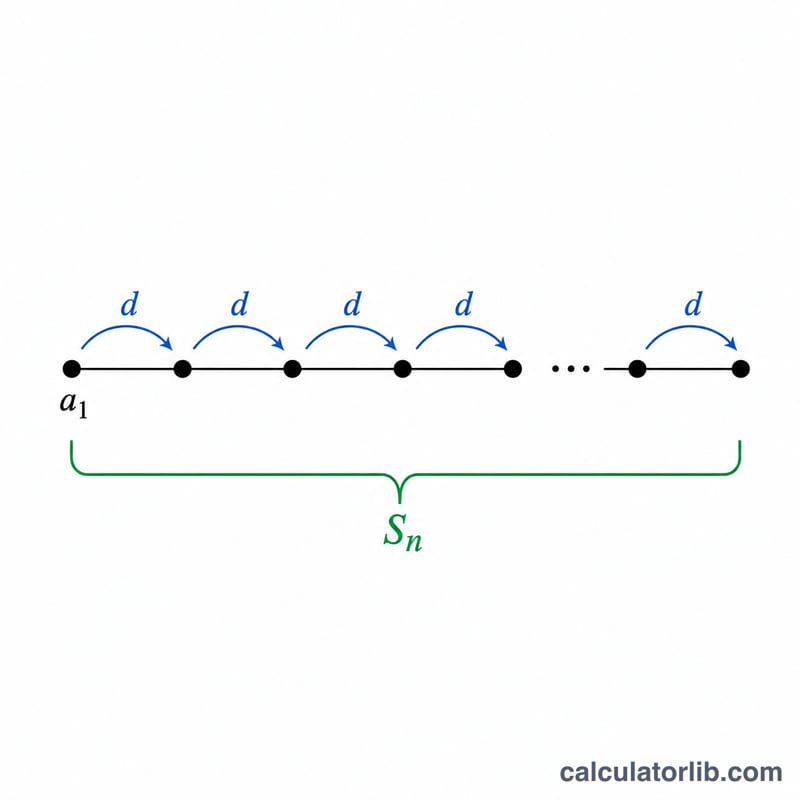
An arithmetic series is the sum of the terms of an arithmetic sequence — a list of numbers where each term increases by a fixed amount called the common difference (\(d\)). Starting from a first term \(a_1\), the sequence is \(a_1, a_1+d, a_1+2d\), and so on. The sum of the first \(n\) terms is written \(S_n\). This calculator computes \(S_n\) instantly along with the last term \(a_n\).
How to Use This Calculator
Enter three values: the first term \(a_1\), the common difference \(d\) (it can be negative or a decimal), and the number of terms \(n\) (a positive whole number). The calculator returns the total sum, the value of the last term \(a_n\), and echoes your inputs so you can verify the setup.
The Formula Explained
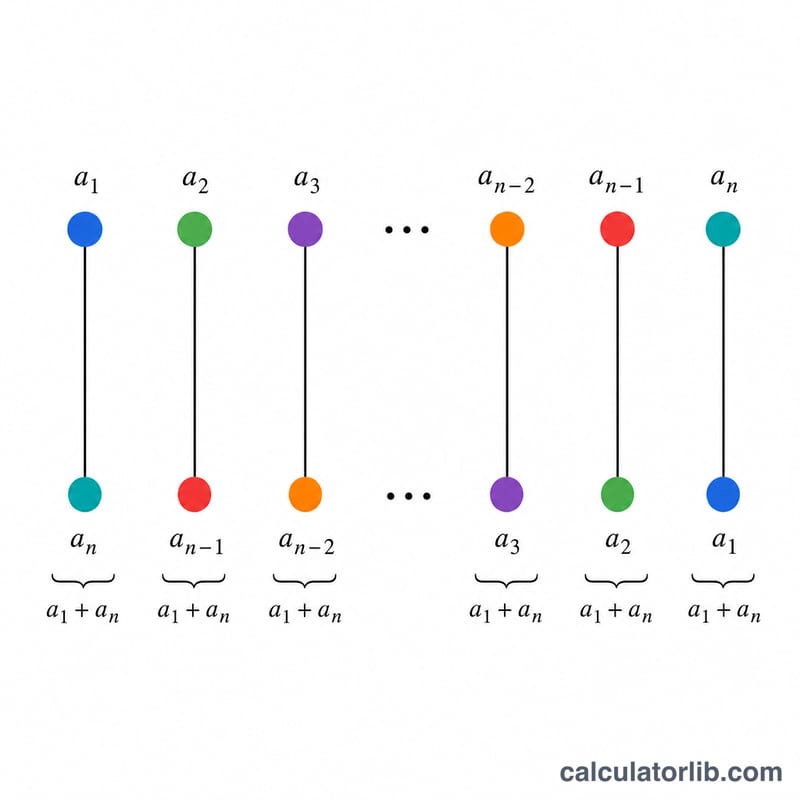
The core formula is $$S_n = \frac{n}{2}\left(2a_1 + \left(n - 1\right)d\right).$$ The expression \((n-1)d\) gives how far the last term has moved from the first, so \(2a_1 + (n-1)d\) equals \(a_1 + a_n\). Multiplying by \(\frac{n}{2}\) is the famous Gauss trick: pairing the first and last terms gives the same total \(a_1 + a_n\), and there are \(\frac{n}{2}\) such pairs. This gives the equivalent form $$S_n = \frac{n(a_1 + a_n)}{2}.$$
Worked Example
Suppose \(a_1 = 2\), \(d = 3\), and \(n = 5\). The terms are \(2, 5, 8, 11, 14\). The last term is $$a_n = 2 + (5-1)\cdot 3 = 14.$$ The sum is $$S_5 = \frac{5}{2}\left(2\cdot 2 + 4\cdot 3\right) = \frac{5}{2}\left(4 + 12\right) = \frac{5}{2}\cdot 16 = 40.$$ Checking by addition: \(2 + 5 + 8 + 11 + 14 = 40\). ✔
FAQ
Can \(d\) be negative? Yes — a negative common difference produces a decreasing sequence, and the formula still works.
What if \(d = 0\)? Every term equals \(a_1\), so the sum is simply \(n \cdot a_1\).
Does this work for non-integer terms? Yes, \(a_1\) and \(d\) may be decimals; only \(n\) must be a positive integer because it counts terms.