What Is the Custom Dice Roller Calculator?
The Custom Dice Roller Calculator simulates rolling any number of dice with any number of sides — perfect for tabletop role-playing games like Dungeons & Dragons, board games, or any situation where you need a random result. Enter how many dice to roll, how many sides each die has, and an optional flat modifier, and the tool returns a live roll plus the theoretical minimum, maximum, and average outcome.
How to Use It
Set Number of dice (\(n\)), Sides per die (\(s\)), and an optional Modifier that is added to the total. For example, the classic "3d6+2" means roll three six-sided dice and add 2. Click calculate to get a fresh random total. Reload to roll again.
The Formula Explained
Each die is rolled with floor(random() × s) + 1, which yields a uniform integer from 1 to \(s\). The total is the sum of all \(n\) dice plus the modifier:
$$\text{Total} = \sum_{i=1}^{\text{Dice}} \left( \lfloor \text{rand} \times \text{Sides} \rfloor + 1 \right) + \text{Modifier}$$
The predictable statistics are: $$\begin{aligned} \text{Min} &= \text{Dice} + \text{Modifier} \\[0.4em] \text{Max} &= \text{Dice} \times \text{Sides} + \text{Modifier} \\[0.4em] \text{Avg} &= \text{Dice} \times \frac{\text{Sides} + 1}{2} + \text{Modifier} \end{aligned}$$
Worked Example
For 3d6+2: minimum \(= 3 + 2 = 5\), maximum \(= 3 \times 6 + 2 = 20\), average \(= 3 \times (6+1)/2 + 2 = 10.5 + 2 = 12.5\). Any single roll lands somewhere between 5 and 20, clustering near 12.5.
Common Dice Setups Compared
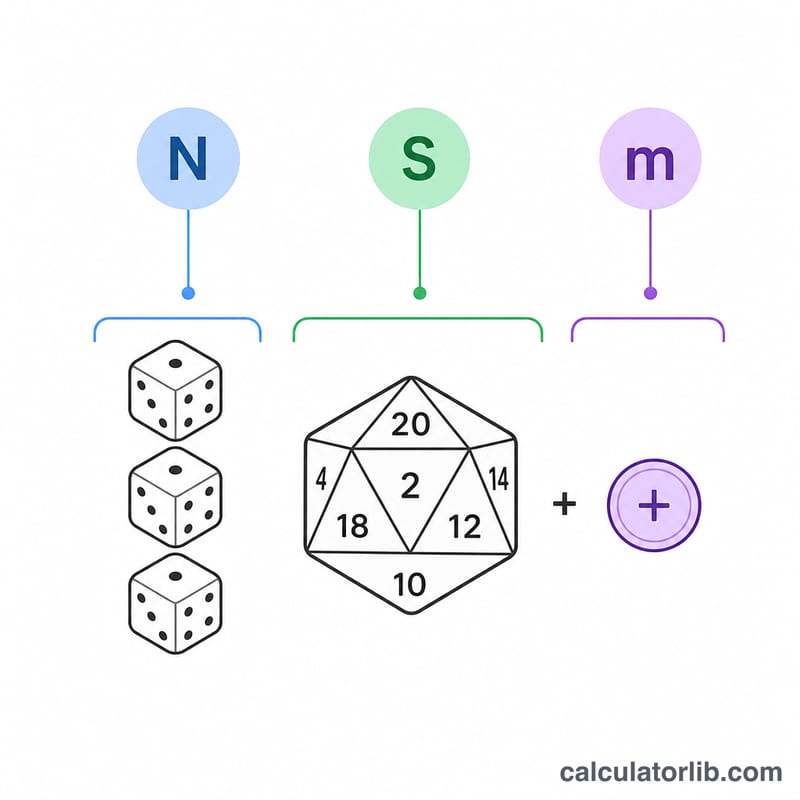
In NdS+m notation, N is the number of dice, S is the number of sides per die, and m is a flat modifier. Each setup below uses these formulas: \(\text{Min} = N + m\), \(\text{Max} = N \times S + m\), and \(\text{Avg} = N \times \frac{S+1}{2} + m\).
| Setup | Min | Max | Average |
|---|---|---|---|
| 1d20 | 1 | 20 | 10.5 |
| 1d100 | 1 | 100 | 50.5 |
| 2d6 | 2 | 12 | 7 |
| 3d6+2 | 5 | 20 | 12.5 |
| 4d6 | 4 | 24 | 14 |
| 2d10 | 2 | 20 | 11 |
| 1d8+3 | 4 | 11 | 7.5 |
Worked example for 3d6+2: Min = \(3 + 2 = 5\), Max = \(3 \times 6 + 2 = 20\), Avg = \(3 \times 3.5 + 2 = 12.5\). The average is the long-run mean of many rolls; any single roll can land anywhere between the minimum and maximum.
Standard Polyhedral Dice Reference
These are the dice commonly used in tabletop role-playing and board games. The average per die is \(\frac{S+1}{2}\), which assumes every face is equally likely.
| Die | Sides (S) | Range | Average per die |
|---|---|---|---|
| d4 | 4 | 1 to 4 | 2.5 |
| d6 | 6 | 1 to 6 | 3.5 |
| d8 | 8 | 1 to 8 | 4.5 |
| d10 | 10 | 1 to 10 | 5.5 |
| d12 | 12 | 1 to 12 | 6.5 |
| d20 | 20 | 1 to 20 | 10.5 |
| d100 | 100 | 1 to 100 | 50.5 |
Note: a physical d10 is often numbered 0 to 9. In that case a 0 is usually read as 10, which gives the 1 to 10 range shown here.
Dice Notation Glossary
- NdS notation: A shorthand for rolling N dice that each have S sides. For example, 3d6 means roll three six-sided dice and add the results.
- Die / dice: A die is a single randomizing object, and dice is the plural. Here a die is any virtual die with a chosen number of sides.
- Sides: The number of possible outcomes on one die. A die with S sides returns a whole number from 1 to S.
- Modifier: A fixed number added to (or subtracted from) the total after all dice are summed, as in the +2 of 3d6+2.
- Minimum: The lowest possible total, reached when every die shows 1: \(N + m\).
- Maximum: The highest possible total, reached when every die shows its top face: \(N \times S + m\).
- Average (expected value): The mean total over many rolls: \(N \times \frac{S+1}{2} + m\). It does not predict any single roll.
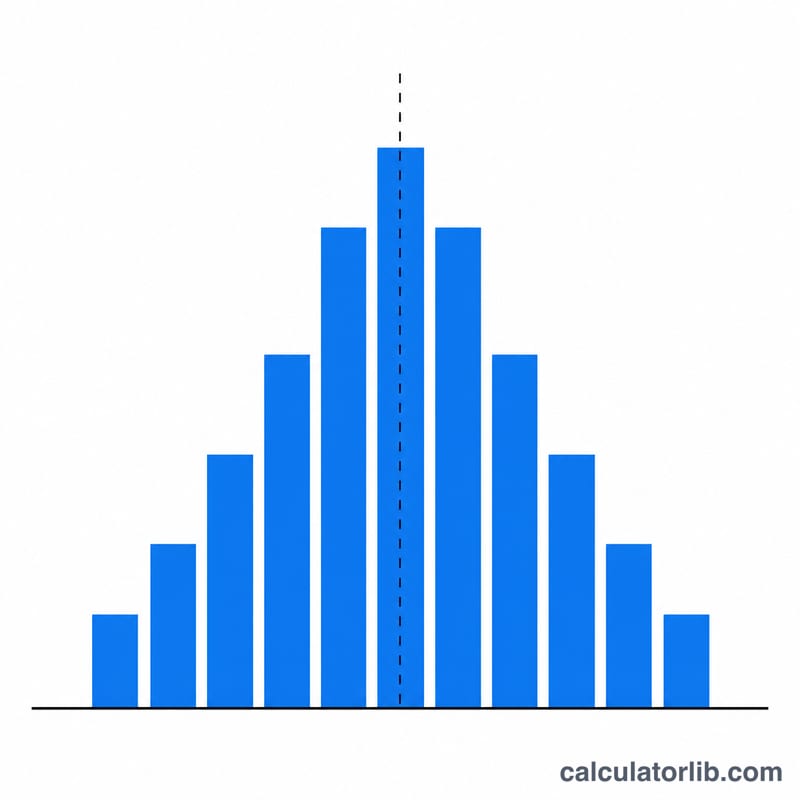
- Uniform distribution: Every face of a single die is equally likely. The sum of several dice is not uniform; middle totals occur more often than extremes.
- Pseudo-random: Numbers produced by a computer algorithm that behave statistically like random values, without being truly physical randomness. This is fine for games and general use.
- d% / d100: A percentile die giving 1 to 100. Physically it is often made from two ten-sided dice, one for tens and one for ones. Here you can simply set sides to 100.
FAQ
Are the rolls truly random? They use a pseudo-random generator, which is statistically uniform and fine for games but not cryptographic use.
Why does my total change each time? Each calculation produces a new random roll. The min, max, and average shown are fixed properties of your dice setup.
Can I use it for d20 or d100? Yes — set sides to 20 or 100. Any positive whole number of sides works.