What is the D6 Dice Roller?
The 6-Sided Dice (D6) Roller is a virtual dice generator for board games, tabletop RPGs, and probability lessons. It rolls any number of dice, supports custom sides (so you can also roll a D4, D8, D12, D20 and more), and adds an optional modifier to the total — just like the "2d6+3" notation used in many games.
How to use it
Enter how many dice you want to roll, how many sides each die has (6 for a classic D6), and an optional modifier that is added to the final total. Submit to see each individual roll, the sum of the dice, the grand total including the modifier, the minimum and maximum possible outcomes, and the statistically expected average.
The formula explained
Each die is rolled with \( \text{roll} = \lfloor \operatorname{random}() \times \text{sides} \rfloor + 1 \). Because random() returns a number in the range [0, 1), multiplying by the number of sides and flooring gives a uniform integer from 0 to sides−1; adding 1 shifts it to the familiar 1-to-sides range. The grand total is the sum of every die plus the modifier:
$$\text{Total} = \sum_{i=1}^{\text{Dice}} \operatorname{rand}\left(1,\ \text{Sides}\right) + \text{Modifier}$$
The expected average of a fair roll is:
$$\text{Average} = \text{Dice} \cdot \frac{\text{Sides} + 1}{2} + \text{Modifier}$$
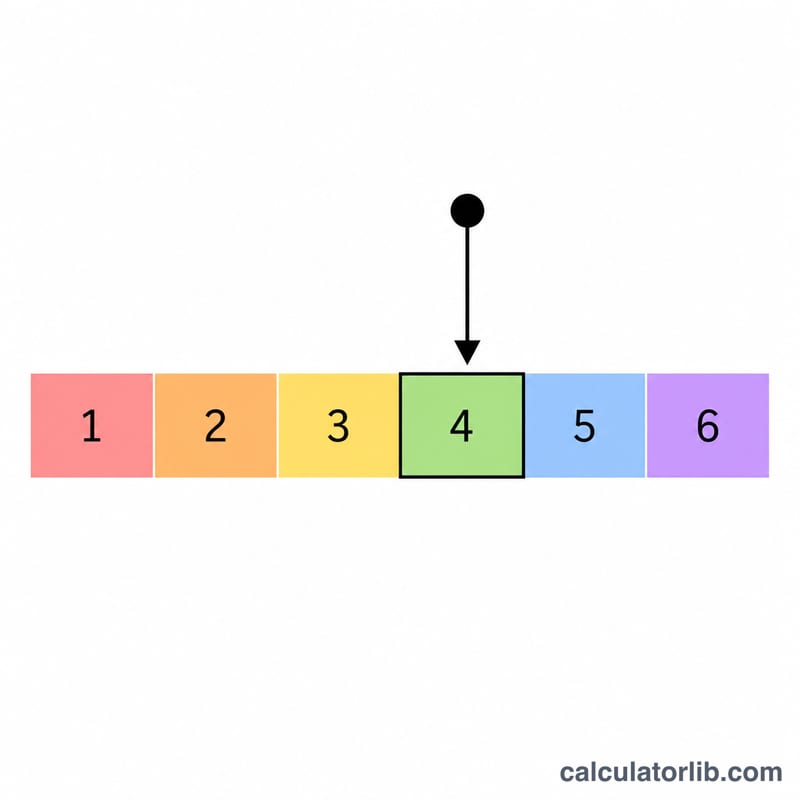
Worked example
Rolling 2d6+0: each die ranges from 1 to 6. The minimum possible total is 2 (both show 1), the maximum is 12 (both show 6), and the expected average is:
$$2 \times \frac{6 + 1}{2} = 7$$
A single trial might show rolls of 4 and 3 for a total of 7.
2d6 Sum Probability Table
Two six-sided dice can land in \(6 \times 6 = 36\) equally likely ways. Most totals can be made by more than one combination. For example, 7 comes from 1+6, 2+5, 3+4, 4+3, 5+2 and 6+1. That is why the middle totals come up more often than the extremes. The probability of a total is the number of ways to roll it divided by 36:
$$P(\text{total}) = \frac{\text{ways}}{36}$$For example, \(P(7) = \frac{6}{36} = \frac{1}{6} \approx 16.67\%\), and \(P(2) = P(12) = \frac{1}{36} \approx 2.78\%\).
| Total | Ways (out of 36) | Exact fraction | Probability | Chance of this total or higher |
|---|---|---|---|---|
| 2 | 1 | 1/36 | 2.78% | 36/36 = 100% |
| 3 | 2 | 2/36 = 1/18 | 5.56% | 35/36 ≈ 97.22% |
| 4 | 3 | 3/36 = 1/12 | 8.33% | 33/36 ≈ 91.67% |
| 5 | 4 | 4/36 = 1/9 | 11.11% | 30/36 ≈ 83.33% |
| 6 | 5 | 5/36 | 13.89% | 26/36 ≈ 72.22% |
| 7 | 6 | 6/36 = 1/6 | 16.67% | 21/36 ≈ 58.33% |
| 8 | 5 | 5/36 | 13.89% | 15/36 ≈ 41.67% |
| 9 | 4 | 4/36 = 1/9 | 11.11% | 10/36 ≈ 27.78% |
| 10 | 3 | 3/36 = 1/12 | 8.33% | 6/36 ≈ 16.67% |
| 11 | 2 | 2/36 = 1/18 | 5.56% | 3/36 ≈ 8.33% |
| 12 | 1 | 1/36 | 2.78% | 1/36 ≈ 2.78% |
To get the "or higher" column, add the ways for that total and every total above it. For example, rolling 8 or higher on 2d6 is \(\frac{5+4+3+2+1}{36} = \frac{15}{36} \approx 41.67\%\). The "ways" column adds up to 36, so the probabilities add up to 100%.
Single die note: with one D6, every face from 1 to 6 is equally likely, at \(\frac{1}{6} \approx 16.67\%\) each. No face is more likely than another. The peaked pattern above only appears when you add two or more dice together.
Common Dice Notations Compared
In standard dice notation, NdS+M means: roll N dice with S sides each, then add the modifier M. The lowest possible total is when every die shows 1. The highest is when every die shows its top face. The expected (long-run) average uses the fact that one fair die averages \(\frac{S+1}{2}\):
$$\text{Min} = N + M, \qquad \text{Max} = N \times S + M, \qquad \text{Average} = \frac{N \times (S+1)}{2} + M$$For example, 2d6+3 gives \(\text{Min} = 2 + 3 = 5\), \(\text{Max} = 2 \times 6 + 3 = 15\) and \(\text{Average} = \frac{2 \times 7}{2} + 3 = 10\).
| Notation | Dice × Sides + Modifier | Minimum | Maximum | Expected average |
|---|---|---|---|---|
| 1d6 | 1 × 6 + 0 | 1 | 6 | 1 × 7 / 2 = 3.5 |
| 2d6 | 2 × 6 + 0 | 2 | 12 | 2 × 7 / 2 = 7 |
| 3d6 | 3 × 6 + 0 | 3 | 18 | 3 × 7 / 2 = 10.5 |
| 4d6 | 4 × 6 + 0 | 4 | 24 | 4 × 7 / 2 = 14 |
| 2d6+3 | 2 × 6 + 3 | 5 | 15 | 2 × 7 / 2 + 3 = 10 |
| 1d4 | 1 × 4 + 0 | 1 | 4 | 1 × 5 / 2 = 2.5 |
| 1d8 | 1 × 8 + 0 | 1 | 8 | 1 × 9 / 2 = 4.5 |
| 1d10 | 1 × 10 + 0 | 1 | 10 | 1 × 11 / 2 = 5.5 |
| 1d12 | 1 × 12 + 0 | 1 | 12 | 1 × 13 / 2 = 6.5 |
| 1d20 | 1 × 20 + 0 | 1 | 20 | 1 × 21 / 2 = 10.5 |
The expected average is a long-run mean, not a roll you are guaranteed to see. For 1d6 (3.5) or 1d20 (10.5), you can never actually roll the average.
Bell-curve effect: 3d6 and 1d20 have the same average of 10.5, but they behave very differently. A single die is uniform. On 1d20, a 1 is just as likely as a 10 or a 20, at 5% each. When you add several dice, high and low rolls tend to cancel out, so totals bunch up near the average and the extremes become rare. On 3d6, a total of 3 or 18 has only a 1 in 216 chance each. The more dice you add, the more tightly the results cluster around the average, and the closer the distribution gets to a bell shape. A modifier shifts the whole range up or down but does not change its shape.
FAQ
Are the rolls truly random? They use a pseudo-random number generator, which is statistically fair and more than adequate for games and demonstrations.
Can I roll dice other than D6? Yes — change the "Sides per die" field to roll a D4, D8, D10, D20, or any die from 2 to 100 sides.
What does the modifier do? It is a fixed number added to (or subtracted from) the total of all dice, matching tabletop notation like "3d6+2".