What Is the EV Range Calculator?
This tool estimates how far an electric vehicle can travel on a single charge using two core numbers: the battery's energy capacity in kilowatt-hours (kWh) and the car's energy consumption in watt-hours per mile (Wh/mi). It also lets you set a usable-battery percentage so the estimate reflects real-world driving rather than a perfect 0–100% drain.
How to Use It
Enter your battery capacity (found on the spec sheet, e.g. 75 kWh), your efficiency in Wh per mile (typical EVs range from 220 to 350 Wh/mi), and the usable percentage of the pack. Many drivers keep usage between 10% and 90% to protect battery longevity, which is roughly 80% usable. Press calculate to see the estimated range, usable energy, and your miles-per-kWh efficiency.
The Formula Explained
Range is simply usable energy divided by the energy needed per mile. First, usable energy = battery × (usable% ÷ 100). Then convert efficiency from Wh/mi to kWh/mi by dividing by 1000. Finally, Range = usable kWh ÷ kWh per mile. A lower Wh/mi figure means a more efficient car and a longer range.
$$\text{Range (mi)} = \frac{\text{Battery (kWh)} \times \dfrac{\text{Usable (\%)}}{100}}{\dfrac{\text{Efficiency (Wh/mi)}}{1000}}$$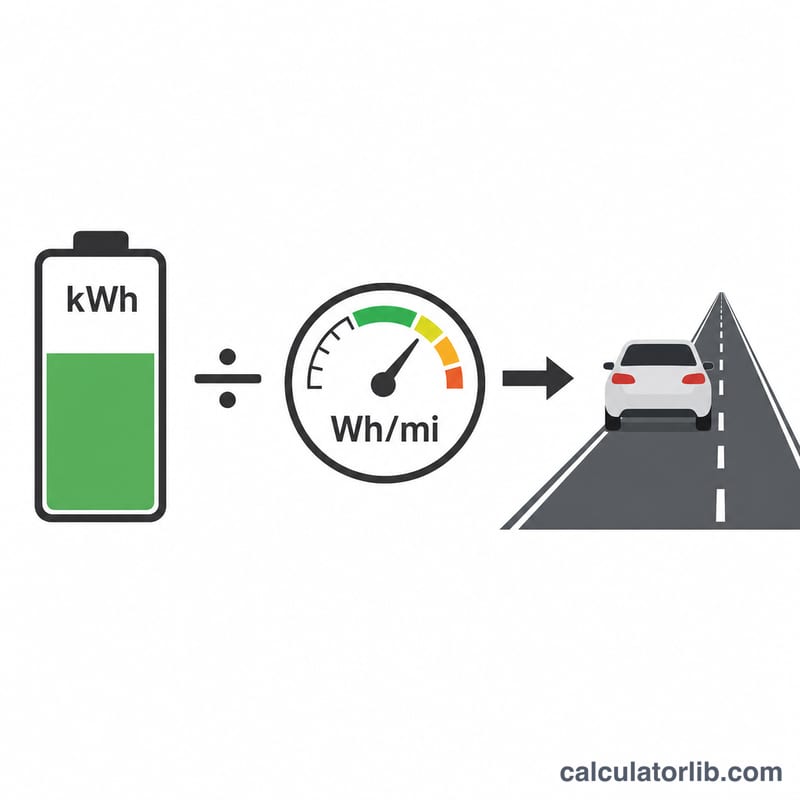
Worked Example
Suppose a car has a 75 kWh battery, consumes 280 Wh/mi, and you use 100% of the pack. Consumption = \(280 \div 1000 = 0.28\) kWh/mi. Range = \(75 \div 0.28 \approx 267.9\) miles. That matches typical EPA-style estimates for a mid-size electric sedan.
$$\text{Range} = \frac{75 \times \dfrac{100}{100}}{\dfrac{280}{1000}} = \frac{75}{0.28} \approx 267.9 \text{ mi}$$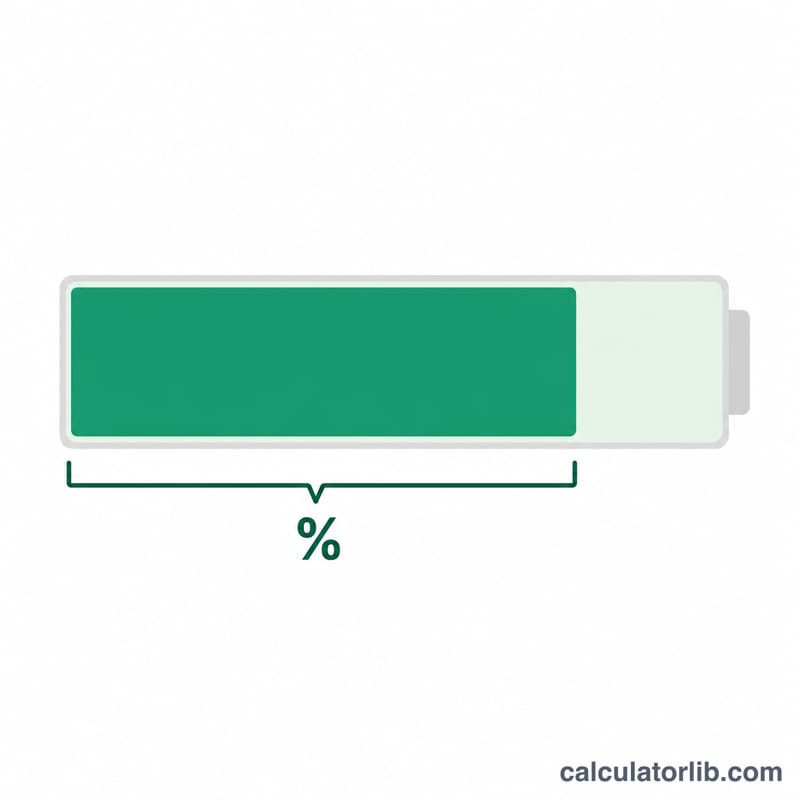
Range Under Different Conditions
The same battery gives very different range depending on weather, speed and how much of the pack you plan to use. The table uses a 75 kWh battery and the formula \(\text{Range} = \text{usable kWh} \div (\text{Wh/mi} \div 1000)\).
| Scenario | Usable % | Usable kWh | Efficiency (Wh/mi) | Range (mi) |
|---|---|---|---|---|
| Ideal mild weather | 100% | 75.0 | 250 | 300.0 |
| Typical mixed driving | 90% | 67.5 | 280 | 241.1 |
| Cold weather | 80% | 60.0 | 350 | 171.4 |
| Highway driving | 80% | 60.0 | 330 | 181.8 |
Example (mixed driving): $$\text{Range} = \frac{75 \times 0.90}{280 / 1000} = \frac{67.5}{0.28} \approx 241.1 \text{ mi}$$
Cold weather and highway speeds raise consumption (more Wh per mile), and limiting the charge level lowers usable kWh, so both effects compound.
Typical EV Efficiency Ranges by Vehicle Type
These are approximate, general figures. Actual efficiency varies by model, tires, speed, temperature, load and driving style. In the United States, EPA ratings are the standard source for a specific vehicle's official efficiency and range.
| Vehicle type | Typical efficiency (Wh/mi) | Equivalent (mi/kWh) |
|---|---|---|
| Compact / sedan | about 220–300 | about 4.55–3.33 |
| SUV / crossover | about 280–380 | about 3.57–2.63 |
| Pickup / large SUV | about 400–550 | about 2.50–1.82 |
Conversion: \(\text{mi/kWh} = 1000 \div \text{Wh/mi}\). For example, \(1000 \div 280 \approx 3.57\) mi/kWh.
Battery capacities in current EVs run from roughly 40 kWh in smaller cars to 100 kWh or more in large SUVs and trucks. Larger packs add range but also weight, which can raise consumption.
Efficiency Unit Conversions
Key factors: 1 mi = 1.609 km, and one gallon of gasoline equivalent is defined as 33.7 kWh (the EPA basis for MPGe).
| Wh/mi | mi/kWh (1000 ÷ Wh/mi) | kWh/100 mi (Wh/mi ÷ 10) | Wh/km (Wh/mi ÷ 1.609) | MPGe (33.7 ÷ kWh/mi) |
|---|---|---|---|---|
| 250 | 4.00 | 25.0 | 155.4 | 134.8 |
| 280 | 3.57 | 28.0 | 174.0 | 120.4 |
| 300 | 3.33 | 30.0 | 186.5 | 112.3 |
| 350 | 2.86 | 35.0 | 217.5 | 96.3 |
Example: for 280 Wh/mi, kWh/mi = 0.28, so \(\text{MPGe} = 33.7 \div 0.28 \approx 120.4\).
FAQ
Why use Wh per mile? It is the standard EV efficiency unit in the US (the EV equivalent of MPG). Lower is better.
Does weather affect range? Yes — cold temperatures, highway speeds, and climate control can raise consumption by 15–40%. Increase your Wh/mi input to model this.
Should I use 100% usable battery? For maximum theoretical range, yes. For everyday planning and battery health, 80–90% gives a more practical figure.