What Is Expanded Form?
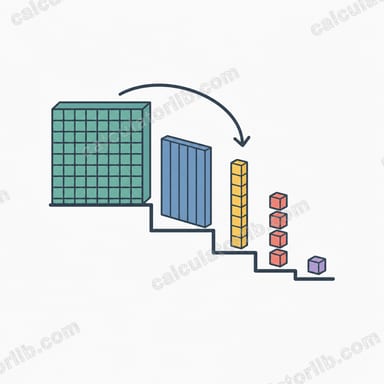
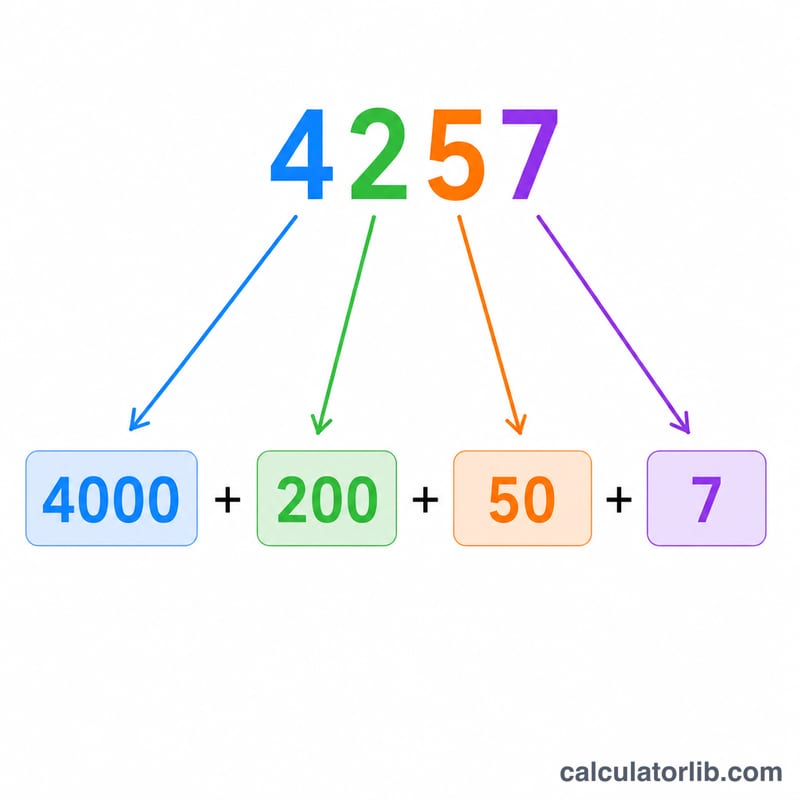
Expanded form is a way of writing a number that shows the value of each digit. Instead of writing 4,567 as a single compact number, expanded form breaks it apart into the sum of each digit multiplied by its place value: \(4000 + 500 + 60 + 7\). This makes place value visible and is a core skill in elementary math.
How to Use This Calculator
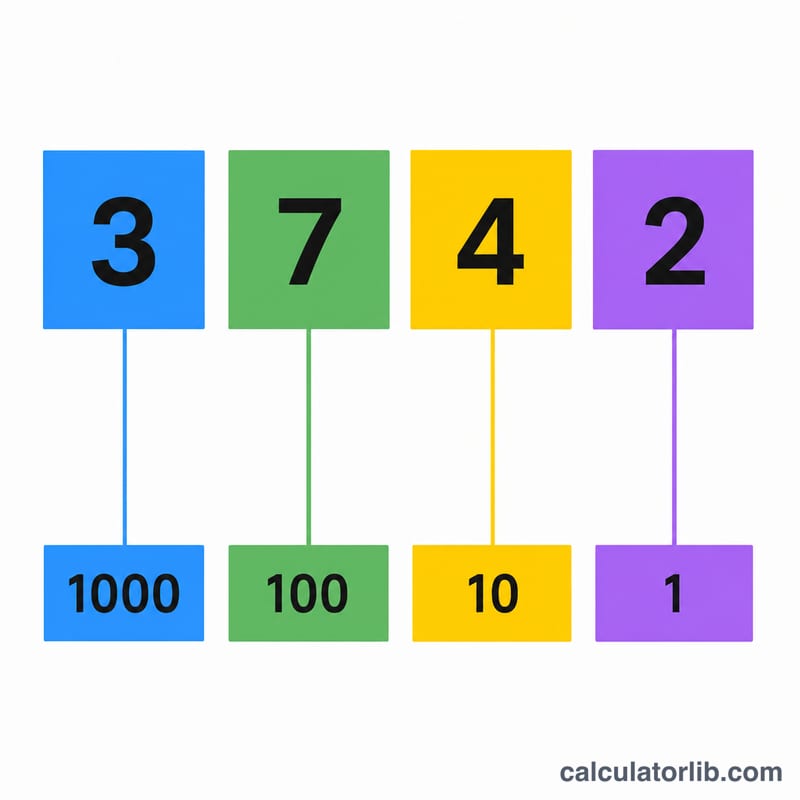
Type any whole number into the input box and the calculator instantly shows two versions of its expanded form: the sum of the place values (e.g. \(4000 + 500 + 60 + 7\)) and the factored version that shows the work (e.g. \(4 \times 1000 + 5 \times 100 + 6 \times 10 + 7 \times 1\)). Zero digits are skipped because they contribute nothing to the total. The result table also reports how many digits and how many non-zero terms the number has.
The Formula Explained
Every whole number can be written as $$N = \sum_{i} d_i \times 10^{\,p_i}$$ where \(d_i\) is a digit and \(p_i\) is its position counted from the right, starting at 0. The rightmost digit has place value \(10^0 = 1\), the next has \(10^1 = 10\), then \(10^2 = 100\), and so on. Multiply each digit by its place value and add the results to recover the original number.
Worked Example
Take the number 3,205. The digits from left to right are 3, 2, 0, 5 in the thousands, hundreds, tens, and ones places. So: $$3 \times 1000 + 2 \times 100 + 0 \times 10 + 5 \times 1 = 3000 + 200 + 0 + 5$$ Dropping the zero term, the expanded form is 3000 + 200 + 5.
Place Value Chart
In the base-ten system every digit carries a weight of \(10^{p}\), where \(p\) is the digit's position counted from the right, starting at 0. This is the same index \(p_i\) used in the formula \(\text{Number} = \sum_i d_i \times 10^{\,p_i}\), so the chart below reads directly into the expanded form: the rightmost digit always pairs with \(10^0 = 1\).
| Position index \(p\) | Place name | Power of ten | Place value |
|---|---|---|---|
| 0 | Ones | \(10^{0}\) | 1 |
| 1 | Tens | \(10^{1}\) | 10 |
| 2 | Hundreds | \(10^{2}\) | 100 |
| 3 | Thousands | \(10^{3}\) | 1,000 |
| 4 | Ten thousands | \(10^{4}\) | 10,000 |
| 5 | Hundred thousands | \(10^{5}\) | 100,000 |
| 6 | Millions | \(10^{6}\) | 1,000,000 |
| 7 | Ten millions | \(10^{7}\) | 10,000,000 |
| 8 | Hundred millions | \(10^{8}\) | 100,000,000 |
| 9 | Billions | \(10^{9}\) | 1,000,000,000 |
| 10 | Ten billions | \(10^{10}\) | 10,000,000,000 |
| 11 | Hundred billions | \(10^{11}\) | 100,000,000,000 |
Notice that the place names repeat in groups of three — ones/tens/hundreds, then thousands/ten thousands/hundred thousands, then millions/ten millions/hundred millions, and so on. Those groups are exactly the groups marked off by the comma separators used in English-language number writing, so each comma you pass moving left raises the group name by one step (thousand → million → billion). In some countries a space or a period is used as the thousands separator instead of a comma, but the grouping of three digits is the same.
One caution for large numbers: this chart uses the short scale, in which one billion is \(10^{9}\). That convention is standard in English-speaking countries. Several other languages and countries use the long scale, where \(10^{9}\) is called a milliard and "billion" means \(10^{12}\) — the arithmetic of the powers of ten never changes, only the name attached to the group.
More Worked Examples
Each example below lists the digits with their position index \(p\), writes the factored form (digit × place value), simplifies to the summed form, and then adds the terms back up as a check.
Example 1 — A two-digit number: 47
Reading from the right: the 7 sits at \(p = 0\) (ones) and the 4 at \(p = 1\) (tens).
$$47 = 4 \times 10^{1} + 7 \times 10^{0}$$Substituting the place values gives the factored form
$$47 = 4 \times 10 + 7 \times 1$$and multiplying out gives the summed form
$$47 = 40 + 7$$Check: \(40 + 7 = 47\). ✓ The expanded form of 40 + 7 adds back to the original number.
Example 2 — Interior and trailing zeros: 10,040
This five-digit number has digits 1, 0, 0, 4, 0 from left to right, so the positions are \(p = 4, 3, 2, 1, 0\):
$$10{,}040 = 1 \times 10^{4} + 0 \times 10^{3} + 0 \times 10^{2} + 4 \times 10^{1} + 0 \times 10^{0}$$In factored form that is
$$10{,}040 = 1 \times 10000 + 0 \times 1000 + 0 \times 100 + 4 \times 10 + 0 \times 1$$Any term whose digit is 0 equals 0, so three of the five terms vanish — the two interior zeros (thousands and hundreds) and the trailing zero in the ones place:
$$10{,}040 = 10000 + 0 + 0 + 40 + 0 = 10000 + 40$$Check: \(10000 + 40 = 10040\). ✓ The compact expanded form is 10000 + 40. The zeros still matter in the original numeral, where they hold the places open; they simply contribute nothing to the sum.
Example 3 — A six-digit number: 826,593
The digits 8, 2, 6, 5, 9, 3 occupy positions \(p = 5\) down to \(p = 0\):
| Digit \(d\) | Position \(p\) | Place | Term \(d \times 10^{p}\) |
|---|---|---|---|
| 8 | 5 | Hundred thousands | 8 × 100000 = 800000 |
| 2 | 4 | Ten thousands | 2 × 10000 = 20000 |
| 6 | 3 | Thousands | 6 × 1000 = 6000 |
| 5 | 2 | Hundreds | 5 × 100 = 500 |
| 9 | 1 | Tens | 9 × 10 = 90 |
| 3 | 0 | Ones | 3 × 1 = 3 |
Factored form:
$$826{,}593 = 8 \times 100000 + 2 \times 10000 + 6 \times 1000 + 5 \times 100 + 9 \times 10 + 3 \times 1$$Summed form:
$$826{,}593 = 800000 + 20000 + 6000 + 500 + 90 + 3$$Check, adding from the smallest term upward: \(3 + 90 = 93\); \(93 + 500 = 593\); \(593 + 6000 = 6593\); \(6593 + 20000 = 26593\); \(26593 + 800000 = 826593\). ✓ So 800000 + 20000 + 6000 + 500 + 90 + 3 is the expanded form.
Example 4 (optional) — A negative number: −512
A minus sign applies to the whole value, not to one digit. Expand the magnitude first and then negate the entire sum:
$$512 = 5 \times 100 + 1 \times 10 + 2 \times 1 = 500 + 10 + 2$$$$-512 = -(500 + 10 + 2)$$If you prefer to distribute the sign, every term becomes negative: \(-512 = -500 - 10 - 2\). Check: \(-500 - 10 - 2 = -512\). ✓ Writing \(-500 + 10 + 2\) would be wrong — that equals \(-488\) — which is why the parentheses (or a minus sign on every term) are essential.
FAQ
Why is the zero term left out? A digit of 0 multiplied by any place value equals 0, so it adds nothing and is omitted for clarity.
Does it work with decimals? This calculator focuses on whole numbers; decimal places (tenths, hundredths) are not included.
What about negative numbers? Negative numbers are supported — the expanded form is wrapped in parentheses with a leading minus sign.