What Is Frequency Bandwidth?
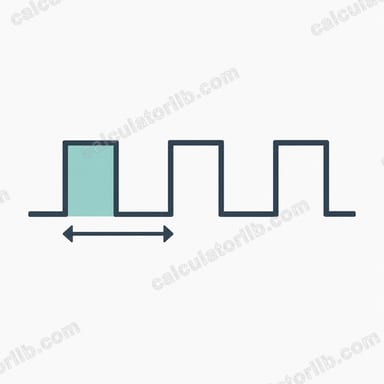
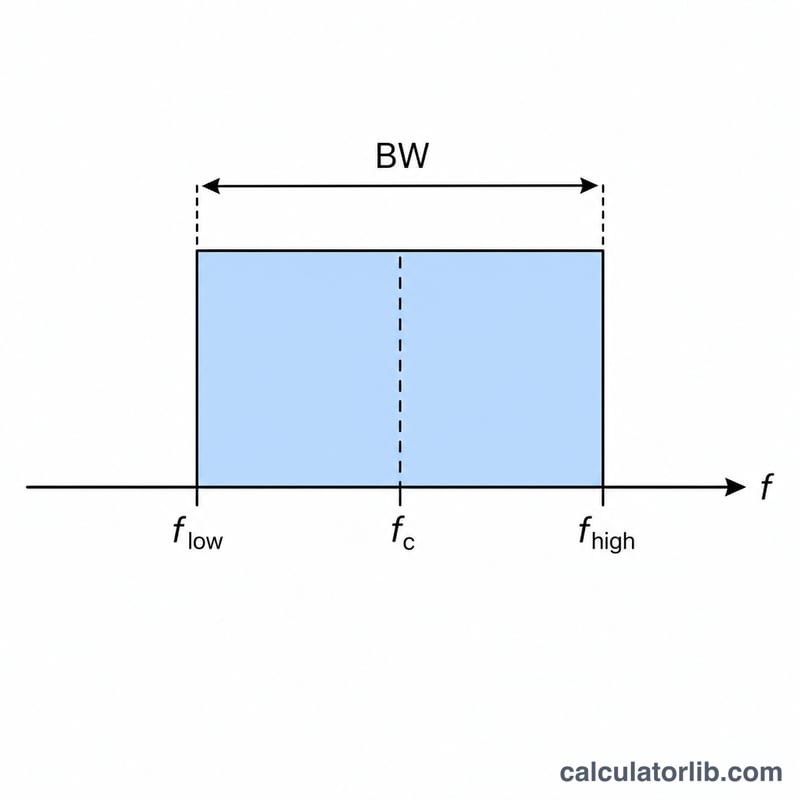
Bandwidth is the width of a frequency band — the range of frequencies a signal, channel, or system occupies. It is found simply by subtracting the lowest frequency from the highest frequency in the band. Bandwidth is a fundamental concept in electronics, telecommunications, audio engineering, and radio-frequency (RF) design, where it determines data capacity, signal fidelity, and channel allocation.
How to Use This Calculator
Enter the upper (higher) frequency limit and the lower frequency limit, both in hertz (Hz). The calculator returns the bandwidth, the center frequency (the midpoint of the two limits), and the fractional bandwidth — the bandwidth expressed as a percentage of the center frequency, which is useful for comparing how "wide" different bands are relative to their location in the spectrum.
The Formula Explained
The core relationship is \(\text{BW} = f_{\text{high}} - f_{\text{low}}\). The center frequency is the average, \(\frac{f_{\text{high}} + f_{\text{low}}}{2}\), and the fractional bandwidth is BW divided by the center frequency, multiplied by 100 to express it as a percentage. A narrowband signal has a small fractional bandwidth; an ultra-wideband signal has a large one.
$$\text{BW} = \text{Upper Frequency (Hz)} - \text{Lower Frequency (Hz)}$$where
$$f_c = \frac{\text{Upper Frequency} + \text{Lower Frequency}}{2} \qquad \text{BW}_\% = \frac{\text{BW}}{f_c}\times 100$$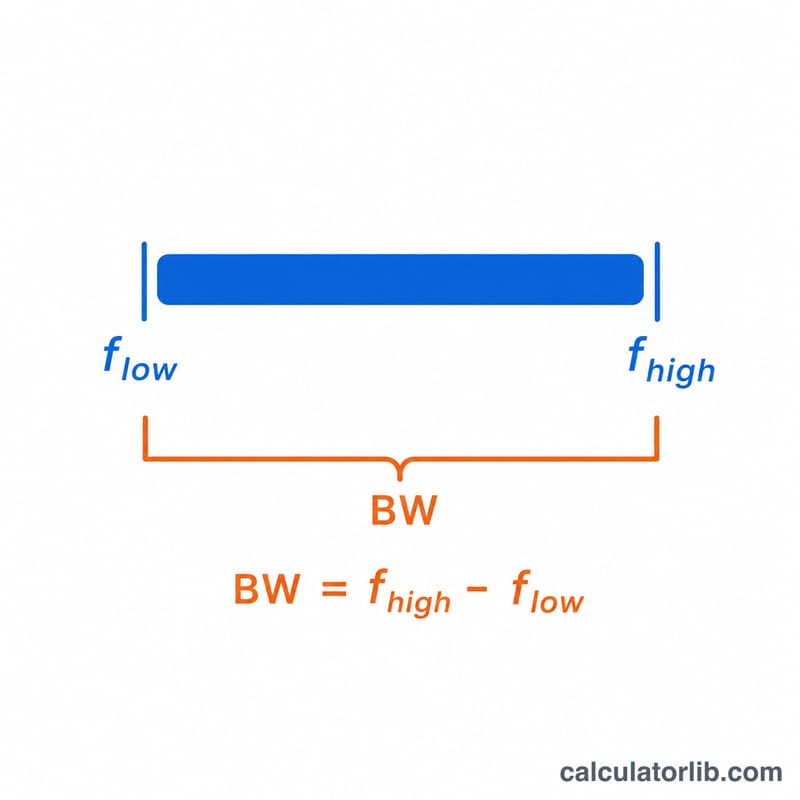
Worked Example
Consider the audible audio range: \(f_{\text{high}} = 20{,}000\ \text{Hz}\) and \(f_{\text{low}} = 20\ \text{Hz}\). The bandwidth is $$20{,}000 - 20 = 19{,}980\ \text{Hz}.$$ The center frequency is $$\frac{20{,}000 + 20}{2} = 10{,}010\ \text{Hz},$$ and the fractional bandwidth is $$\frac{19{,}980}{10{,}010}\times 100 \approx 199.6\%.$$
Typical Bandwidths of Common Signals and Bands
Fractional bandwidth is \(\text{FBW} = \dfrac{f_\text{high} - f_\text{low}}{(f_\text{high}+f_\text{low})/2} \times 100\%\). The values below use commonly published band definitions. Channel plans differ by country, so the AM and FM rows note where a figure is regional. Where a row says "example", the channel center was picked for illustration.
| Signal / band | f_low | f_high | Bandwidth | Approx. fractional bandwidth |
|---|---|---|---|---|
| Voice telephony | 300 Hz | 3,400 Hz | 3.1 kHz | ≈ 167.6% |
| Audible audio (nominal human hearing) | 20 Hz | 20 kHz | 19,980 Hz (≈ 20 kHz) | ≈ 199.6% |
| AM broadcast channel (example: 1,000 kHz carrier, 10 kHz channel spacing as in the US; 9 kHz elsewhere) | 995 kHz | 1,005 kHz | 10 kHz | ≈ 1.0% |
| FM broadcast channel (example: 100 MHz, 200 kHz spacing) | 99.9 MHz | 100.1 MHz | 200 kHz | ≈ 0.2% |
| FM broadcast band (87.5–108 MHz, as used in much of the world) | 87.5 MHz | 108 MHz | 20.5 MHz | ≈ 21.0% |
| Wi-Fi 2.4 GHz channel (example: channel 6, 20 MHz wide) | 2,427 MHz | 2,447 MHz | 20 MHz | ≈ 0.82% |
| Wi-Fi 2.4 GHz band | 2.400 GHz | 2.4835 GHz | 83.5 MHz | ≈ 3.4% |
| Bluetooth (classic, 1 MHz channels across the band) | 2.402 GHz | 2.480 GHz | 78 MHz (79 channels of 1 MHz) | ≈ 3.2% |
| FCC ultra-wideband (UWB) band, US | 3.1 GHz | 10.6 GHz | 7.5 GHz | ≈ 109.5% |
Interpreting Your Bandwidth and Fractional Bandwidth
Absolute bandwidth tells you how much spectrum a signal occupies. Fractional bandwidth compares that span with the center frequency, so it shows how "wide" the signal is relative to where it sits in the spectrum.
- Narrowband: fractional bandwidth below about 1%.
- Wideband: fractional bandwidth from about 1% to 20%.
- Ultra-wideband (UWB): in the US, the FCC defines UWB as a fractional bandwidth above 20%, or an absolute bandwidth of at least 500 MHz. Other regulators may use different rules.
These thresholds are conventions and the boundaries are not sharp. A channel at 1% sits right on the narrowband/wideband border.
Capacity link: for a given signal-to-noise ratio, more bandwidth allows more potential channel capacity. The Shannon–Hartley theorem gives the upper limit: \(C = B \log_2(1+\text{SNR})\), where \(C\) is in bits per second, \(B\) in Hz, and SNR is a linear power ratio, not dB.
What the calculator measures: it returns the span between the upper and lower frequencies you enter, \(\text{BW} = f_\text{high} - f_\text{low}\). It does not measure anything itself. If you enter −3 dB points, you get the −3 dB bandwidth. If you enter allocated band edges, you get the allocated span. The result is only as meaningful as the limits you choose.
Fractional bandwidth above 100%: this is normal for wideband ranges. The center frequency is the arithmetic mean of the two limits, and when \(f_\text{low}\) is small compared with \(f_\text{high}\), the span exceeds that mean. For example, 20 Hz to 20,000 Hz gives \(\text{BW} = 19{,}980\) Hz and a center of 10,010 Hz, so \(\text{FBW} = 19{,}980/10{,}010 \approx 1.996 = 199.6\%\). The theoretical maximum with this definition is 200%, reached as \(f_\text{low} \to 0\).
Frequency Unit Conversion Table
Convert both frequencies to the same unit before subtracting. The bandwidth then comes out in that unit.
| Unit | In hertz | Equivalent |
|---|---|---|
| 1 Hz | 1 Hz | 10−3 kHz = 10−6 MHz = 10−9 GHz |
| 1 kHz | 1,000 Hz | 103 Hz = 10−3 MHz |
| 1 MHz | 1,000,000 Hz | 106 Hz = 1,000 kHz |
| 1 GHz | 1,000,000,000 Hz | 109 Hz = 1,000 MHz |
| 1 THz | 1012 Hz | 1,000 GHz |
Quick example: 2.4 GHz = 2,400 MHz = 2,400,000 kHz = 2,400,000,000 Hz.
FAQ
What units should I use? Use the same unit for both inputs — typically hertz (Hz), but kHz, MHz, or GHz also work as long as both values match; the bandwidth comes out in that same unit.
What is fractional bandwidth used for? It tells you how wide a band is relative to its center. Antennas and filters are often classified as narrowband (<1%), wideband, or ultra-wideband (>20%) based on this figure.
Can bandwidth be negative? If you enter a lower frequency that is larger than the upper one, the result will be negative — simply swap the values so \(f_{\text{high}}\) is the larger number.