What Is the G Force Calculator?
G-force is a way of expressing acceleration as a multiple of Earth's standard gravitational acceleration. One "g" equals 9.80665 m/s² — the nominal acceleration an object feels at rest on Earth's surface. This calculator converts any linear acceleration value in metres per second squared (m/s²) into its equivalent G-force, a unit commonly used in aviation, motorsport, roller-coaster design, and aerospace engineering.
How to Use It
Enter the acceleration in m/s² and the calculator instantly returns the G-force. For reference, 9.80665 m/s² equals exactly 1 g, while 19.6133 m/s² equals 2 g. Use it to interpret accelerometer readings, sensor data, or physics homework.
The Formula Explained
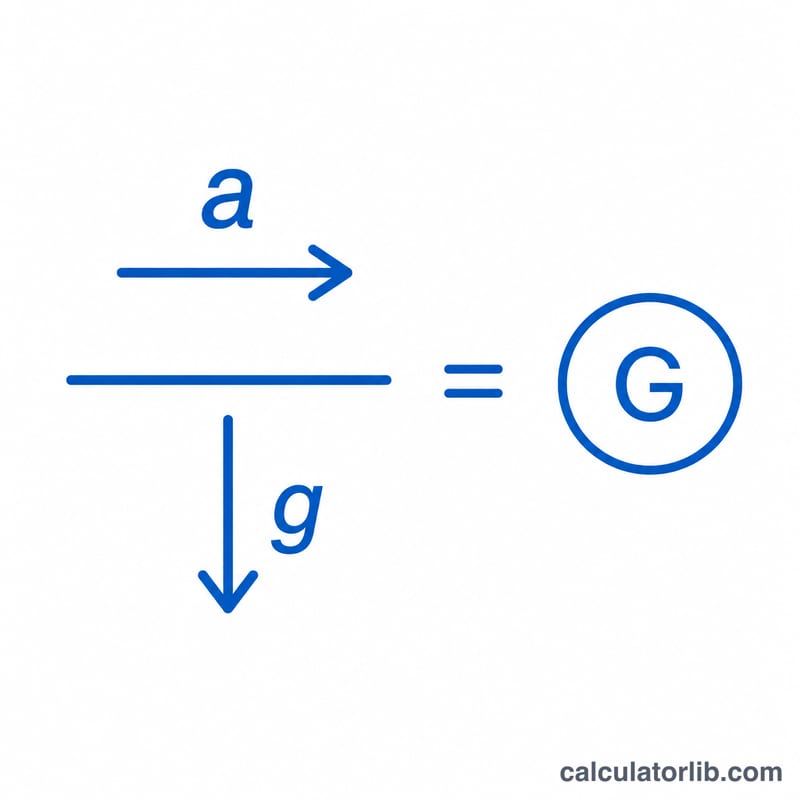
The conversion is simply $$G = \frac{a}{9.80665}$$ where a is the acceleration in m/s² and 9.80665 is the standard gravity constant (g₀) defined by international agreement. Because it is a straight division by a fixed constant, doubling the acceleration doubles the G-force.
Worked Example
Suppose a race car decelerates at 49.03325 m/s² during heavy braking. Dividing by 9.80665 gives $$\frac{49.03325}{9.80665} = 5 \text{ g}$$ That means the driver experiences five times their normal body weight pushing them forward — a punishing but survivable load.
Common G-Force Levels in Everyday Life and Engineering
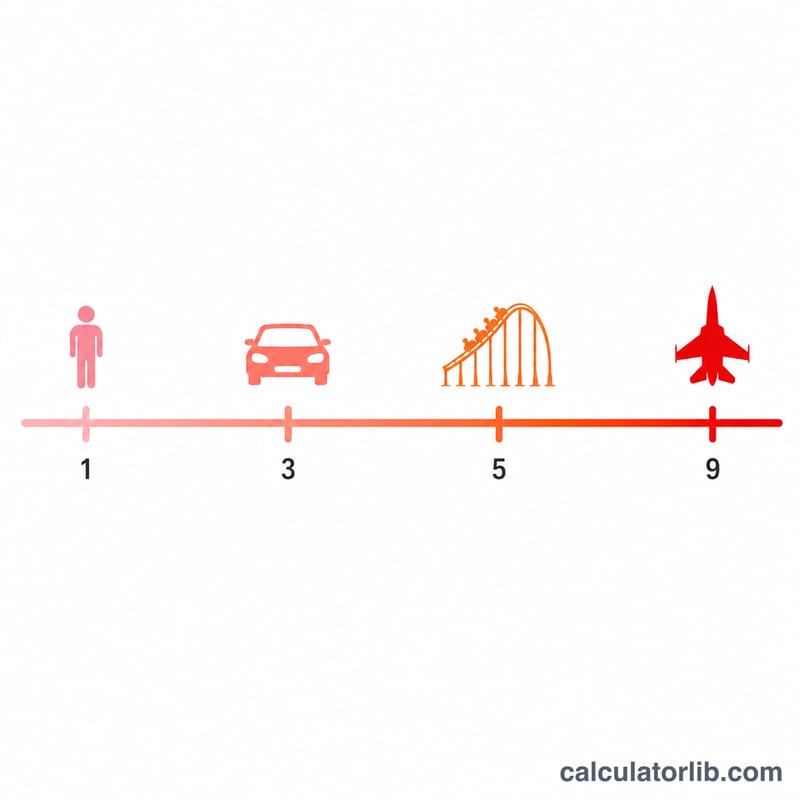
One g is the standard acceleration of gravity, defined as exactly 9.80665 m/s². The values below are typical or approximate figures; real events vary with vehicle, ride and maneuver.
| Situation | Typical G-force | Approx. acceleration (m/s²) |
|---|---|---|
| Standing still on Earth | 1 g | 9.80665 |
| Elevator starting up or down | ~0.1–0.2 g | ~1–2 |
| Commercial airliner takeoff | ~0.3 g | ~2.9 |
| Car braking hard | ~0.8–1 g | ~7.8–9.8 |
| Roller coaster | 3–5 g | ~29–49 |
| Space shuttle launch | ~3 g | ~29 |
| Formula 1 braking/cornering | ~5–6 g | ~49–59 |
| Apollo reentry peak | ~6–7 g | ~59–69 |
| Fighter pilot turns | up to ~9 g | ~88 |
| Moon surface gravity (for comparison) | ~0.165 g | ~1.62 |
| Mars surface gravity (for comparison) | ~0.38 g | ~3.71 |
Acceleration Unit Conversion Table
Equivalents of 1 g (standard gravity):
- 1 g = 9.80665 m/s²
- 1 g = 32.1740 ft/s²
- 1 g = 980.665 Gal (cm/s²)
- 1 g = 35.3039 km/h per second
- 1 g = 21.937 mph per second
| G-force | m/s² | ft/s² |
|---|---|---|
| 0.5 g | 4.9033 | 16.087 |
| 1 g | 9.8067 | 32.174 |
| 2 g | 19.6133 | 64.348 |
| 5 g | 49.0333 | 160.870 |
| 10 g | 98.0665 | 321.740 |
To convert from m/s² to g, divide by 9.80665. To go the other way, multiply by 9.80665.
Interpreting Your G-Force Result
The formula is \(G = \frac{a}{9.80665}\), where \(a\) is acceleration in m/s². The result tells you how many times normal gravity the acceleration represents. Example: \(a = 29.42\) m/s² gives \(G = \frac{29.42}{9.80665} \approx\) 3.00 g.
G-force as apparent weight
A g value is a multiple of apparent weight. A 70 kg person at 3 g experiences a load equivalent to about 210 kg-force, which is roughly \(70 \times 9.80665 \times 3 \approx 2059\) newtons, compared with about 687 N at 1 g.
Direction matters
- Positive g (+Gz): acceleration directed head-to-foot in the body frame, pushing blood toward the feet, as in a pull-up in an aircraft or the bottom of a loop.
- Negative g (−Gz): acceleration directed foot-to-head, pushing blood toward the head, as in an outside loop. It is typically tolerated at much lower magnitudes than positive g.
- Lateral g (±Gy) and front-to-back g (±Gx): sideways or chest-to-back loads, as in cornering or braking. The body generally tolerates Gx loads better than Gz loads.
Sustained versus momentary exposure
Duration is as important as magnitude. Sustained loads lasting many seconds affect circulation and vision, while impacts lasting milliseconds can reach tens of g without the same circulatory effects, though they still stress tissue and structures.
Documented thresholds from aviation physiology
- Roughly 4–5 g sustained positive g in untrained, unprotected people can cause greyout, tunnel vision or blackout (G-LOC follows at higher loads or faster onset).
- Trained pilots using a g-suit and an anti-g straining maneuver can tolerate about 9 g for short periods.
- Brief impact tolerance is far higher, with survivable crash and ejection loads reported well above these sustained limits, depending on direction, duration and restraint.
These figures are general reference values from aviation physiology and vary between individuals and conditions. They are not medical advice or a safety guarantee.
FAQ
What is 1 g in m/s²? Exactly 9.80665 m/s², the internationally defined standard gravity.
Is local gravity exactly 9.80665? No — actual gravity varies slightly (roughly 9.78–9.83 m/s²) by latitude and altitude, but G-force is conventionally referenced to the standard value.
How many g's can a human survive? Trained pilots tolerate around 9 g briefly with a g-suit; sustained exposure above a few g quickly causes blood to pool and loss of consciousness.