What Is the Mentzer Index?
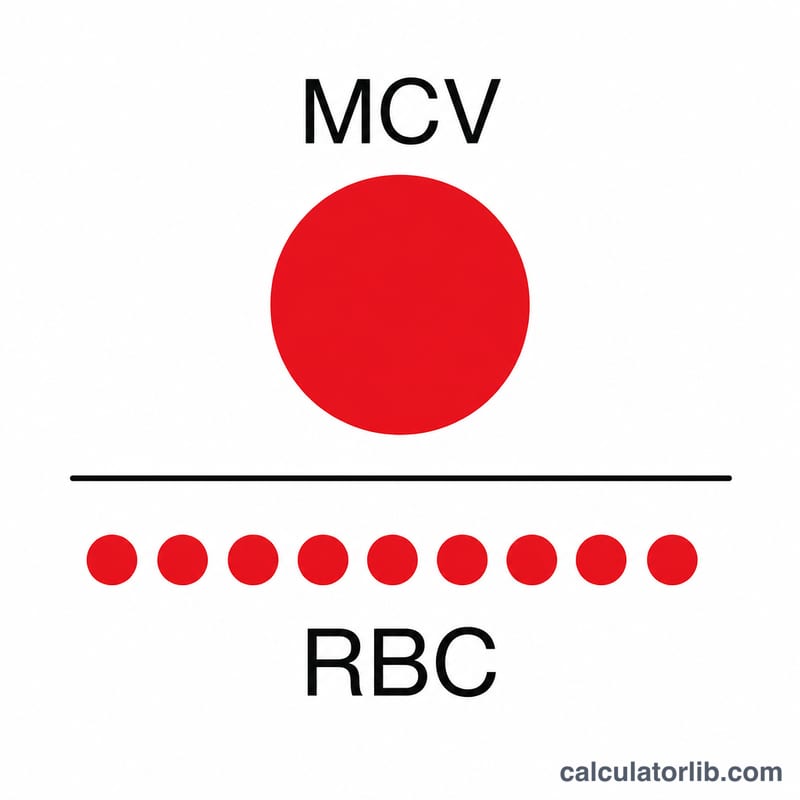
The Mentzer Index is a simple screening ratio used in hematology to help differentiate between beta thalassemia trait and iron deficiency anemia in patients with microcytic anemia. It is calculated by dividing the mean corpuscular volume (MCV) by the red blood cell (RBC) count. Both values come directly from a routine complete blood count (CBC). This tool is a clinical-decision aid, not a diagnosis—always confirm with further testing.
How to Use This Calculator
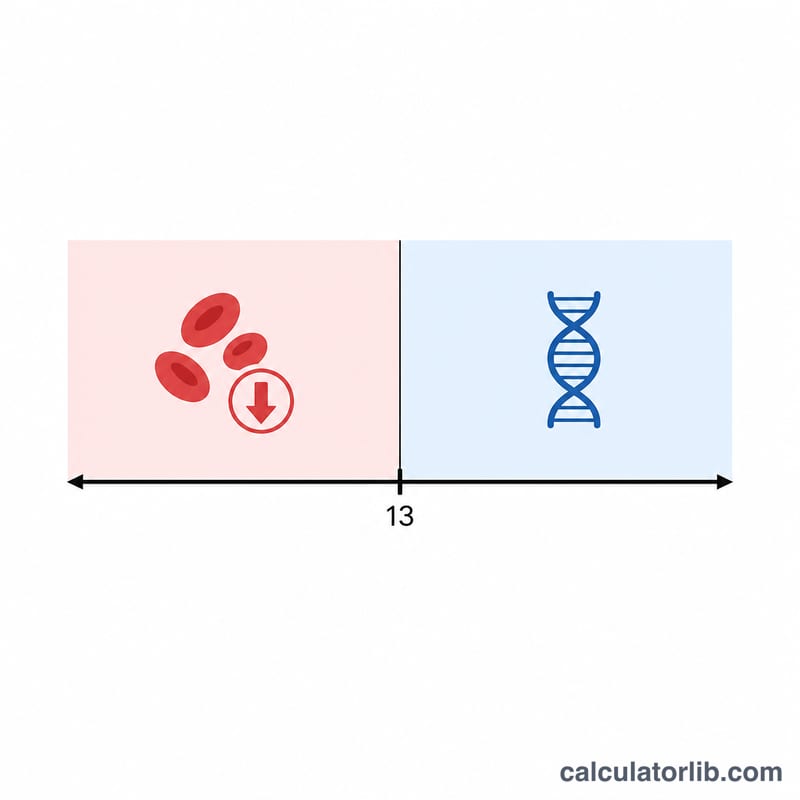
Enter your MCV in femtoliters (fL) and your RBC count in millions per microliter (millions/µL), both taken from your CBC report. The calculator instantly returns the Mentzer Index and a quick interpretation based on the standard cutoff of 13.
The Formula Explained
The equation is simply $$\text{Mentzer Index} = \frac{\text{MCV (fL)}}{\text{RBC (millions/}\mu\text{L)}}$$ The reasoning: in thalassemia trait, the body produces many small red cells, so the RBC count stays relatively high while MCV is low—giving a small ratio. In iron deficiency, the marrow makes fewer cells, lowering the RBC count, so the ratio is larger. The widely used interpretation is: an index below 13 suggests thalassemia trait, while an index above 13 suggests iron deficiency anemia.
Worked Example
Suppose a patient has an MCV of 65 fL and an RBC count of 5.5 million/µL. The Mentzer Index = $$65 \div 5.5 = 11.82$$ Because \(11.82\) is below 13, the result is suggestive of thalassemia trait, warranting hemoglobin electrophoresis for confirmation.
Interpreting Your Mentzer Index Result
The Mentzer Index is a simple ratio of mean corpuscular volume to red blood cell count, first proposed by W. C. Mentzer in 1973 as a way to sort microcytic anemias into two broad groups:
$$\text{Mentzer Index} = \frac{\text{MCV in fL}}{\text{RBC in millions per }\mu\text{L}}$$The logic is physiological: in beta thalassemia trait the marrow produces many small red cells, so RBC count is normal or high while MCV is low — a small numerator over a large denominator gives a low ratio. In iron deficiency the marrow cannot produce enough cells at all, so both MCV and RBC fall, and the ratio stays high.
The three result bands
| Mentzer Index | Suggests | Typical accompanying pattern |
|---|---|---|
| Less than 13 | Beta thalassemia trait (thalassemia minor) | Low MCV with normal or elevated RBC count; RDW often normal |
| About 13 (borderline) | Indeterminate — the index does not discriminate | Either condition, or both together; further testing required |
| Greater than 13 | Iron deficiency anemia | Low MCV with low RBC count; RDW often raised; ferritin low |
Worked example
A patient with MCV 65 fL and RBC 5.8 × 10⁶/µL:
$$\text{Index} = \frac{65}{5.8} = 11.21$$The result 11.21 falls below 13, which points toward beta thalassemia trait and would prompt hemoglobin electrophoresis or HPLC. By contrast, MCV 72 fL with RBC 3.9 × 10⁶/µL gives 18.46 — above 13, favouring iron deficiency and prompting iron studies.
The index only applies to microcytic anemia
The ratio was designed and validated in patients who already have microcytosis, conventionally MCV below 80 fL in adults. If MCV is normal (80–100 fL) or high (macrocytic), the Mentzer Index is meaningless — a normal MCV divided by a normal RBC count will almost always land above 13, which is not evidence of iron deficiency. Always confirm that the MCV is genuinely low before using the result at all.
Accuracy limits and situations that break the index
Published studies report a wide spread of sensitivity and specificity for the <13 cut-off — commonly in the region of 60–95% depending on the population studied, the mix of alpha and beta variants, and how many patients had concurrent iron deficiency. Because reported performance varies so much between cohorts, the index should be treated as a triage aid that decides which confirmatory test to order first, not as a test with a fixed, trustworthy accuracy. Reliability falls further when:
- Iron deficiency and thalassemia trait coexist — iron deficiency suppresses the RBC count and can also lower HbA2, masking the trait and pushing the index upward.
- Recent blood transfusion — donor red cells distort MCV and RBC for weeks.
- Anemia of chronic disease or inflammation — mild microcytosis with a normal or high ferritin confuses both the index and the iron studies.
- Pregnancy — plasma volume expansion dilutes the RBC count and alters the ratio.
- Alpha thalassemia trait — the index was derived mainly for beta thalassemia trait and performs less consistently for alpha variants; HbA2 is typically normal in alpha trait, so electrophoresis alone will not exclude it.
- Children, mixed nutritional deficiencies (B12/folate), lead exposure, sideroblastic anemia and hemoglobin E disorders — all shift MCV or RBC independently of the two conditions being separated.
What the result should prompt next
- Index below 13: hemoglobin electrophoresis or HPLC to quantify HbA2 (and HbF); an HbA2 above roughly 3.5% supports beta thalassemia trait. Iron studies are still usually checked in parallel, because iron deficiency can falsely lower HbA2.
- Index above 13: serum ferritin plus iron studies (serum iron, transferrin/TIBC, transferrin saturation). Ferritin is the single most useful test, but it is an acute-phase reactant and can be falsely normal during infection or inflammation.
- Index near 13: order both sets of tests; the ratio has given no useful information.
- If both sets are normal or discordant, DNA/genetic testing for alpha and beta globin variants may be required.
This is a screening ratio, not a diagnosis
A Mentzer Index cannot diagnose or exclude either condition. It is one number derived from two values on a complete blood count, and it must be read by a clinician alongside the full CBC (hemoglobin, hematocrit, RDW, MCH, blood film), the patient's symptoms, diet, family and ethnic background, and the confirmatory laboratory tests above. Other discriminant formulas (England–Fraser, Srivastava, Green–King, RDW index) are sometimes calculated at the same time and can disagree with each other. This page is general health information, not medical advice, and it gives no individual prescription — discuss any abnormal blood count with a qualified healthcare professional rather than acting on the ratio alone.
MCV, RBC and Related CBC Reference Values
The values below are typical adult reference intervals as reported by many clinical laboratories (commonly quoted in US and Western European labs). They are given so you can see where a Mentzer Index input sits relative to normal — they are not diagnostic thresholds.
| Parameter | Units | Typical adult reference interval | Relevance to the Mentzer Index |
|---|---|---|---|
| MCV (mean corpuscular volume) | fL | 80–100 | Below 80 fL = microcytic; the index is only meaningful in this range. It is the numerator. |
| RBC (red blood cell count) — men | ×10⁶/µL (= ×10¹²/L) | 4.7–6.1 | Denominator of the index. Normal or high alongside a low MCV is the classic thalassemia-trait pattern. |
| RBC — women | ×10⁶/µL | 4.2–5.4 | Low RBC with low MCV is the classic iron-deficiency pattern. |
| Hemoglobin — men | g/dL | 13.5–17.5 | Defines anemia; often only mildly reduced in thalassemia trait. |
| Hemoglobin — women | g/dL | 12.0–15.5 | As above; WHO uses slightly different anemia cut-offs (13 g/dL men, 12 g/dL non-pregnant women). |
| Hematocrit — men | % | 41–53 | Roughly three times the hemoglobin value in g/dL. |
| Hematocrit — women | % | 36–46 | Used with RBC and Hb to derive MCV and MCH. |
| RDW (red cell distribution width) | % | 11.5–14.5 | Usually normal in beta thalassemia trait (uniformly small cells) and raised in iron deficiency (anisocytosis). A key tiebreaker when the index is near 13. |
| MCH (mean corpuscular hemoglobin) | pg | 27–33 | Low in both conditions; often markedly low (<27 pg) in thalassemia trait even with near-normal hemoglobin. |
| MCHC | g/dL | 32–36 | Frequently reduced in established iron deficiency. |
| HbA2 (on electrophoresis/HPLC) | % | Normal <3.2; >3.5 suggests beta thalassemia trait | The confirmatory test for a low index. Values of 3.2–3.5% are borderline; concurrent iron deficiency can falsely lower HbA2. |
| Serum ferritin | ng/mL (= µg/L) | Men ~24–336; women ~11–307 (lab-dependent) | Low in iron deficiency (values below ~15–30 ng/mL are commonly used to confirm depleted stores); normal or high in thalassemia trait. Falsely normal during inflammation. |
| Transferrin saturation | % | ~20–50 | Reduced (commonly <16–20%) in iron deficiency; typically normal in thalassemia trait. |
Important caveats about reference intervals
- Intervals are laboratory-specific. They depend on the analyzer, the reagent lot and the reference population used to derive them. The ranges printed on the patient's own report always take precedence over any table, including this one.
- Age matters. Children have physiologically lower MCV and hemoglobin than adults — an MCV of 75 fL can be normal in a toddler — so adult cut-offs (and the 13 threshold itself) should not be applied to pediatric results without specialist interpretation.
- Sex matters. Male reference ranges for RBC, hemoglobin and hematocrit are higher than female ranges, which is why they are listed separately above.
- Altitude matters. Populations living at high altitude have chronically higher hemoglobin, hematocrit and RBC counts; labs in those regions publish shifted intervals, and an unadjusted range will misclassify results.
- Pregnancy, smoking, hydration status and recent transfusion all shift these values independently of any underlying hemoglobin disorder.
This table is general reference information, not medical advice. Interpretation of a complete blood count — and any decision about further testing or treatment — belongs with a qualified healthcare professional.
FAQ
Is the Mentzer Index definitive? No. It is a screening guide with imperfect sensitivity and specificity. Borderline values near 13 are especially uncertain and require further workup.
What units should I use? MCV in fL and RBC count in millions/µL (10⁶/µL), as reported on a standard CBC.
Why MCV over RBC and not the reverse? The ratio was defined this way so that the value falls below 13 for thalassemia and above 13 for iron deficiency, giving a single memorable cutoff.