What is the Minecraft Stack Calculator?
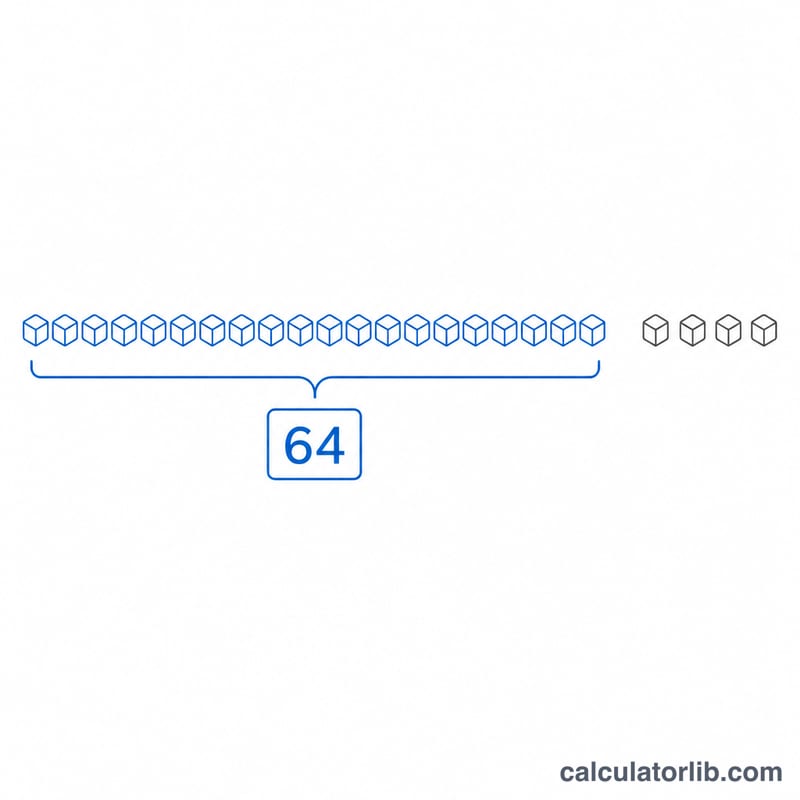
In Minecraft, items are stored in stacks. Most blocks and items stack up to 64, while a few — like snowballs, eggs, and ender pearls — only stack to 16, and tools, armor, and potions never stack (size 1). This calculator takes a raw item count and tells you how many full stacks it makes plus how many loose items are left over. It is handy for planning chest storage, shulker boxes, trades, and bulk crafting.
How to use it
Enter the total number of items you have, then pick the items-per-stack value that matches the item type (64, 16, or 1). The calculator returns the number of full stacks, the remainder, the stack size used, and the verified total. For example, organizing 1,000 cobblestone into chests is far easier when you know it equals 15 stacks plus 40 blocks.
The formula explained
The math is integer division and a modulo (remainder) operation. $$\text{Stacks} = \left\lfloor \frac{\text{items}}{\text{stackSize}} \right\rfloor$$ gives the count of complete stacks. The leftover is $$\text{remainder} = \text{items} - (\text{stacks} \times \text{stackSize})$$, which is equivalent to \(\text{items} \bmod \text{stackSize}\). Multiplying the stacks back out and adding the remainder always reproduces your original total, confirming nothing is lost.
Worked example
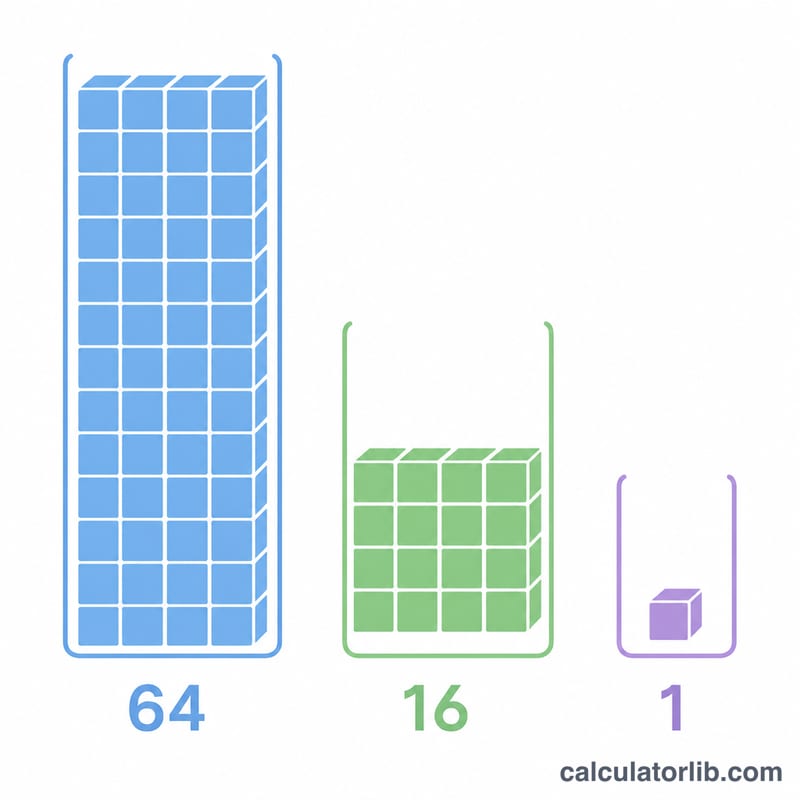
Suppose you mined 1,000 cobblestone (stack size 64). $$\lfloor 1000 \div 64 \rfloor = \lfloor 15.625 \rfloor = 15 \text{ full stacks}$$ Remainder = \(1000 - (15 \times 64) = 1000 - 960 = 40\). So you have 15 stacks and 40 blocks, filling 15 inventory slots completely with one slot holding 40.
Stacks to Storage: Chests, Shulker Boxes and Containers
In vanilla Minecraft (Java Edition and Bedrock Edition), storage is counted in slots, and each slot holds one stack. Most blocks and materials stack to 64; a smaller group (snowballs, eggs, ender pearls, signs, empty buckets, honey bottles) stacks to 16; and tools, weapons, armour, potions, boats and minecarts do not stack at all (stack size 1). So a container's real capacity is simply:
$$\text{Container capacity} = \text{Slots} \times \text{Stack Size}$$The table below gives the capacity of every common vanilla container at each of the three stack sizes the calculator supports. Modded or datapack-altered games may use different stack sizes, so treat these as vanilla figures.
| Container | Slots | Max items at stack 64 | at stack 16 | at stack 1 |
|---|---|---|---|---|
| Single chest | 27 | 1,728 | 432 | 27 |
| Double chest | 54 | 3,456 | 864 | 54 |
| Shulker box | 27 | 1,728 | 432 | 27 |
| Barrel | 27 | 1,728 | 432 | 27 |
| Hopper | 5 | 320 | 80 | 5 |
| Dispenser / Dropper | 9 | 576 | 144 | 9 |
| Player inventory (27 main + 9 hotbar) | 36 | 2,304 | 576 | 36 |
| Ender chest | 27 | 1,728 | 432 | 27 |
The largest practical single-container payload is a double chest packed with full shulker boxes. Each shulker box holds 1,728 items of a stack-64 material, and a double chest holds 54 of them:
$$54 \times 1{,}728 = 93{,}312 \text{ items}$$Note that shulker boxes cannot be nested — a shulker box cannot be placed inside another shulker box — so 93,312 is the ceiling for this trick, not the start of an infinite chain. An ender chest's 27 slots are per-player and shared across every ender chest in the world.
Stacks and Remainder for Common Item Counts
These are the item counts players meet most often — a partial haul, a full shulker box, a full double chest, a round mining target. "Stacks" is the number of completely full stacks, and the remainder is what is left over in a partial stack. "Slots @64" counts the storage slots actually occupied: the full stacks plus one extra slot whenever the remainder is greater than zero.
| Item Count | Stacks @64 (+ remainder) | Stacks @16 (+ remainder) | Slots @64 |
|---|---|---|---|
| 100 | 1 + 36 | 6 + 4 | 2 |
| 256 | 4 + 0 | 16 + 0 | 4 |
| 500 | 7 + 52 | 31 + 4 | 8 |
| 1,000 | 15 + 40 | 62 + 8 | 16 |
| 1,728 (full shulker box) | 27 + 0 | 108 + 0 | 27 |
| 3,456 (full double chest) | 54 + 0 | 216 + 0 | 54 |
| 10,000 | 156 + 16 | 625 + 0 | 157 |
Every row satisfies the identity \(\text{Stacks} \times \text{Stack Size} + \text{Remainder} = \text{Total Items}\). Checking the 10,000-item row at stack size 64:
$$156 \times 64 + 16 = 9{,}984 + 16 = 10{,}000$$And the 500-item row at stack size 16:
$$31 \times 16 + 4 = 496 + 4 = 500$$Two patterns are worth remembering. First, the 16-stack column has no remainder at 256, 1,728, 3,456 or 10,000, because each of those counts is a multiple of 16 — a stack-16 item packs evenly far more often than intuition suggests. Second, a remainder always costs a whole extra slot: 10,000 items needs 157 slots even though 156 of them are completely full, which is why 10,000 blocks will not fit in a double chest (54 slots) but will fit in six shulker boxes (162 slots) with room to spare.
FAQ
How many slots will my items take? Each full stack uses one slot, and any remainder uses one more slot — so \(15 \text{ stacks} + 40 \text{ leftover} = 16 \text{ slots}\).
Which items stack to only 16? Snowballs, eggs, ender pearls, signs, buckets of items, and a handful of others use a 16 stack size.
Does a double chest hold 27 or 54 stacks? A single chest has 27 slots and a double chest has 54 slots, so at stack size 64 a double chest holds up to \(54 \times 64 = 3{,}456\) items.