What Is Muzzle Energy?
Muzzle energy is the kinetic energy a bullet carries the instant it leaves the barrel. It is a core figure in ballistics and shooting because it indicates how much work a projectile can do on a target — influencing penetration, terminal performance, and recoil. This calculator uses the customary U.S. units common in American shooting sports: bullet weight in grains and muzzle velocity in feet per second (fps), producing energy in foot-pounds (ft-lb).
How to Use the Calculator
Getting a result takes only two inputs, both of which appear on most ammunition boxes or load data:
- Bullet weight (grains): The mass of the projectile. Common values range from about 35 gr for small .22 rounds to 180 gr or more for hunting rifle bullets.
- Muzzle velocity (fps): The speed of the bullet leaving the barrel, often listed by the manufacturer or measured with a chronograph.
Enter both numbers and the calculator instantly returns the muzzle energy in foot-pounds.
The Formula Explained
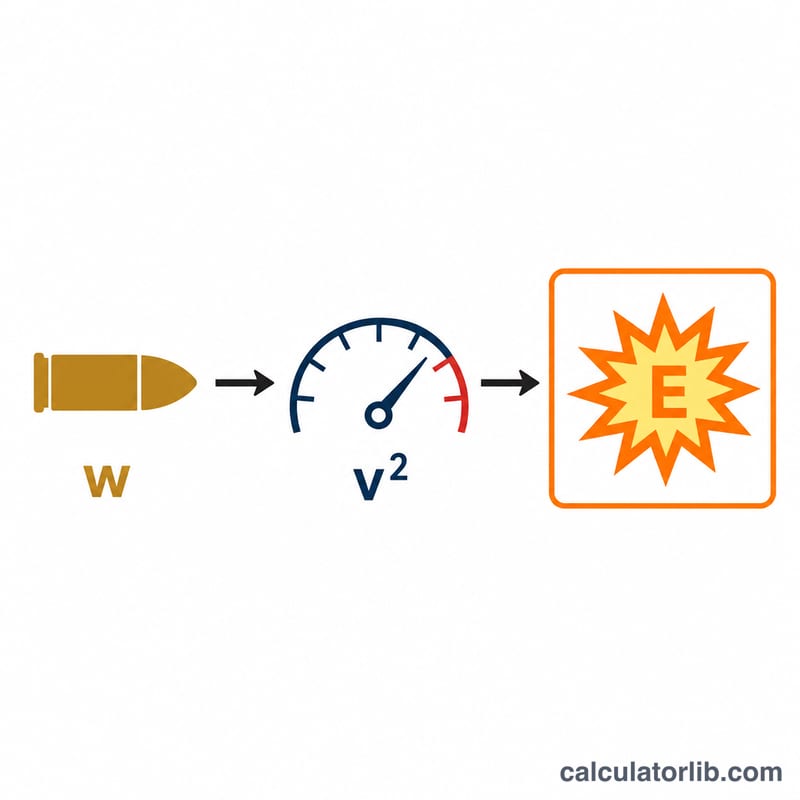
Muzzle energy is derived from the classic kinetic energy equation \(KE = \tfrac{1}{2}mv^2\). When using grains and fps, the constant 450,240 converts the units so the answer comes out in foot-pounds:
- $$\text{Energy (ft-lb)} = \frac{\text{Bullet Weight} \times \text{Velocity}^2}{450{,}240}$$
The constant accounts for the conversion of grains to pounds (7,000 grains per pound) and the gravitational factor used to relate mass and weight. Note that velocity is squared, so speed has a far larger effect on energy than weight.
Worked Example
Consider a standard 9mm load with a 115-grain bullet traveling at 1,180 fps:
- Velocity squared: \(1{,}180 \times 1{,}180 = 1{,}392{,}400\)
- Multiply by weight: \(115 \times 1{,}392{,}400 = 160{,}126{,}000\)
- Divide by 450,240: \(\approx 356 \text{ ft-lb}\)
So this cartridge delivers roughly 356 foot-pounds at the muzzle.
Typical Muzzle Energy by Common Cartridge
The table uses the calculator's formula \(E = \frac{ w \times v^{2}}{450437.5}\), with bullet weight \(w\) in grains and velocity \(v\) in feet per second. The result is in foot-pounds (ft-lb). The loads are typical factory figures, and real velocities vary by manufacturer, bullet style and barrel length. Treat the energies as approximate.
| Cartridge | Bullet weight (gr) | Muzzle velocity (fps) | Approx. muzzle energy (ft-lb) |
|---|---|---|---|
| .22 LR | 40 | 1,200 | ~128 |
| 9mm Luger | 115 | 1,180 | ~355 |
| .45 ACP | 230 | 850 | ~369 |
| .223 Remington | 55 | 3,240 | ~1,282 |
| .308 Winchester | 150 | 2,820 | ~2,648 |
| 12-gauge slug (1 oz = 437.5 gr) | 437.5 | 1,600 | ~2,486 |
Example substitution for the .45 ACP: \(E = \frac{230 \times 850^{2}}{450437.5} = \frac{230 \times 722{,}500}{450437.5} \approx 369\) ft-lb.
Unit Conversions for Muzzle Energy
| Conversion | Factor |
|---|---|
| Grains to grams | 1 gr = 0.06479891 g |
| Grains to pounds | 1 gr = 1/7000 lb ≈ 0.000142857 lb |
| Feet per second to metres per second | 1 fps = 0.3048 m/s |
| Metres per second to feet per second | 1 m/s ≈ 3.28084 fps |
| Foot-pounds to joules | 1 ft-lb = 1.35582 J |
| Joules to foot-pounds | 1 J ≈ 0.737562 ft-lb |
Sample conversions:
| Imperial value | Metric equivalent |
|---|---|
| 115 gr | ≈ 7.45 g |
| 55 gr | ≈ 3.56 g |
| 1,180 fps | ≈ 359.7 m/s |
| 3,240 fps | ≈ 987.6 m/s |
| 355 ft-lb | ≈ 482 J |
| 1,282 ft-lb | ≈ 1,738 J |
The metric formula is $$E(\text{J}) = 0.5 \times m(\text{kg}) \times v(\text{m/s})^{2}$$
Check with the 9mm load: \(m = 7.452\) g = 0.007452 kg and \(v = 359.66\) m/s, so \(E = 0.5 \times 0.007452 \times 359.66^{2} \approx 482\) J. That matches 355 ft-lb × 1.35582.
Interpreting Your Muzzle Energy Result
Muzzle energy is the kinetic energy of the bullet as it leaves the barrel. Very roughly, typical factory loads fall into these ranges:
- Rimfire (.22 LR): about 100–150 ft-lb.
- Common handgun cartridges (9mm, .45 ACP and similar): about 300–500 ft-lb. Magnum handgun loads are considerably higher.
- Intermediate rifle cartridges (such as .223 Remington): about 1,200–1,300 ft-lb, and somewhat more for cartridges such as 7.62×39.
- Full-power rifle cartridges (such as .308 Winchester): about 2,500 ft-lb and up, with larger and magnum rifle cartridges well above 3,000 ft-lb.
Keep these limits in mind when using the number:
- Energy declines downrange as drag slows the bullet. Because energy depends on the square of velocity, even a modest speed loss causes a noticeable drop in energy.
- Muzzle energy says nothing about bullet construction, such as expansion, penetration or fragmentation.
- It does not include momentum, which is weight times velocity and is a different quantity.
- It does not account for shot placement, which is often the dominant factor in practical results.
Legal and hunting rules that set a minimum muzzle or impact energy for certain game or uses differ between countries, states and regions. Check the regulations that apply where you are.
Frequently Asked Questions
Does more muzzle energy mean a better cartridge? Not always. Energy is one factor; bullet design, expansion, and accuracy also matter for terminal performance.
Why is velocity more important than weight? Because velocity is squared in the formula, doubling speed quadruples energy, while doubling weight only doubles it.
Can I use this for metric units? This tool expects grains and fps. For grams and meters per second you would need a different conversion constant.