What Is PSA Density?
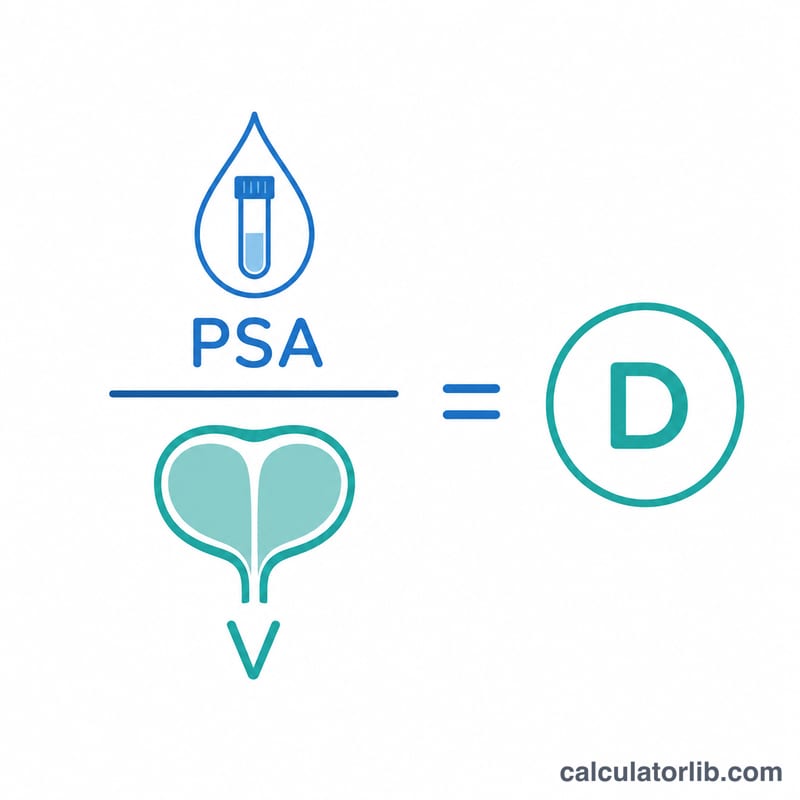
PSA density (PSAD) is a value used in prostate health assessment that normalizes a man's serum prostate-specific antigen (PSA) level to the size of his prostate gland. Because larger prostates naturally produce more PSA, a single PSA number can be misleading. Dividing PSA by prostate volume helps distinguish PSA elevations caused by benign enlargement (BPH) from those that may warrant further investigation. This tool is for general educational purposes and is not a substitute for medical advice.
How to Use This Calculator
Enter your serum PSA level in nanograms per milliliter (ng/mL) — typically from a blood test — and your prostate volume in cubic centimeters (cc, which equals mL), usually measured by transrectal ultrasound (TRUS) or MRI. The calculator divides the two to give the PSA density.
The Formula Explained
The equation is simply $$\text{PSAD} = \frac{\text{Serum PSA (ng/mL)}}{\text{Prostate Volume (cc)}}$$ A commonly cited reference threshold is \(0.15\) ng/mL per cc: values at or above this level are sometimes used as one factor supporting a recommendation for prostate biopsy, while lower values may favor surveillance. Thresholds vary between clinicians and guidelines.
Worked Example
Suppose a man has a serum PSA of 6 ng/mL and a prostate volume of 50 cc. The PSA density is $$6 \div 50 = 0.12 \text{ ng/mL per cc}.$$ Because \(0.12\) is below \(0.15\), this would generally be considered a lower density despite the moderately raised total PSA, likely reflecting a large gland.
Interpreting Your PSA Density Result
PSA density (PSAD) relates the blood PSA level to the size of the prostate: \(\text{PSAD} = \frac{\text{PSA (ng/mL)}}{\text{Prostate volume (cc)}}\). Because a larger prostate, such as in benign prostatic hyperplasia, can raise PSA without cancer, dividing by volume is meant to separate PSA that is "expected" for gland size from PSA that is relatively high for it.
Commonly used bands (ng/mL per cc)
- Below 0.10: lower density. In studies, clinically significant prostate cancer is less often found in this range, though it is not excluded.
- 0.10 to below 0.15: an intermediate zone. Interpretation depends heavily on other findings.
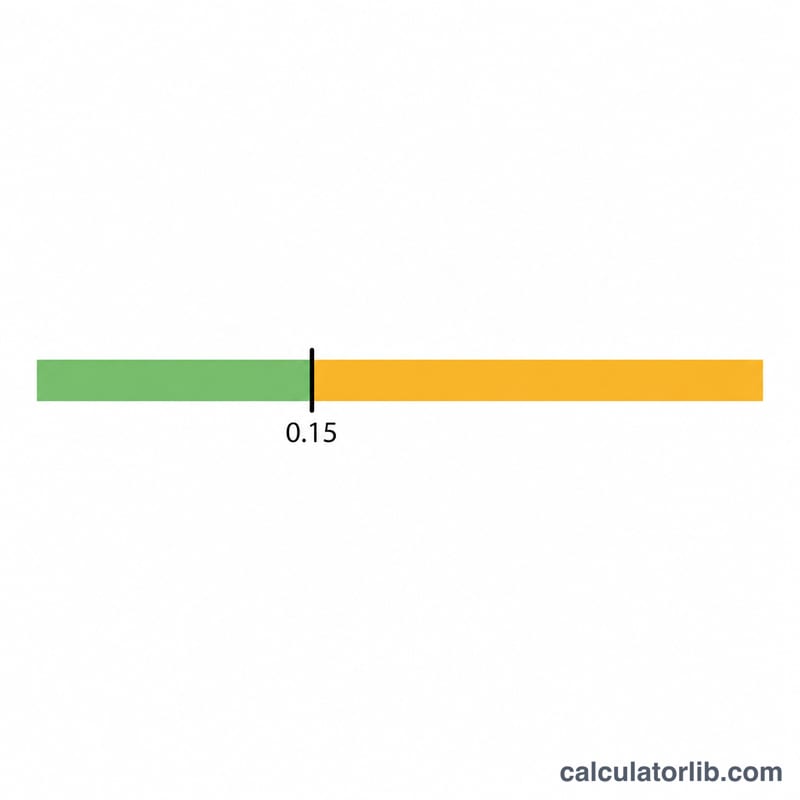
- 0.15 and above: higher density. Studies associate this range with a greater likelihood of clinically significant prostate cancer on biopsy, and 0.15 is the most widely cited reference threshold.
These cut-offs are not universal. Some studies, MRI-guided pathways and active surveillance protocols use 0.10 or 0.20 instead, for example when deciding whether to biopsy after an equivocal MRI or whether a man remains suitable for surveillance. The threshold used depends on the setting and the guideline or study.
PSAD is one piece of the picture
Clinicians consider PSAD alongside the PSA trend over time, age, digital rectal exam (DRE) findings, MRI results, family history, and any prior biopsy history. A single PSAD value does not stand on its own.
Limitations
- The result depends on how prostate volume was measured. Transrectal ultrasound (TRUS) and MRI can give different volumes, and measurement varies between operators and methods, which changes PSAD.
- PSA itself fluctuates because of infection, inflammation, recent ejaculation or procedures, and some medications (for example 5-alpha-reductase inhibitors lower PSA).
- PSAD is a risk indicator, not a diagnosis. A high value does not mean cancer is present, and a low value does not rule it out.
This is general educational information, not medical advice. Please discuss your own PSA, volume and PSAD results with a qualified clinician.
PSA Density Across Example Scenarios
The table shows how the same PSA can give different densities depending on prostate volume, using \(\text{PSAD} = \text{PSA} \div \text{volume}\) and the 0.15 reference threshold.
| Serum PSA (ng/mL) | Prostate volume (cc) | Calculation | PSAD (ng/mL per cc) | Relative to 0.15 |
|---|---|---|---|---|
| 4 | 30 | 4 ÷ 30 | 0.13 | Below 0.15 |
| 6 | 50 | 6 ÷ 50 | 0.12 | Below 0.15 |
| 6 | 30 | 6 ÷ 30 | 0.20 | At or above 0.15 |
| 8 | 40 | 8 ÷ 40 | 0.20 | At or above 0.15 |
| 10 | 80 | 10 ÷ 80 | 0.125 | Below 0.15 |
| 10 | 50 | 10 ÷ 50 | 0.20 | At or above 0.15 |
Note that a PSA of 10 ng/mL gives a density below 0.15 in an 80 cc gland but 0.20 in a 50 cc gland. Values of 4 ÷ 30 are rounded from 0.133. These figures are illustrative only and are not a guide to any individual's risk; interpretation belongs with a clinician.
FAQ
Is cc the same as mL? Yes — for prostate volume, \(1\) cc equals \(1\) mL.
What is a "normal" PSA density? Many clinicians use \(0.15\) as a cutoff, but interpretation depends on age, PSA trend, imaging, and other factors. Always discuss results with your doctor.
How is prostate volume measured? Most commonly via ultrasound or MRI using the ellipsoid formula (\(\text{length} \times \text{width} \times \text{height} \times 0.52\)).