What the Rectangle Diagonal Calculator Does
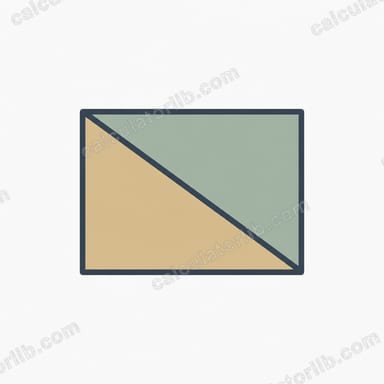
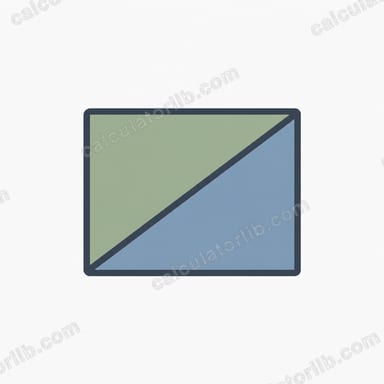
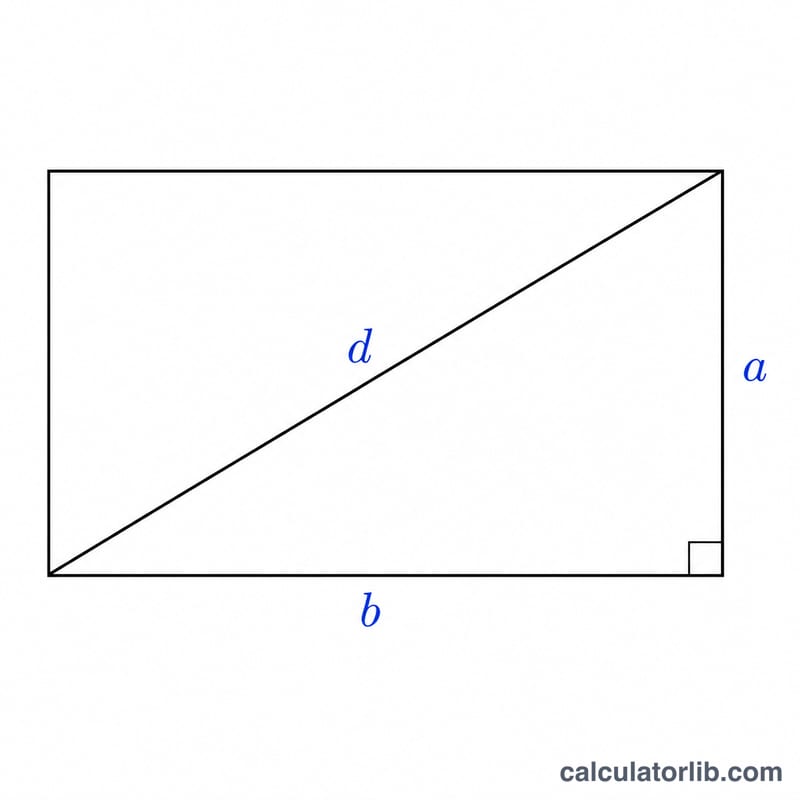
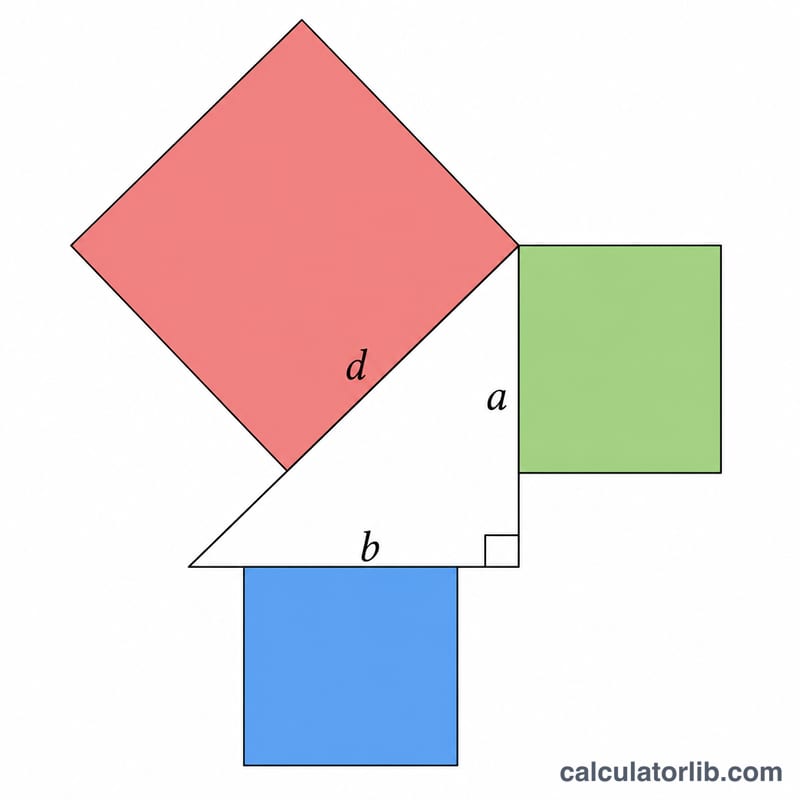
This calculator finds the straight-line distance across a rectangle—from one corner to the opposite corner—using just two measurements: the length and the width. Because a rectangle's diagonal splits it into two right triangles, the diagonal is simply the hypotenuse, which we can solve with the Pythagorean theorem. The tool works with any consistent unit (cm, inches, metres, feet), and as a bonus it also reports the rectangle's area and perimeter from the same two numbers.
How to Use It
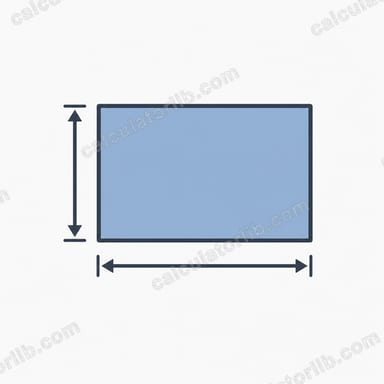
- Length: enter the longer (or any) side of the rectangle.
- Width: enter the adjacent side.
Press calculate and you instantly get the diagonal, plus the area and perimeter. Keep both inputs in the same unit so the results make sense—if length is in inches, width must be in inches too.
The Formula Explained
The diagonal is computed as:
$$d = \sqrt{\text{Length}^{2} + \text{Width}^{2}}$$Here l is the length and w is the width. Each side is squared, the squares are added, and the square root of that sum is the diagonal. The calculator also derives:
- \(\text{Area} = l \times w\)
- \(\text{Perimeter} = 2 \times (l + w)\)
Worked Example
Suppose you have a rectangle with a length of 8 and a width of 6.
- Diagonal: $$\sqrt{8^{2} + 6^{2}} = \sqrt{64 + 36} = \sqrt{100} = \mathbf{10}$$
- Area: \(8 \times 6 = \mathbf{48}\)
- Perimeter: \(2 \times (8 + 6) = \mathbf{28}\)
This is the classic 6-8-10 right triangle, so the diagonal comes out to a clean 10 units. Most real-world rectangles produce a decimal diagonal, which the calculator handles automatically.
More Worked Examples
Each example uses the same formula, \(d = \sqrt{l^2 + w^2}\). Before you start, make sure the length and width are in the same unit. The diagonal comes out in that unit too.
Example 1: A 4 ft × 8 ft plywood sheet (decimal result)
In North America, plywood is usually sold in 4 ft × 8 ft sheets. To find the distance from corner to corner:
- Square each side: \(8^2 = 64\) and \(4^2 = 16\).
- Add the squares: \(64 + 16 = 80\).
- Take the square root: \(\sqrt{80} \approx 8.94427\) ft.
- Round: about 8.944 ft.
- Convert the decimal part to inches: \(0.94427 \times 12 \approx 11.33\) in. So the diagonal is about 8 ft 11.3 in.
Example 2: A metric room measuring 5.2 m × 3.8 m
- Square each side: \(5.2^2 = 27.04\) and \(3.8^2 = 14.44\) (both in m²).
- Add the squares: \(27.04 + 14.44 = 41.48\).
- Take the square root: \(\sqrt{41.48} \approx 6.4405\) m.
- Round: about 6.44 m, which is roughly 644 cm from one corner to the opposite corner.
Example 3: Checking a 12 ft × 16 ft deck frame for square
A rectangular frame is square (all corners at 90°) only when its diagonals match the value from the Pythagorean theorem.
- Square each side: \(12^2 = 144\) and \(16^2 = 256\).
- Add the squares: \(144 + 256 = 400\).
- Take the square root: \(\sqrt{400} = 20\) ft exactly, so no rounding is needed.
- Check the frame: measure both diagonals. If each one reads 20 ft and the two are equal, the frame is square. If one is longer than the other, push the frame along the longer diagonal until both match.
This 12-16-20 frame is the 3-4-5 triangle scaled up by 4. That is why builders use 3-4-5 measurements as a quick way to check a corner is square.
Common Rectangle Sizes and Their Diagonals
Every diagonal below was calculated with \(d = \sqrt{l^2 + w^2}\). The diagonal is in the same unit as the sides. The Pythagorean triples come out as whole numbers, so they work well for setting out square corners at any scale, in feet, metres or anything else. Paper and sheet sizes are listed in the units their standards use.
| Item | Length | Width | Calculation | Diagonal |
|---|---|---|---|---|
| 3-4-5 triple | 4 | 3 | \(\sqrt{16 + 9} = \sqrt{25}\) | 5 |
| 6-8-10 triple | 8 | 6 | \(\sqrt{64 + 36} = \sqrt{100}\) | 10 |
| 5-12-13 triple | 12 | 5 | \(\sqrt{144 + 25} = \sqrt{169}\) | 13 |
| 8-15-17 triple | 15 | 8 | \(\sqrt{225 + 64} = \sqrt{289}\) | 17 |
| 9-12-15 triple | 12 | 9 | \(\sqrt{144 + 81} = \sqrt{225}\) | 15 |
| 12-16-20 triple | 16 | 12 | \(\sqrt{256 + 144} = \sqrt{400}\) | 20 |
| Unit square | 1 | 1 | \(\sqrt{1 + 1} = \sqrt{2}\) | ≈ 1.414 |
| Plywood sheet (North American size) | 8 ft | 4 ft | \(\sqrt{64 + 16} = \sqrt{80}\) | ≈ 8.944 ft |
| US Letter paper (North American standard) | 11 in | 8.5 in | \(\sqrt{121 + 72.25} = \sqrt{193.25}\) | ≈ 13.90 in |
| A4 paper (ISO 216) | 297 mm | 210 mm | \(\sqrt{88209 + 44100} = \sqrt{132309}\) | ≈ 363.74 mm |
Note: 6-8-10, 9-12-15 and 12-16-20 are all the 3-4-5 triangle scaled by 2, 3 and 4. Use the largest one that fits your layout. Over longer distances, small measuring errors have less effect on the angle.
Frequently Asked Questions
Does it matter which side I call length and which I call width?
No. Because both values are squared and added together, swapping them gives the identical diagonal, area, and perimeter.
What units does the calculator use?
It is unit-agnostic. Whatever unit you enter (inches, cm, feet, metres), the diagonal comes back in that same unit and the area in that unit squared.
Why is the diagonal useful in DIY and construction?
Checking the diagonal is the fastest way to confirm a frame, deck, or wall is truly square. If the measured corner-to-corner distance matches the calculated diagonal, your corners are exact right angles.