What this calculator does
This tool converts a known air temperature and dew point into relative humidity (RH). Relative humidity expresses how much water vapor is in the air compared with the maximum the air could hold at that temperature. When the dew point equals the air temperature, the air is saturated and RH is 100%; the larger the gap between them, the drier the air feels.
How to use it
Enter the current air temperature in degrees Celsius and the dew point in degrees Celsius. The calculator returns the relative humidity as a percentage. Because dew point can never exceed air temperature in real conditions, RH is capped at 100%.
The formula explained
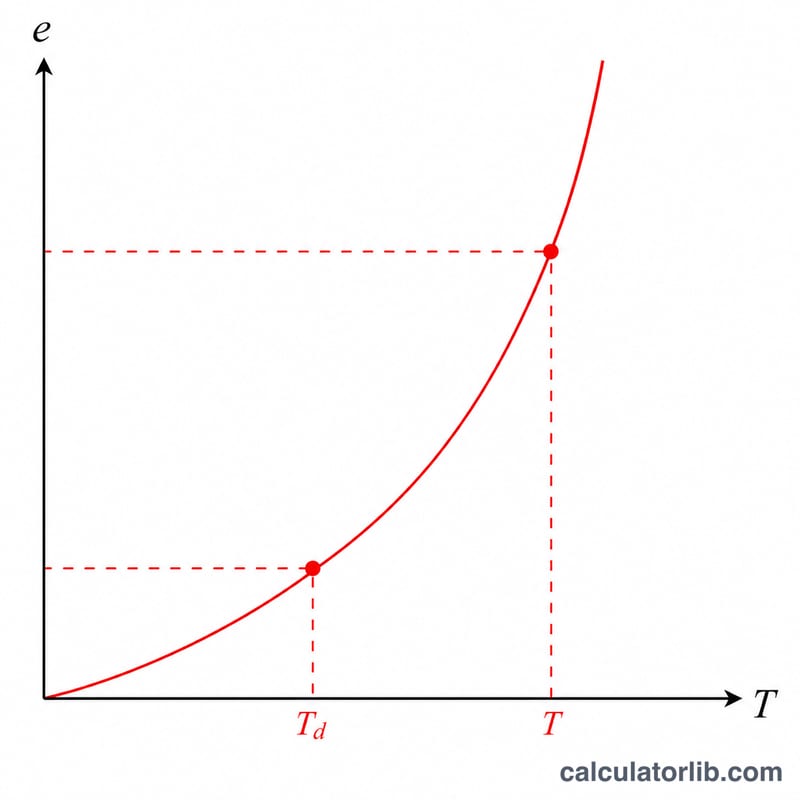
The calculator uses the widely accepted Magnus approximation for saturation vapor pressure. The ratio of the saturation vapor pressure at the dew point to that at the air temperature gives the relative humidity:
$$\text{RH} = 100 \times \frac{\exp\!\left(\dfrac{17.625 \cdot \text{Dew Point}}{243.04 + \text{Dew Point}}\right)}{\exp\!\left(\dfrac{17.625 \cdot \text{Air Temp}}{243.04 + \text{Air Temp}}\right)}$$ where \(T\) is air temperature and \(T_d\) is dew point, both in °C. The constants 17.625 and 243.04 are the Alduchov–Eskridge coefficients, which improve accuracy over the classic 17.27/237.7 set.
Worked example
For an air temperature of 25 °C and a dew point of 15 °C: the numerator is \(\exp(17.625 \cdot 15 / 258.04) = \exp(1.02447) \approx 2.7857\), and the denominator is \(\exp(17.625 \cdot 25 / 268.04) = \exp(1.64384) \approx 5.1759\).
$$\text{RH} = 100 \times \frac{2.7857}{5.1759} \approx 53.83\%$$
Interpreting Your Relative Humidity Result
Relative humidity (RH) is the amount of water vapor in the air as a percentage of the most it could hold at the current air temperature. The usual bands are:
- Below 30%: dry air. It can bring dry skin, static electricity and irritated airways.
- About 30–60%: the typical indoor comfort range. ASHRAE guidance suggests keeping indoor humidity up to about 60%.
- Above 60%: humid. Mold growth, dust mites and condensation on cold surfaces become more likely, especially if it persists.
- 100%: saturated. The air temperature equals the dew point, so dew, fog or condensation forms.
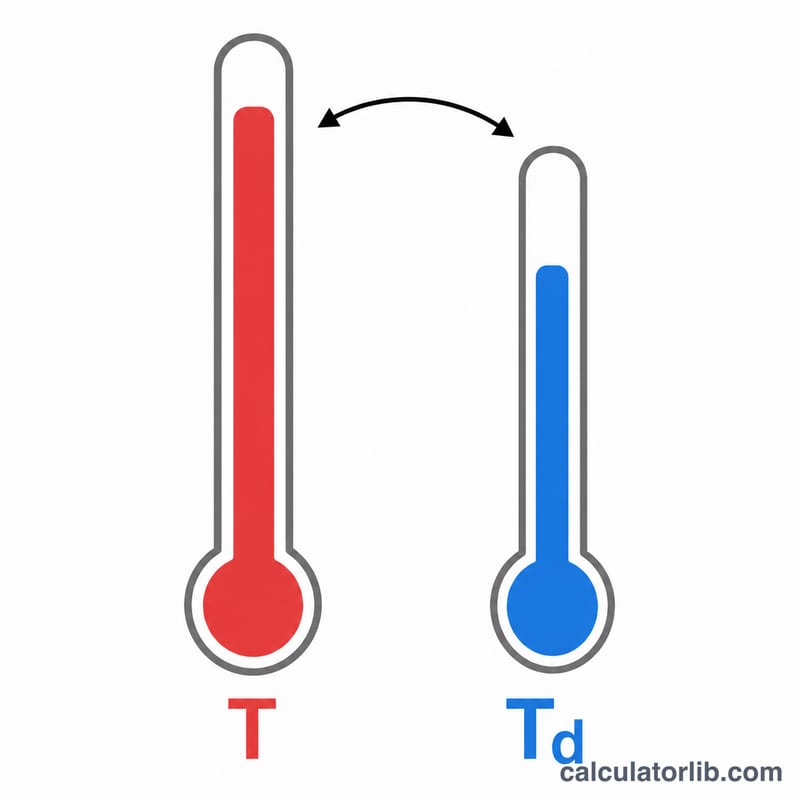
Spread and RH. The gap between air temperature T and dew point Td tells you how close the air is to saturation. For spreads of only a few degrees Celsius, a rough rule is:
$$\text{RH} \approx 100 - 5\times(T - T_d)$$
For example, a 2 °C spread gives about 90%. This is only an approximation. It gets worse as the spread grows and at very high or low temperatures, so use the full Magnus formula for real results.
RH depends on temperature. If the dew point stays constant, the actual amount of moisture in the air stays the same. RH still falls as the air warms and rises as it cools. For example, a dew point of 10 °C gives about 52.5% RH at 20 °C, but only about 28.9% at 30 °C. Compare dew points, not RH, when you want to judge how muggy it feels or how much moisture is in the air.
Constants Used in the Magnus Formula
The Magnus formula approximates saturation vapor pressure over liquid water as an exponential of the form \(\exp\left(\frac{bT}{c+T}\right)\). Because RH is a ratio of vapor pressures at the dew point and at the air temperature, the constant prefactor cancels and only b and c matter:
$$\text{RH} = 100\times\frac{ \exp\left(\frac{b\,T_d}{c+T_d}\right)}{ \exp\left(\frac{b\,T}{c+T}\right)}$$
| Parameter set | b (dimensionless) | c (°C) | Notes |
|---|---|---|---|
| Alduchov–Eskridge (used here) | 17.625 | 243.04 | Valid for about −40 to 50 °C, with a stated accuracy of about 0.4% |
| Sonntag | 17.62 | 243.12 | Very close to Alduchov–Eskridge, with a slightly different fit |
| Classic Magnus–Tetens | 17.27 | 237.7 | Older, widely used simplified set, somewhat less accurate at temperature extremes |
Temperatures T and Td are in degrees Celsius, and b has no unit. The constants apply to saturation over liquid water. Below 0 °C, results are relative to supercooled liquid water, not ice, so they can differ from a frost-point-based RH. Outside roughly −40 to 50 °C, accuracy is not guaranteed.
FAQ
Why is RH never above 100%? Once the air is saturated, extra moisture condenses out as dew or fog, so relative humidity is physically limited to 100%.
Does this work in Fahrenheit? No — convert temperatures to Celsius first, since the Magnus coefficients here are defined for °C.
How accurate is it? The Alduchov–Eskridge form is accurate to within about 0.4% over the −40 °C to 50 °C range typical of weather conditions.