
What Is the Net Promoter Score (NPS)?
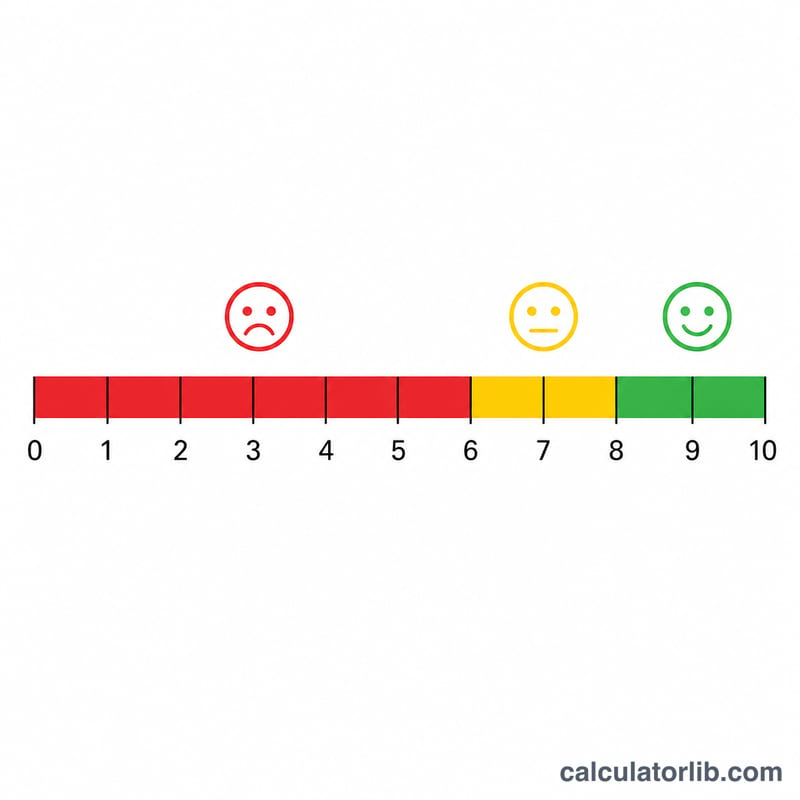
The Net Promoter Score is a widely used customer-loyalty metric. After asking "How likely are you to recommend us to a friend or colleague?" on a 0–10 scale, respondents are grouped into three buckets: Promoters (scored 9–10), Passives (7–8) and Detractors (0–6). NPS distills loyalty into a single number ranging from −100 to +100.
How to Use This Calculator
Enter how many respondents fell into each bucket — promoters, passives and detractors. The calculator converts each bucket to a percentage of total responses, then subtracts the detractor percentage from the promoter percentage. Passives count toward the total but do not directly add or subtract from the score.
The Formula Explained
NPS = (% Promoters) − (% Detractors). With N total responses, % Promoters = Promoters ÷ N × 100 and % Detractors = Detractors ÷ N × 100. Because passives are diluted into the denominator, a high passive count lowers both percentages and pulls the score toward zero.
$$\text{NPS} = \left(\frac{\text{Promoters} - \text{Detractors}}{\text{Promoters} + \text{Passives} + \text{Detractors}}\right) \times 100$$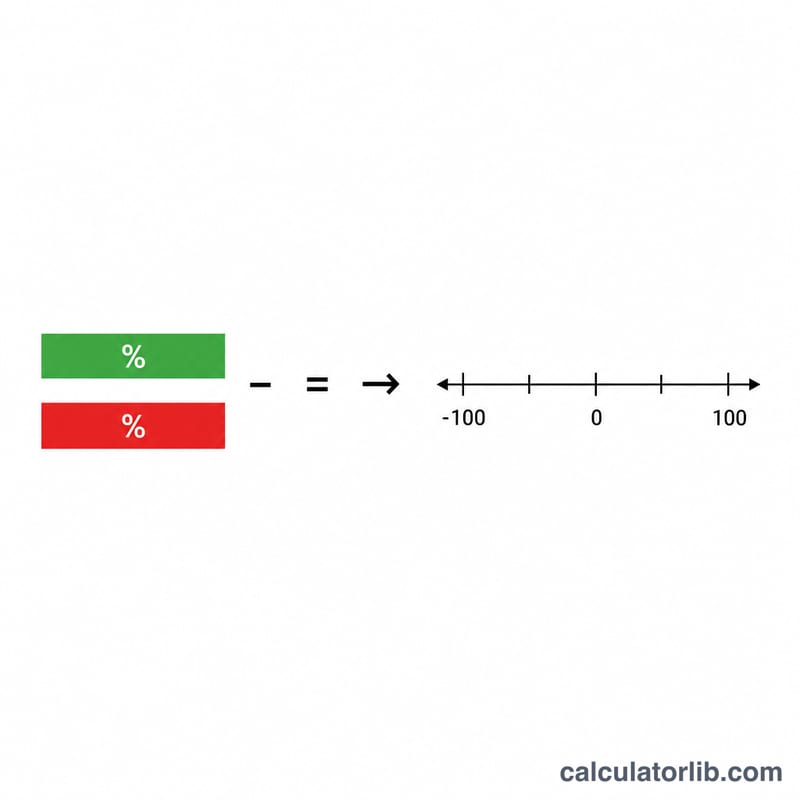
Worked Example
Suppose you survey 100 customers: 60 promoters, 30 passives, 10 detractors. % Promoters = 60%, % Detractors = 10%. \(\text{NPS} = 60 - 10 = +50\). A score of +50 is generally considered excellent.
$$\text{NPS} = \left(\frac{60 - 10}{60 + 30 + 10}\right) \times 100 = +50$$FAQ
What is a good NPS? It varies by industry, but anything above 0 means more promoters than detractors. Scores above +50 are excellent and above +70 are world-class.
Why don't passives count? Passives are satisfied but unenthusiastic; they neither boost nor harm word-of-mouth, so they only affect the denominator.
Can NPS be negative? Yes. If detractors outnumber promoters, the score falls below zero, down to a minimum of −100.