What Is Sound Intensity Level?
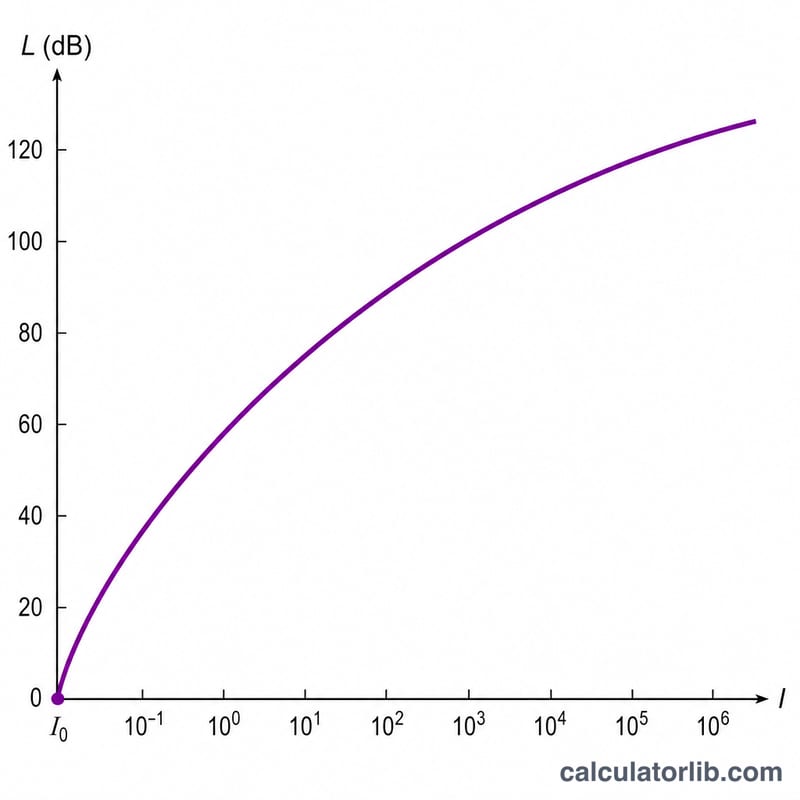
Sound intensity level (SIL) expresses how strong a sound is on a logarithmic decibel (dB) scale relative to a fixed reference. The human ear responds to an enormous range of intensities, so a logarithmic scale compresses that range into manageable numbers. The reference intensity \(I_0 = 1 \times 10^{-12}\ \text{W/m}^2\) corresponds to the quietest sound a healthy young person can detect, which is defined as 0 dB.
How to Use This Calculator
Enter the measured sound intensity \(I\) in watts per square meter (W/m²) and the reference intensity \(I_0\). Leave \(I_0\) at the default 1e-12 W/m² unless you have a specific reference. The calculator returns the sound intensity level in decibels. You can type values in scientific notation such as 1e-6.
The Formula Explained
The sound intensity level is given by $$L = 10 \cdot \log_{10}\!\left(\frac{\text{Intensity } I}{\text{Reference } I_0}\right)$$ The ratio \(I/I_0\) is dimensionless, and taking its base-10 logarithm and multiplying by 10 converts the ratio into decibels. Every tenfold increase in intensity adds 10 dB, so a sound that is 100× more intense is 20 dB higher.
Worked Example
Suppose normal conversation has an intensity of \(I = 1 \times 10^{-6}\ \text{W/m}^2\). With \(I_0 = 1 \times 10^{-12}\ \text{W/m}^2\), the ratio is \(10^6\), so $$L = 10 \cdot \log_{10}(10^6) = 10 \times 6 = 60\ \text{dB}$$ — a typical conversational level.
Typical Sound Levels and Intensities
The table lists common sounds with approximate levels in decibels (dB) and the matching intensity in W/m², calculated from \(I = 10^{-12} \times 10^{L/10}\). All values are approximate. Real sources vary with distance, environment and the individual device.
| Source | Approx. level (dB) | Approx. intensity (W/m²) |
|---|---|---|
| Threshold of hearing (about 1 kHz) | 0 | 1e-12 |
| Rustling leaves | 10 | 1e-11 |
| Whisper | 30 | 1e-9 |
| Quiet office | 40–50 | 1e-8 to 1e-7 |
| Normal conversation | 60 | 1e-6 |
| Busy traffic | 70–80 | 1e-5 to 1e-4 |
| Lawn mower / heavy traffic | ~90 | 1e-3 |
| Rock concert / chainsaw | ~110 | 1e-1 |
| Threshold of pain | 120–130 | 1 to 10 |
| Jet engine at close range | ~140 | 100 |
How Intensity Changes Affect Decibel Level
Because the scale is logarithmic, multiplying the intensity by a factor \(k\) adds \(10\log_{10}(k)\) dB, whatever the starting level.
| Intensity ratio | Change in level |
|---|---|
| 2× (double) | +3.01 dB |
| 10× | +10 dB |
| 100× | +20 dB |
| 1000× | +30 dB |
| 0.5× (half) | −3.01 dB |
| 0.1× | −10 dB |
Absolute examples with \(I_0 = 10^{-12}\) W/m²:
| Intensity I (W/m²) | Substitution | Level L (dB) |
|---|---|---|
| 1e-12 | \(10\log_{10}(10^{-12}/10^{-12}) = 10\log_{10}(1)\) | 0 |
| 1e-9 | \(10\log_{10}(10^{3}) = 10 \times 3\) | 30 |
| 1e-6 | \(10\log_{10}(10^{6}) = 10 \times 6\) | 60 |
| 1e-3 | \(10\log_{10}(10^{9}) = 10 \times 9\) | 90 |
Interpreting Your Result
The calculator gives the sound intensity level, computed directly from intensity in W/m² relative to a reference (normally \(10^{-12}\) W/m²). This is not the same as an A-weighted sound pressure level (dBA) measured by a sound level meter. A-weighting adjusts for the ear's varying sensitivity across frequencies. For a broadband sound the two numbers can differ, so treat the comparisons below as approximate guides.
- Perceived loudness: an increase of about 10 dB is commonly perceived as roughly twice as loud, even though the intensity rises tenfold. A 3 dB increase doubles intensity but is only just clearly noticeable.
- NIOSH (United States): the recommended exposure limit is 85 dBA as an 8-hour time-weighted average, with a 3 dB exchange rate. Each 3 dB increase halves the permitted time (88 dBA for 4 hours, 91 dBA for 2 hours).
- OSHA (United States): the permissible exposure limit is 90 dBA over 8 hours, with a 5 dB exchange rate (95 dBA for 4 hours, 100 dBA for 2 hours).
- WHO: the WHO–ITU safe listening guidance for personal audio devices suggests keeping adult exposure to about 80 dB(A) or less for up to roughly 40 hours per week. WHO environmental noise guidelines also give lower recommended levels for community noise, such as traffic and night-time noise.
These limits apply to specific jurisdictions or organizations and to measured A-weighted levels, so check the rules that apply where you are. The values on this page are general reference information, not medical or occupational-safety advice. If you are concerned about noise exposure or hearing, consult a qualified professional.
FAQ
Why is 0 dB not silence? 0 dB is the threshold of hearing, not zero sound energy. Sounds below this exist but are inaudible to most people.
What is a safe sound level? Prolonged exposure above 85 dB can cause hearing damage; levels around 120 dB are painful.
Can the level be negative? Yes. If the intensity is below the reference (\(I < I_0\)), the logarithm is negative, giving a negative dB value.