
What this calculator does
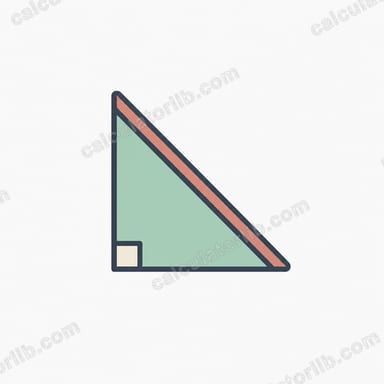
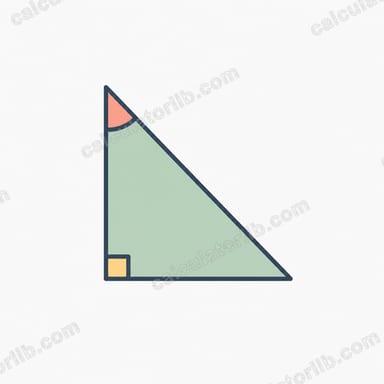
This tool finds the two acute angles of a right triangle when you know the lengths of its two legs (the sides that meet at the right angle). Because the right angle is fixed at 90°, the remaining two angles must add up to 90°. Knowing the legs is enough to pin them both down using basic trigonometry.
How to use it
Enter the length of leg a (the side opposite to angle A) and leg b (the side adjacent to angle A). The calculator returns angle A, angle B, and the hypotenuse. Any consistent unit (cm, m, inches) works since angles depend only on the ratio of the legs.
The formula explained
In a right triangle, the tangent of an angle equals the opposite side over the adjacent side. So angle \(A = \arctan(a / b)\). Since the three angles sum to 180° and one is 90°, the other acute angle is simply \(B = 90^{\circ} - A\). The hypotenuse follows from the Pythagorean theorem: \(c = \sqrt{a^{2} + b^{2}}\).
$$A = \arctan\!\left(\frac{a}{b}\right), \quad B = 90^{\circ} - A$$$$c = \sqrt{a^{2} + b^{2}}$$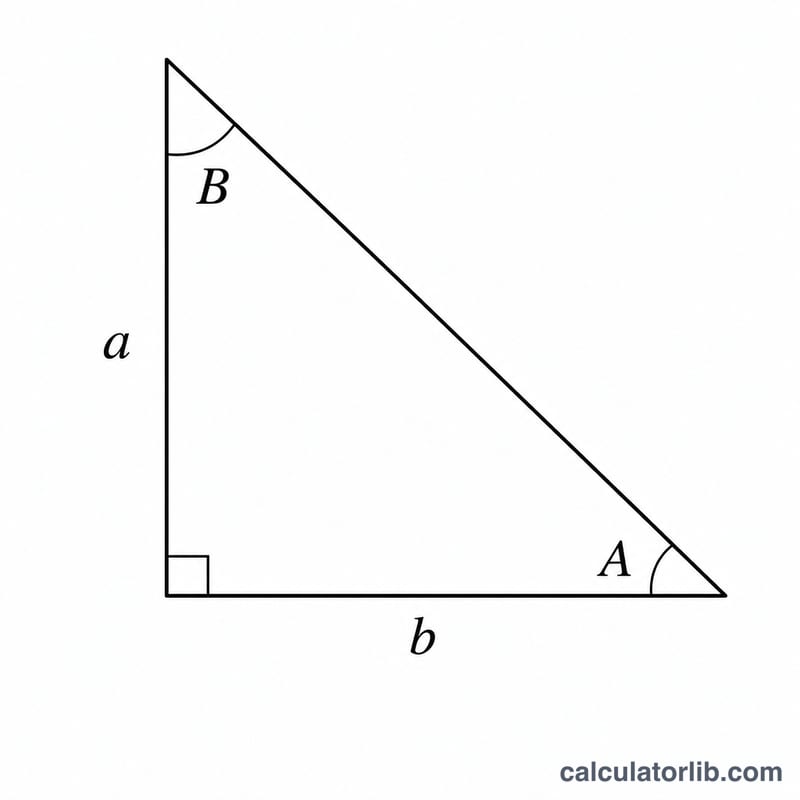
Worked example
Suppose \(a = 3\) and \(b = 4\). Then \(A = \arctan(3/4) = \arctan(0.75) \approx 36.87^{\circ}\). Angle \(B = 90 - 36.87 = 53.13^{\circ}\). The hypotenuse is \(\sqrt{3^{2} + 4^{2}} = \sqrt{25} = 5\) — the classic 3-4-5 triangle.
$$A = \arctan\!\left(\frac{3}{4}\right) = \arctan(0.75) \approx 36.87^{\circ}$$$$B = 90 - 36.87 = 53.13^{\circ}$$$$c = \sqrt{3^{2} + 4^{2}} = \sqrt{25} = 5$$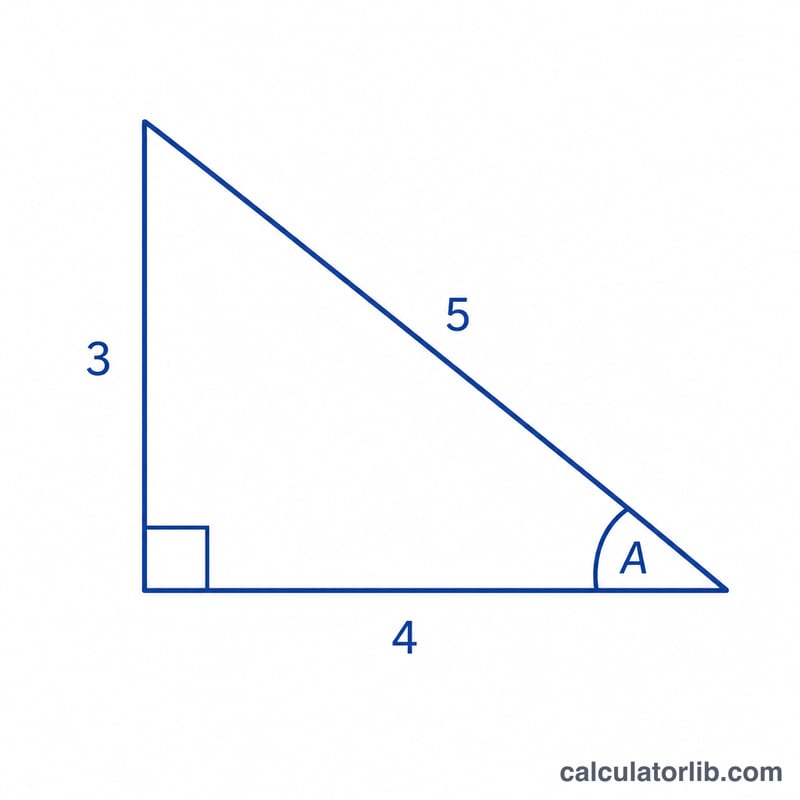
FAQ
What if leg b is 0? If \(b = 0\) the triangle is degenerate; the calculator reports angle A as 90°.
Do the units matter? No. Angles depend only on the ratio \(a/b\), so the result is the same whether you use millimeters or miles, as long as both legs use the same unit.
Why do A and B add to 90°? The angles of any triangle sum to 180°. With one angle being the 90° right angle, the two remaining acute angles must total 90°.