
What This Amortization Calculator Does
This calculator works out the fixed monthly payment on a fully amortizing loan — the kind used for mortgages, car loans, and personal loans worldwide. You enter three things: the loan amount (the principal you borrow), the annual interest rate as a percentage, and the loan term split into years and months. It then returns your monthly payment, the total interest you'll pay over the life of the loan, and the total cost (principal plus interest), along with a full year-by-year amortization schedule.
The Formula Behind It
The monthly payment uses the standard amortization formula:
$$A = P \frac{r(1+r)^n}{(1+r)^n-1}$$
- P — the loan amount (principal)
- r — the monthly interest rate, calculated as the annual rate ÷ 100 ÷ 12
- n — total number of payments, calculated as (years × 12) + months
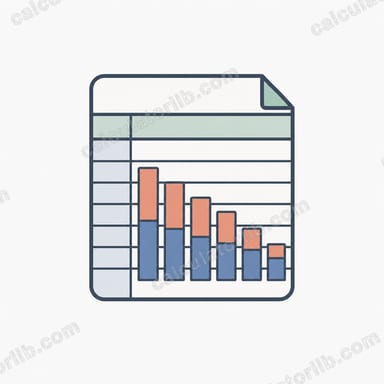
Each month, the calculator multiplies the remaining balance by the monthly rate to find the interest portion, subtracts that from your fixed payment to find the principal portion, then reduces the balance. Early payments are interest-heavy; later ones pay down more principal.
Worked Example
Suppose you borrow $200,000 at 5% annual interest over 30 years and 0 months.
- Monthly rate r = 5 ÷ 100 ÷ 12 = 0.0041667
- Number of payments n = 30 × 12 = 360
Plugging in gives a monthly payment of about $1,073.64. Over 360 payments that's roughly $386,512 total, meaning about $186,512 in interest. In month one, interest is $200,000 × 0.0041667 ≈ $833.33, so only about $240.31 goes to principal — which is why the annual schedule shows the balance falling slowly at first.
How Rate and Term Change Your Payment
The table below uses a fixed loan amount of \(P = \$200{,}000\) and shows how the monthly payment, total interest paid, and total cost of the loan change as the annual interest rate and term vary. The monthly payment is computed with the amortization formula \(M = P\,\frac{r(1+r)^n}{(1+r)^n-1}\), where \(r\) is the monthly rate and \(n\) is the number of payments.
| Rate | Term | Monthly Payment | Total Interest | Total Cost |
|---|---|---|---|---|
| 3% | 15 yr | $1,381.16 | $48,609 | $248,609 |
| 3% | 20 yr | $1,109.20 | $66,207 | $266,207 |
| 3% | 30 yr | $843.21 | $103,555 | $303,555 |
| 5% | 15 yr | $1,581.59 | $84,686 | $284,686 |
| 5% | 20 yr | $1,319.91 | $116,779 | $316,779 |
| 5% | 30 yr | $1,073.64 | $186,512 | $386,512 |
| 7% | 15 yr | $1,797.66 | $123,578 | $323,578 |
| 7% | 20 yr | $1,550.60 | $172,144 | $372,144 |
| 7% | 30 yr | $1,330.60 | $279,018 | $479,018 |
Two patterns stand out. First, a higher rate raises both the monthly payment and the total interest. Second, a longer term lowers the monthly payment but sharply increases total interest, because the balance is paid down more slowly. At 7%, stretching from a 15-year to a 30-year term cuts the monthly payment by about $467 but more than doubles the interest paid.
Key Terms Defined
- Principal (\(P\))
- The original amount borrowed, before any interest is added. It is the base on which interest is charged and the amount that the amortization schedule gradually reduces to zero.
- Amortization
- The process of paying off a loan with regular, equal payments over time. Each payment covers the interest accrued for the period and applies the remainder to reduce the principal.
- Monthly interest rate (\(r\))
- The periodic rate applied each month. It equals the annual nominal rate divided by 12 (and by 100 to convert from a percent): \(r = \frac{\text{annual rate}}{1200}\). For example, a 6% annual rate gives \(r = 0.005\).
- Number of payments (\(n\))
- The total count of monthly payments over the life of the loan: \(n = 12 \times \text{years} + \text{months}\). A 30-year loan has \(n = 360\).
- Total interest
- The sum of all interest paid over the loan term, equal to total of payments minus principal: \(n \cdot M - P\).
- Total cost
- The total amount repaid over the full term, equal to the monthly payment times the number of payments: \(n \cdot M\). It combines the principal and all interest.
- Nominal interest rate vs. APR
- The nominal (or stated) rate is the base interest rate used to compute the payment. The Annual Percentage Rate (APR) reflects the nominal rate plus certain fees and closing costs expressed as a yearly rate, so it is usually higher than the nominal rate and gives a fuller picture of borrowing cost. This amortization calculator uses the nominal rate only.
Understanding Your Results
The monthly payment is the fixed amount you pay each period for the entire term. Because the payment is constant, it is sometimes called a level or fully-amortizing payment: it is sized so that the final payment brings the balance to exactly zero.
The total interest is the extra you pay beyond what you borrowed. A larger total-interest figure indicates more is going to the lender rather than toward your principal balance — driven up by a higher rate, a larger principal, or a longer term. Comparing total interest across scenarios is often more revealing than comparing monthly payments alone, since a low monthly payment can hide a high lifetime cost.
The total cost is principal plus total interest — the complete sum you will have repaid by the end of the loan.
An important feature of amortization is how the interest-to-principal ratio shifts over time. Early in the loan the balance is large, so most of each payment goes toward interest and only a little reduces principal. As the balance falls, the interest portion of each payment shrinks and the principal portion grows, even though the total payment stays the same. By the end of the term, nearly the entire payment is principal. This is why making extra principal payments early has an outsized effect on total interest — it removes balance during the period when interest charges are highest.
This is general educational information about how loan amortization works, not personal financial advice. Actual loan terms, fees, and APR depend on your lender and circumstances.
Frequently Asked Questions
Can I enter a term with extra months? Yes. The Years and Months fields are combined into total months, so a term like 5 years and 6 months (66 payments) is handled exactly.
What does the annual schedule show? It groups payments into 12-month blocks, totalling principal paid, interest paid, and the remaining balance at year's end. If your term isn't a whole number of years, the final block is flagged as a partial year.
What if I enter 0% interest? The standard formula divides by zero at 0%, so always enter a positive rate. For a true 0% loan, the payment would simply be the loan amount divided by the number of months.