
What is the Magnetic Field of a Long Wire Calculator?
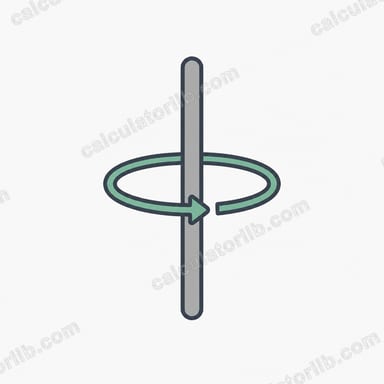
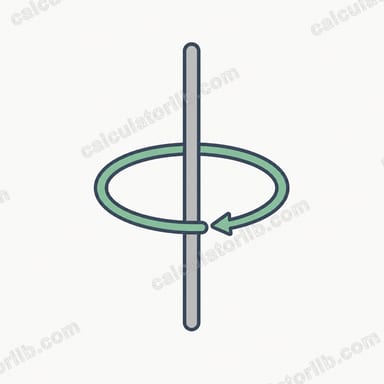
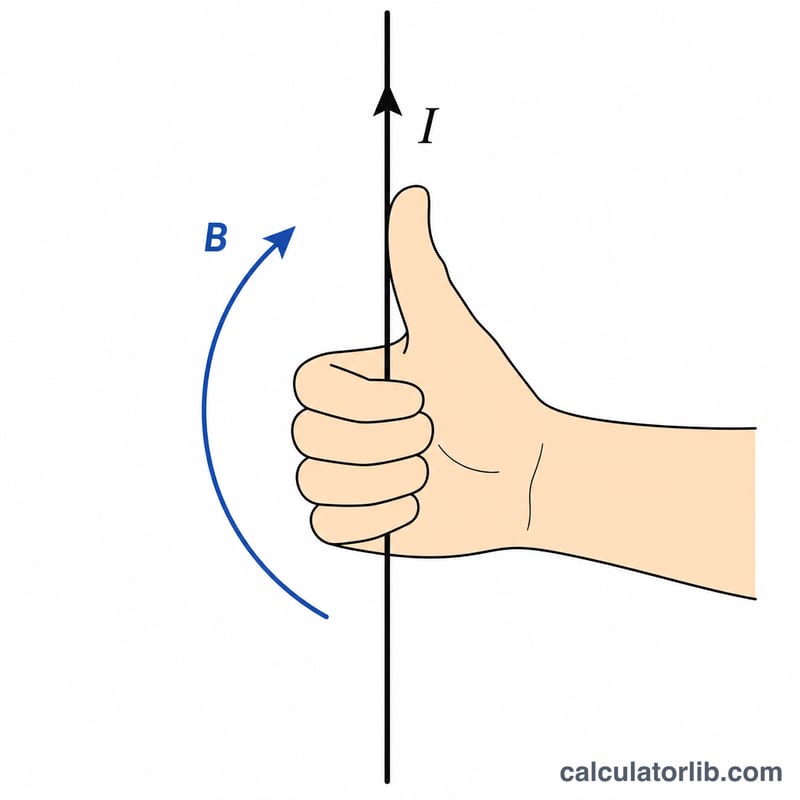
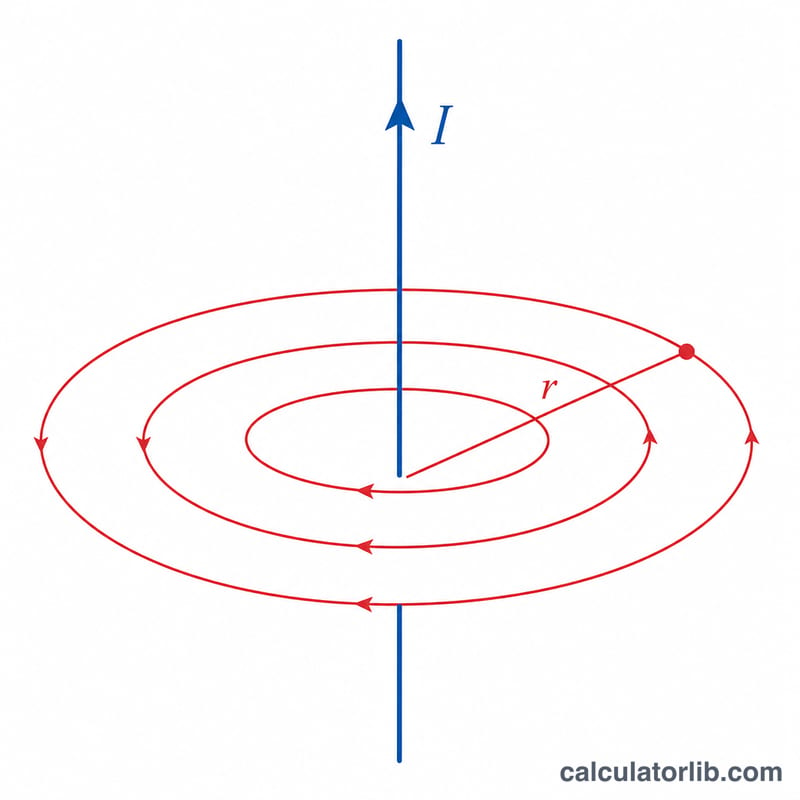
This calculator finds the magnetic flux density B produced at a given perpendicular distance from a long, straight wire that carries a steady electric current. It applies Ampere's law (derived from the Biot-Savart law) for an idealized infinitely long wire, giving the classic result \(B = \frac{\mu_0 \, I}{2\pi \, r}\). The field lines form concentric circles around the wire, and B falls off in proportion to \(1/r\).
How to Use It
Enter the current I flowing through the wire in amperes and the distance r from the center of the wire in meters. The calculator returns the magnetic field B in tesla, along with convenient conversions to microtesla (\(1 \text{ T} = 10^6 \text{ \textmu T}\)) and gauss (\(1 \text{ T} = 10^4 \text{ G}\)). Make sure r is measured outside the wire and uses the same units (meters).
The Formula Explained
The relationship is $$B = \frac{\mu_0 \, I}{2\pi \, r},$$ where \(\mu_0 = 4\pi \times 10^{-7} \ \text{T}\cdot\text{m/A}\) is the permeability of free space. The numerator scales the field with current, while the \(2\pi \, r\) denominator captures how the field weakens with distance. Doubling the current doubles B; doubling the distance halves B.
Worked Example
Suppose a wire carries \(I = 10 \text{ A}\) and you measure the field at \(r = 0.05 \text{ m}\) (5 cm). Then $$B = \frac{4\pi \times 10^{-7} \times 10}{2\pi \times 0.05} = \frac{1.2566 \times 10^{-5}}{0.3142} \approx 4.0 \times 10^{-5} \ \text{T},$$ which equals 40 µT or 0.4 gauss — comparable to the strength of Earth's magnetic field.
Typical Magnetic Field Strengths for Comparison
The values below give a sense of scale for magnetic flux density \(B\) across everyday and technical situations. Because field strengths span many orders of magnitude, the same physical field is often quoted in tesla (T), microtesla (µT) or gauss (G), where \(1\,\text{T} = 10^{6}\,\mu\text{T} = 10^{4}\,\text{G}\).
| Source | Approximate field | In tesla |
|---|---|---|
| Earth's magnetic field (surface) | 25–65 µT | 2.5–6.5 × 10⁻⁵ T |
| Typical household appliance power cord (a few cm away) | 0.1–3 µT | 1 × 10⁻⁷ – 3 × 10⁻⁶ T |
| Directly under a high-voltage transmission line | 1–20 µT | 1 × 10⁻⁶ – 2 × 10⁻⁵ T |
| Refrigerator (fridge) magnet at its surface | ~5 mT | 5 × 10⁻³ T |
| Small neodymium magnet at surface | 0.2–0.5 T | 0.2–0.5 T |
| Clinical MRI scanner | 1.5–3 T | 1.5–3 T |
| Strong research/superconducting magnet | 10–20 T | 10–20 T |
As a worked check on the wire formula, a current of \(I = 10\,\text{A}\) at a perpendicular distance of \(r = 0.05\,\text{m}\) gives
$$B = \frac{\mu_0 I}{2\pi r} = \frac{(4\pi\times10^{-7})(10)}{2\pi(0.05)} = 4\times10^{-5}\,\text{T} = \,$$that is, 40 µT — comparable to the Earth's own field, which is why the magnetic effect of ordinary household wiring is small at typical distances.
FAQ
Does this work near the wire's surface? The formula is valid for points outside the conductor. Very close to or inside a thick wire, the field behavior differs.
Why does the field weaken with distance? Because the same field encircles a larger circumference (\(2\pi \, r\)) farther out, so B is proportional to \(1/r\).
What units should I use? Current in amperes and distance in meters give B directly in tesla; the result also shows microtesla and gauss for convenience.