What this converter does
This tool converts an angle written in decimal degrees (for example 30.52°) into the traditional degrees-minutes-seconds (DMS) or sexagesimal form, written as \(D^{\circ}\,M^{\prime}\,S^{\prime\prime}\). DMS notation is the standard way to express angles in land surveying, machining and numerical-control (NC) work, mechanical-drawing inspection, astronomy and the latitude/longitude of map coordinates. The math is universal — it works the same in every country.
How to use it
Type the angle in decimal degrees into the single input box. Negative values and fractional values are both accepted. Press calculate and you will get the combined DMS string plus the three separate components (degrees, minutes, seconds) so you can copy whichever you need.
The formula explained
One degree equals 60 minutes, and one minute equals 60 seconds (so one degree is 3600 seconds). To split a decimal angle, take the magnitude \(a\) = |angle|. The whole part is the degrees: \(D = \lfloor a \rfloor\). Multiply the leftover fraction by 60 to get total minutes; its whole part is \(M\). Multiply that minutes-remainder by 60 to get the seconds \(S\). The sign of a negative angle is written on the degrees term, never as negative minutes or seconds.
$$\begin{gathered} D^{\circ}\,M^{\prime}\,S^{\prime\prime} \\[1.5em] \text{where}\quad \left\{ \begin{aligned} D &= \left\lfloor \left| \text{Decimal Degrees} \right| \right\rfloor \\ M &= \left\lfloor \left( \left| \text{Decimal Degrees} \right| - D \right) \times 60 \right\rfloor \\ S &= \left( \left( \left| \text{Decimal Degrees} \right| - D \right) \times 60 - M \right) \times 60 \end{aligned} \right. \end{gathered}$$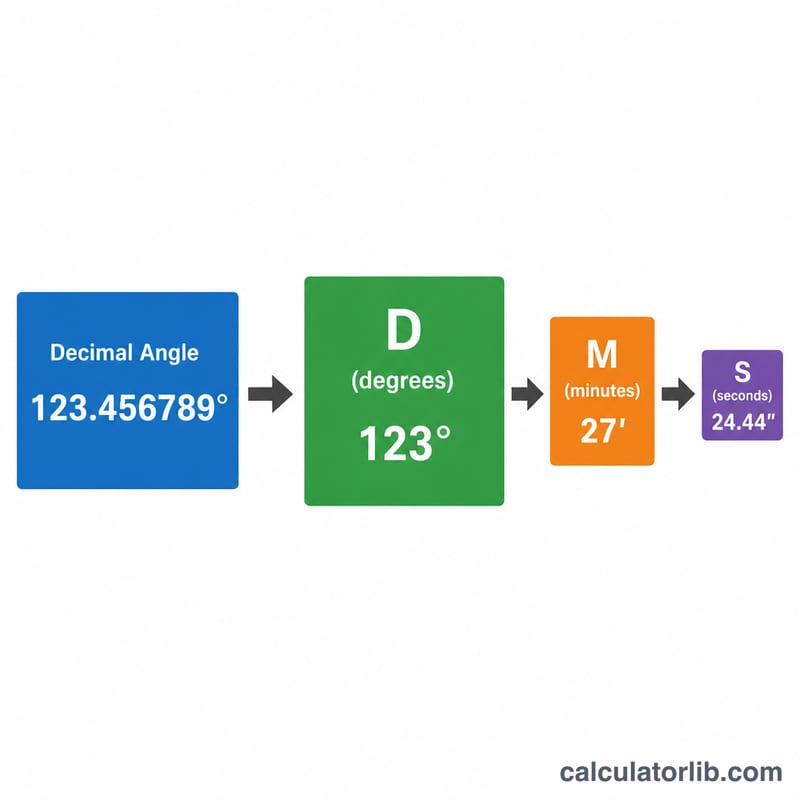
Worked example
Convert 30.52°. Here \(a = 30.52\), so \(D = \lfloor 30.52 \rfloor = 30\). The remainder \(0.52 \times 60 = 31.2\) minutes, so \(M = 31\). The leftover \(0.2 \times 60 = 12\) seconds. Result: \(30^{\circ}\,31^{\prime}\,12^{\prime\prime}\). Check:
$$30 + \frac{31}{60} + \frac{12}{3600} = 30.52$$Correct.
Common Decimal Degrees to DMS Conversions
To convert, keep the whole degrees, multiply the fractional part by 60 to get arcminutes, then multiply the remaining fraction of a minute by 60 to get arcseconds.
| Decimal degrees | DMS |
|---|---|
| 0.25° | 0° 15′ 0″ |
| 0.5° | 0° 30′ 0″ |
| 0.75° | 0° 45′ 0″ |
| 15° | 15° 0′ 0″ |
| 22.5° | 22° 30′ 0″ |
| 30.52° | 30° 31′ 12″ |
| 45° | 45° 0′ 0″ |
| 90° | 90° 0′ 0″ |
| 180° | 180° 0′ 0″ |
| −12.34567° | −12° 20′ 44.412″ |
Fraction-of-a-degree equivalents
| Decimal | Equivalent |
|---|---|
| 0.1° | 6′ |
| 0.01° | 36″ |
| 0.001° | 3.6″ |
| 1′ | 0.016667° |
| 1″ | 0.000278° |
Check of the negative example
For −12.34567°, work with the absolute value 12.34567. Then \(D = 12\). Next, \((12.34567 - 12) \times 60 = 20.7402\), so \(M = 20\). Finally, \((20.7402 - 20) \times 60 = 44.412\), so \(S = 44.412\). The sign applies to the whole angle: −12° 20′ 44.412″.
DMS Terms and Symbols
- Degree (°): 1/360 of a full turn. A right angle is 90°.
- Arcminute (′): 1/60 of a degree, so 60′ = 1°.
- Arcsecond (″): 1/60 of an arcminute, or 1/3600 of a degree, so 60″ = 1′.
- Sexagesimal: a base-60 system. DMS uses it for angles, as clock time does for hours, minutes and seconds.
- Decimal degrees (DD): an angle written as a single decimal number, e.g. 30.52°. Software, GIS and spreadsheets usually prefer it.
- Latitude and longitude: latitude runs from 0° to 90° north or south of the equator, and longitude from 0° to 180° east or west of the prime meridian. In signed decimal form, north and east are positive, and south and west are negative. In DMS the sign is usually replaced by a hemisphere letter (N, S, E, W). For example, −33.8688° latitude is 33° 52′ 7.68″ S.
- Arcminutes and arcseconds versus time minutes and seconds: they share names but measure different things. Arcminutes and arcseconds divide an angle, while time minutes and seconds divide an hour. Do not mix the two. In astronomy, right ascension uses hours, minutes and seconds of time, where 1 hour = 15°.
- Nautical mile: one arcminute of latitude is approximately one nautical mile (1.852 km by definition).
Interpreting Your DMS Result
Ground distance
Along a meridian (north–south), the approximate distances on Earth's surface are:
| Angle | Approx. distance |
|---|---|
| 1° | ≈ 111 km |
| 1′ | ≈ 1.85 km |
| 1″ | ≈ 30.9 m |
| 0.1″ | ≈ 3 m |
| 0.01″ | ≈ 0.3 m |
| 0.001″ | ≈ 3 cm |
East–west distances shrink with latitude by roughly the cosine of the latitude. A degree of longitude is about 111 km at the equator and much less near the poles.
How many decimals of seconds are meaningful
Match the precision to your data. One or two decimals of seconds (about 3 m or 0.3 m) suit most mapping and GPS positions. Consumer GPS is typically good to a few metres, so more digits add no real information. Three decimals (about 3 cm) only make sense with survey-grade GNSS or similar data.
Negative values and hemispheres
A negative latitude means south, and a negative longitude means west. Convert the absolute value, then add the letter. For example, −12.34567° longitude becomes 12° 20′ 44.412″ W.
Instrument angular resolution
Theodolites and total stations are commonly graded by angle accuracy, such as 1″, 5″ or 20″. This is often quoted as a standard deviation per ISO 17123-3. High-precision total stations reach 1″, general survey instruments are around 5″, and basic construction theodolites are around 20″. At 100 m, an angular error of 1″ shifts a point by about 0.5 mm, 5″ by about 2.4 mm and 20″ by about 9.7 mm. Reporting seconds much finer than the instrument's accuracy gives false precision.
FAQ
How are negative angles handled? The minus sign is applied to the whole angle and shown on the degrees component, e.g. -12.34567° becomes \(-12^{\circ}\,20^{\prime}\,44.412^{\prime\prime}\).
Why do my seconds sometimes show many decimals? Seconds are a real number and can carry long decimal tails from floating-point arithmetic; the converter reports full precision so you can round to your own needs.
What about rounding to exactly 60? If rounding pushes seconds to 60 or minutes to 60, the value is carried up (60 seconds = 1 minute, 60 minutes = 1 degree) so you never see an out-of-range component.