What This Calculator Does
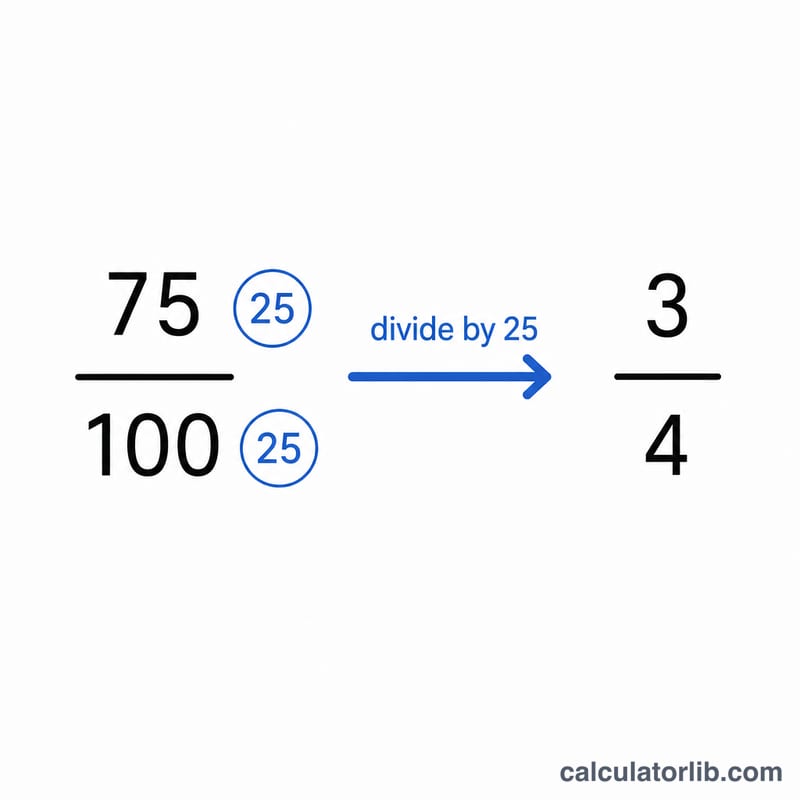
This Decimal to Fraction Calculator turns a decimal into the exact fraction it stands for, reduces that fraction to its simplest form and shows it as a mixed number when the value is 1 or more. For example, 0.75 is 75/100, which reduces to 3/4. It is a fast way to turn awkward decimals like 0.625 or 0.4 into clean fractions you can use in recipes, measurements, woodworking, or math homework.
The Inputs
- Decimal Number: type a decimal such as 0.75, .5, -2.125 or 12. Use a dot as the decimal separator; a comma (1,5), a typed fraction (1/2), letters or scientific notation (1e-4) show a message instead of a result. Up to 15 digits are supported.
- Decimal type: choose Terminating (exact) for a decimal that stops, or Repeating when the last digits repeat forever.
- How many trailing digits repeat? (Repeating only): for 0.363636… enter 0.36 and 2; for 1.8333… enter 1.83 and 1.
How the Formula Works
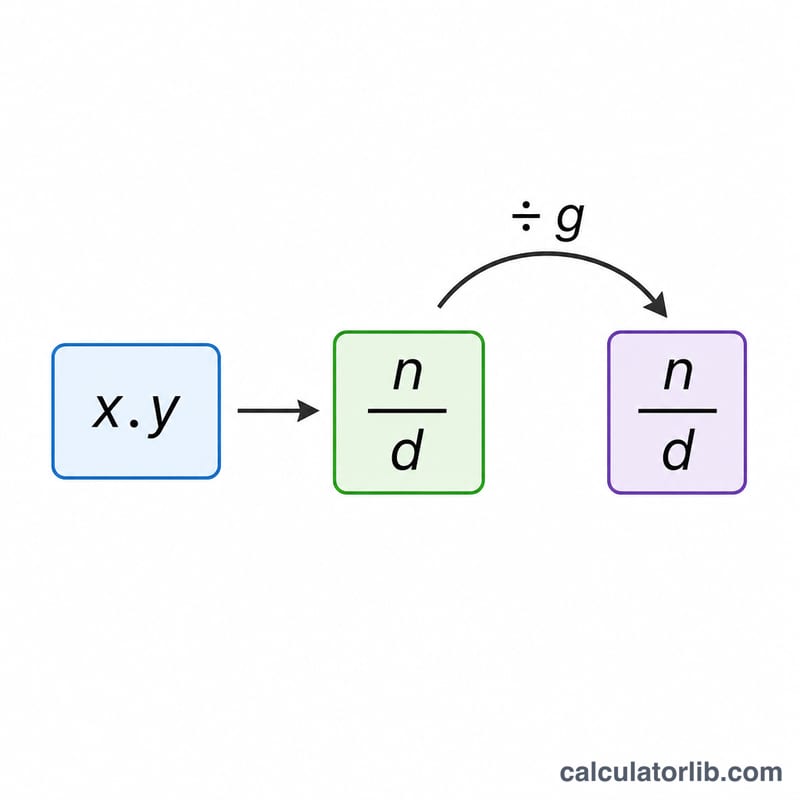
A terminating decimal with \(n\) digits after the point is exactly those digits divided by \(10^n\). The calculator writes that fraction and divides the top and bottom by their greatest common divisor (GCD), using whole-number arithmetic so no precision is lost.
$$x = \frac{\text{digits of } x}{10^n} = \frac{(\text{digits of } x) \div \gcd}{10^n \div \gcd}$$
For 0.375: \(n = 3\), so \(0.375 = \frac{375}{1000}\); the GCD of 375 and 1000 is 125, giving \(\frac{3}{8}\).
For a repeating decimal whose last \(k\) of \(n\) decimal digits repeat, multiplying by \(10^n\) and by \(10^{n-k}\) lines up the repeating tails, and subtracting cancels them:
$$x = \frac{x \cdot 10^n - x \cdot 10^{n-k}}{10^n - 10^{n-k}}$$
For 0.3636… (0.36 with 2 repeating digits): \(\frac{36 - 0}{100 - 1} = \frac{36}{99} = \frac{4}{11}\). A negative decimal is converted the same way and the minus sign goes on the numerator, so \(-2.125 = -\frac{17}{8} = -2\tfrac{1}{8}\).
Worked Example
Enter 0.625. It has three decimal places, so it equals \(\tfrac{625}{1000}\). The GCD of 625 and 1000 is 125, and dividing both by 125 gives 5/8.
Try 0.5 instead: \(\tfrac{5}{10}\) reduced by the GCD 5 is 1/2. Enter 0.4 and you get \(\tfrac{2}{5}\), since \(\tfrac{2}{5} = 0.4\) exactly after simplifying \(\tfrac{4}{10}\).
How to Convert a Decimal to a Fraction by Hand
Every terminating decimal is already a fraction written in shorthand — the only real work is reducing it. Follow these steps with 0.625 as the running example.
- Count the decimal places. Call this count \(n\). For 0.625 there are three digits after the point, so \(n = 3\).
- Write the digits over \(10^n\). Drop the decimal point and use the digits as the numerator: $$0.625 = \frac{625}{10^3} = \frac{625}{1000}$$ This fraction is already correct — it simply is not in lowest terms.
- Find the greatest common divisor with Euclid's algorithm. Repeatedly replace the pair \((a, b)\) with \((b,\ a \bmod b)\) until the remainder is 0; the last non-zero value is the GCD.
\(1000 \bmod 625 = 375\)
\(625 \bmod 375 = 250\)
\(375 \bmod 250 = 125\)
\(250 \bmod 125 = 0\) → GCD = 125 - Divide numerator and denominator by the GCD. $$\frac{625 \div 125}{1000 \div 125} = \frac{5}{8}$$ So 0.625 = 5/8. Check it by dividing back: \(5 \div 8 = 0.625\).
- For numbers of 1 or more, convert to a mixed number. Convert the whole thing first, then split off the integer part. For 2.5: \(2.5 = \frac{25}{10}\), GCD 5, giving the improper fraction \(\frac{5}{2}\). Since \(5 \div 2 = 2\) remainder \(1\), the mixed number is \(2\tfrac{1}{2}\). Alternatively, keep the 2 aside, convert 0.5 to \(\tfrac{1}{2}\), and recombine.
- For repeating decimals, use the 10x − x method. Let \(x\) be the decimal and multiply by \(10^k\), where \(k\) is the length of the repeating block, so the repeating tails line up and cancel by subtraction. With one repeating digit, \(x = 0.333\ldots\): $$10x = 3.333\ldots,\quad 10x - x = 3 \;\Rightarrow\; 9x = 3 \;\Rightarrow\; x = \frac{3}{9} = \frac{1}{3}$$ With a two-digit block, \(x = 0.1212\ldots\): \(100x - x = 12\), so \(99x = 12\) and \(x = \frac{12}{99} = \frac{4}{33}\).
- Sanity-check negatives and rounding. Convert the absolute value and re-attach the minus sign: \(-0.75 = -\frac{3}{4}\). If your decimal came from a rounded measurement, the fraction inherits that rounding — it is an approximation of the original quantity, not of the decimal you typed.
Key Terms Explained
- Numerator
- The top number of a fraction — how many equal parts you have. In \(\frac{5}{8}\) the numerator is 5.
- Denominator
- The bottom number — how many equal parts make one whole. In \(\frac{5}{8}\) the denominator is 8. It can never be 0.
- Proper fraction
- A fraction whose numerator is smaller than its denominator, so its value lies between −1 and 1, e.g. \(\frac{3}{4}\).
- Improper fraction
- A fraction whose numerator is greater than or equal to its denominator, e.g. \(\frac{5}{2}\). It is not "wrong" — it is often the easier form for multiplying and dividing.
- Mixed number
- A whole number written next to a proper fraction, e.g. \(2\tfrac{1}{2}\), which is the same value as \(\frac{5}{2}\).
- Simplified / lowest terms
- A fraction in which the numerator and denominator share no common factor greater than 1. \(\frac{625}{1000}\) and \(\frac{5}{8}\) are equal, but only \(\frac{5}{8}\) is in lowest terms.
- Greatest common divisor (GCD)
- The largest whole number that divides two integers with no remainder; also called the greatest common factor. Dividing both parts of a fraction by their GCD simplifies it in a single step.
- Euclid's algorithm
- An ancient, very fast method of finding the GCD: replace the larger number by its remainder when divided by the smaller, and repeat until the remainder is 0. The last non-zero remainder is the GCD.
- Terminating decimal
- A decimal with finitely many digits after the point, such as 0.375. In base 10 this happens exactly when the reduced denominator has no prime factors other than 2 and 5.
- Repeating (recurring) decimal
- A decimal whose digits eventually cycle forever, such as \(0.1666\ldots\) or \(0.142857142857\ldots\). Often written with a bar or dots over the repeating block. Every repeating decimal is still an exact fraction.
- Rational number
- Any number expressible as a ratio \(\frac{a}{b}\) of integers with \(b \neq 0\). Every terminating or repeating decimal is rational; non-repeating infinite decimals such as \(\pi\) and \(\sqrt{2}\) are irrational and have no exact fractional form.
- Exact vs. approximate
- A decimal you type is finite, so it is always an exact fraction: 0.3333 is \(\frac{3333}{10000}\), not \(\frac{1}{3}\). Only the repeating option treats the last digits as repeating forever, which is how 0.333… becomes \(\frac{1}{3}\).
Common mistakes
- "Dropping the zero after the point changes nothing." It does. Leading zeros count as decimal places: \(0.05\) has \(n = 2\), so \(0.05 = \frac{5}{100} = \frac{1}{20}\), not \(\frac{1}{5}\), which is 0.2.
- "0.999… is just below 1." It is exactly 1. In Repeating mode, enter 0.9 with 1 repeating digit: \(\frac{9 - 0}{10 - 1} = \frac{9}{9} = 1\).
- "Every fraction ends as a decimal." Only some do. In lowest terms, a fraction terminates exactly when its denominator has no prime factors other than 2 and 5. So \(\frac{3}{8}\) gives 0.375, but \(\frac{1}{3}\) and \(\frac{4}{11}\) repeat forever.
- "A bigger denominator means a more precise fraction." Not after reducing. \(\frac{625}{1000}\) and \(\frac{5}{8}\) are the same number. Simplest form only removes common factors, and the value stays the same.
- "A calculator's rounded display is the exact decimal." A rounded value such as 0.3333 is a different number from one-third. It becomes \(\frac{3333}{10000}\), and only the Repeating setting gives \(\frac{1}{3}\). Choose the mode that matches what you mean.
Conventions and edge cases
Each case below was run through this calculator; the result column is what it actually returns.
| Case | Input | Result |
|---|---|---|
| 0.5 | 0.5 | 1/2 |
| Greater than 1 (1.25) | 1.25 | 5/4 |
| Negative decimal (−0.75) | -0.75 | -3/4 |
| 0.333… (3 repeats) | 0.3 | 1/3 |
| 0.333 (terminating) | 0.333 | 333/1000 |
Checked on 2026-11-08
Frequently Asked Questions
Why is 0.3333 not shown as 1/3? Because 0.3333 stops after four digits, it is exactly 3333/10000. If you mean 0.333… with the 3 repeating forever, choose Repeating and enter 1 repeating digit to get 1/3.
What happens with a number greater than 1? It still works. Entering 2.5 produces the improper fraction 5/2 and the mixed number 2 1/2.
Are my results always simplified? Yes. Every result is divided by its greatest common divisor, so you always get the fraction in its lowest terms.